Even ten years ago, when I was studying for my MBA, general marketing courses existed, but it was hard to learn B2B marketing and B2B sales in any detail. The sales books on the market, in particular, mostly focused on insurance, finance, automobiles, pharmaceuticals, and IT sales. Life itself is a series of sales, yet roles and required skills differ by industry and application, and it is hard to find learning that fits exactly. Let's explore B2B sales in general together.
1) The image of 'sales'

What image comes to mind when you hear 'sales'? A salesperson pitching cars, insurance, or water purifiers? Someone who drinks heavily, chain-smokes, flatters clients, sings with a necktie around their head, and dances with a red fire extinguisher on their shoulder like a broadcast camera? From the 1980s and 90s through the 2010s, steady visits and client entertainment were the main way to sell. But generations have changed, and so have habits. Increasingly, what matters is the hybrid salesperson: someone who uses digital tools such as data analysis, forecasting, and AI-driven automation, and adds the human touch of carefully nurturing relationships.
2) Titles for B2B Sales Roles
In 2007, I was working as Taiwan branch manager of a precision tool manufacturer for semiconductors when I got a call from an HR executive at Cabot, a U.S. chemical company with a history of about 140 years (as of 2022), annual revenue of roughly KRW 56 (≈ US$1) trillion, and operating profit of KRW 500 billion (≈ US$374,083,500). Cabot was trying to expand its share of the Asian market for semiconductor inorganic chemicals and pads, and someone had apparently given them my name. We met for an interview at a hotel café near Hsinchu Science Park, home to some 190 companies including the global semiconductor foundry TSMC. The outgoing executive, a Taiwanese-Chinese woman, smiled and asked me, "We're looking for an Account Manager to cover semiconductor makers in Taiwan and China. What do you think, John Kim (the author's English name)?" I was completely thrown. For a sales role, I expected the word 'Sales,' but she said 'Account.' When you hear 'Account Manager,' what comes to mind before you look it up? For me it was 'Accountant,' as in a bookkeeper. With real regret, I said, "Unfortunately, I'm not an accountant. I'm in sales." The Cabot HR executive gave a small laugh and explained, "Oh! An Account Manager is someone who handles sales for specific client companies (accounts). It's the same as a sales role." They offered me three times my salary at the time, but I turned it down because I had to finish a project at the company I was with. Sixteen years later, I sometimes wonder how things would have turned out if I had gone to work in Singapore back then. Sales roles go by more than eight titles, but I will narrow them down to the three most often used in B2B overseas sales: 'Sales Rep.', 'Account Manager', and 'Key Account Manager (KAM)'.
Let's start with the first, 'Sales Representative'. A 'representative' is someone who stands in for another, which is why this role is usually shortened to 'Sales rep.' The first time I heard 'Sales rep.' in a conversation with an overseas client, I took it as 'Sales lab.' (laboratory) and wondered on my own what a 'sales research role' could be. Internally, a Sales rep. communicates with customers by phone and email. Externally, the rep 'represents' the company, meeting client contacts face to face and carrying out sales. Depending on company size, the scope of the job may combine everything from marketing to field sales, or be divided into finer roles.
Second is the 'Account Manager'. This person handles sales for specific customers (accounts). B2B has fewer customers than B2C, but each one demands deep knowledge and experience of its industry and applications, and there is a lot to manage. Core tasks include managing Repeat Orders for products already supplied, testing products newly entering the market, and managing relationships with client contacts. Depending on a client's importance and sales volume, the number of accounts handled can be smaller or larger. By distribution channel, the role is also split into 'direct sales' and 'distributor (dealer)' sales. In direct sales, headquarters sells directly to client companies. In distributor sales, dealers are grouped by region or industry, and a relatively small sales team negotiates with dealer owners and runs promotions.
The third is the Key Account Manager.
If you have worked in corporate sales, you have probably heard of the 'Pareto principle.' The Pareto principle says that 20% of causes produce more than 80% of results. It holds especially true in B2B sales. From a B2B vendor's point of view, in the auto industry it is 'Hyundai and Kia Motors,' in electronics 'Samsung Electronics,' in search portals 'Naver,' and in retail E-Mart and Coupang: one major customer typically accounts for a large share of total revenue. For subsidiaries of large business groups in particular, sales to the parent group can exceed 90%. These key accounts must be managed carefully, because any change in supply volume has an enormous impact on the supplier. Since the counterparts are professionals at large corporations, a senior sales rep on the supplier side often teams up with a junior rep to stay close to the account. A sales rep who does this work is called a 'Key Account Manager (KAM).'
3) The Role of a B2B Sales Rep

Working hard and delivering strong sales results is the baseline, of course. To stand out as a sales rep, you need to keep looking for new business opportunities and identify and win better prospects. By uncovering the issues and problems of both existing and new customer contacts, you can build solutions that create a win-win for both sides. You also act as a messenger between the customer and the various teams in your own company, balancing their interests. Pass market trends and good news from your company to the customer, and pass the customer's information and requirements to your R&D and production teams, so that information never gets stuck. You must keep customer satisfaction high to prevent existing customers from leaving while also growing your share, and you need the thick skin to overcome internal resistance (for example, from production teams) when testing products for new customers.
You must lead your company's strategy by analyzing the market environment, understanding competitors' strategies, and anticipating your customer's competitive position. As you move up in rank, building the sales team, setting targets, and evaluating performance take up a larger share of the role. You also need the skill and judgment to lead key price negotiations with customers to agreement and close contracts, and to use fast-changing sales tools such as CRM (Customer Relationship Management) programs to monitor the sales team's activity in real time and measure and analyze results. Ultimately, a B2B salesperson is a living channel connecting the supplier and the client. A smart, agile B2B sales organization can play a major role in a company's success.
4) Skills of a B2B Salesperson
① Listening skills: Having worked in the sales field from the late 1990s to the early 2010s, I noticed that top-performing sales reps shared a common trait. Contrary to the expectation that flashy, polished, fast talkers would perform best, the reps who were exceptional at putting customers at ease, listening, and empathizing generally performed best. The psychologist 'Sigmund Freud' said that through the technique of 'listening,' you can discover the habits a person shows unconsciously, such as expressions, attitudes, and speech patterns, as well as their patterns of defense mechanisms.
② Questioning skills: On my first overseas business trip, a senior colleague asked whether I was fully prepared. I said yes: schedule, bookings, suit, laptop, and presentation. Then came the next question: had I prepared my 'questions' too? If you throw careless questions at a client contact, you get answers like "You can find that on the internet." or "That's confidential, so I can't share it." With careful questioning, you identify the problem, confirm the purchasing budget, and then offer a solution that resonates with the customer at the right moment.
③ Empathy: Try to think from the standpoint of the person at the client company, not from the salesperson's side. Thinking and feeling entirely from another person's position takes a lot of training. You need to uncover their personal situation and their worries and problems as a member of the organization, research their values, goals, and relationships with stakeholders, and anticipate their emotional state. Then propose a solution to the organization's problem, weigh what they stand to gain or lose, adjust your message, and ask for their feedback. See through their eyes, think with their mind, and feel with their heart.
④ Relationship skills: Take a real interest in the other person, and contact and meet them often. Build familiarity through Facebook, Instagram, LinkedIn, and YouTube so they feel they have seen you before. Then keep in regular touch by email, text, KakaoTalk, and phone, and meet in person to learn their interests and priorities. To keep a conversation going about their hometown, alma mater, or hobbies, you need broad knowledge and experience across many fields. Remember anniversaries and events, and show your true self with a relaxed gaze and smile, tasteful compliments, and comfort, to build a close relationship over the long term.
⑤ Negotiation skills: This is the most fundamental ability in B2B sales. Short, intensive negotiation training can quickly improve performance in the field. You need to prepare by setting negotiation goals, gathering information, and developing options, then learn to reach agreement by using the other side's psychology and emotions while holding the initiative through issue-by-issue tactics. Sales team members should split roles to respond to constantly changing situations. A sales negotiation is not a one-time game, so you should develop strategy and tactics with a long-term relationship in mind.
⑥ Planning skills: Think about the tools a sales rep uses to communicate with customers. Mostly it's email, Excel, PowerPoint, and Word files, and in meetings you'll present slides in Korean or English on a projector screen. You need to build the logic and story of your solution proposal systematically, express it through charts, diagrams, images, and text, and then deliver it with a fitting speaking style, posture, gestures, and movement.
⑦ Execution: When I was in the field and a tedious, difficult customer request came in by fax, I sometimes put it off and let it pile up under my desk. Before long the pile became too big to handle, and I ended up in a really tough spot. If you don't procrastinate, set priorities, move according to plan, and respond quickly, you can keep the customer's trust. If you seize opportunities as they come and respond well, your results will naturally improve. As results improve, the organization will give that rep greater responsibility, experience, and opportunity, and their career will advance steadily.
5) B2B Salesperson Levels and Career Path
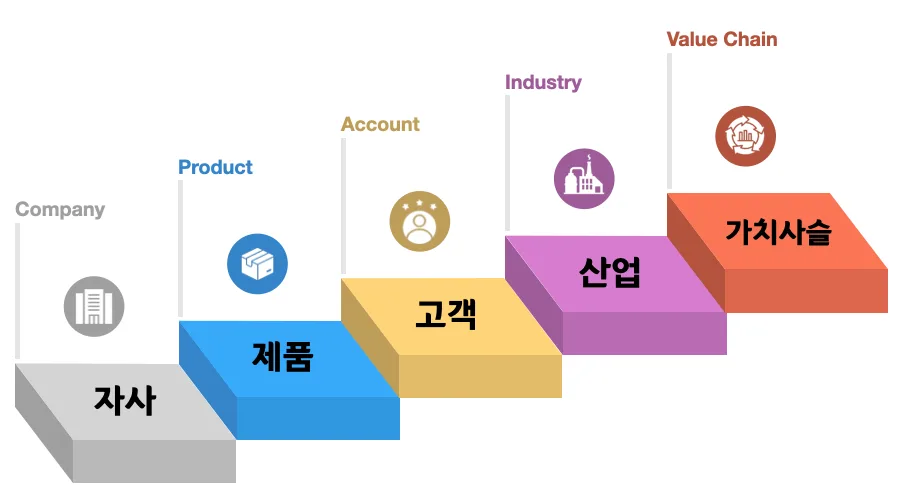
If you are a new hire taking on a 'B2B sales' role for the first time, a technical support engineer moving into B2B sales, or someone who has switched companies into a B2B sales position, you start at the lowest level.
The first level is 'Company'. You need to learn the basics of your own company thoroughly, including its organization, people, history, location, and systems, so that internal communication and the information you give outsiders run smoothly.
The second level is 'Product'. If you don't know the product you sell, you can end up deeply embarrassed in a client meeting. Visit the manufacturing floor often and become an expert who knows in great detail how the product is actually made and how it runs at the client's site. Once you have a firm grasp of your own product, dig into your competitors' products. Only then can you properly understand the strengths and weaknesses of your own.
The third stage is 'Account'. Before visiting, you study the handover materials, internet searches, and the history you hear from senior colleagues. Then, as you visit, hold meetings, and manage the relationship, you accumulate quantitative and qualitative information on the client's organization, contacts, and business situation. When your sales results are good, you start to gain confidence as a salesperson.
The fourth stage is 'Industry'. You begin to see your client's industry: its current state, competitive landscape, and technology roadmap. You also start to notice shifts in applications (areas of use) and get a feel for how to respond. At this level, questions about managing a sales organization and about sales leadership will follow.
The last stage is 'Value Chain'. Once you can see the industries upstream and downstream of your client's product, and the value chain around it, your cooperation and personal network with companies in that chain expand at related trade shows. When you understand how the whole picture works, handling only sales at your company can start to feel confining, and you reach the point of wanting to play a leading role in that value chain. At this stage, many salespeople start their own business, serving as distributors or as suppliers of parts and services, in Korea or overseas.
To be continued