To sell a product or service to business customers, you first shortlist and prioritize prospective client companies, then identify the department and the person in charge at each target. Do the buying department and contact change with the type of product you supply and the size of the client? What do you think?
When it comes to the department that commissions and manages training from training companies or corporate instructors, the department and contact person can vary with the client’s size and business model. At large companies, a dedicated HRD (Human Resources Development) department, often called the 'Training Team', develops new-hire training, level-based training, job training, and one-off training and workshop programs as needed, and is solely responsible for building the capabilities of the organization and employees in line with company goals. At smaller companies, the HRM (Human Resource Management) department, often called the 'HR Team', may also handle training, and in some cases the General Affairs team handles both HR and training. The contact might be an assistant manager on the Training Team or a department head in General Affairs. When a training agency (distributor) steps in between, the department and contact can change again depending on that company’s size and business model. Matching your business manners and tone accordingly is essential.

Let’s look at another example. How would you go about supplying bottled water to Kia’s Gwangju plant? Let’s use some imagination and map out the process. To supply directly, you would first need to find Kia’s purchasing contact. Should you look for that person in the purchasing team at the Seoul headquarters in Yangjae-dong, or find the responsible department at the Gwangju plant? There may even be a separate procurement agency rather than Kia itself. In some cases, it could be the Kia department in charge of facility management, or a partner company that department contracts out to. You have to find your real sales target by calling, emailing, or getting introductions. Simply emailing the presumed contact in the Yangjae-dong purchasing team over and over will not get you anywhere. Once you have a contact, call to set up a meeting. Beforehand, learn the quality, price, and issues of the water they currently receive, and prepare a business proposal covering the product type and volume, supply price, delivery cycle, payment terms, and your delivery record with other clients. Also prepare good answers to the questions the contact is likely to ask at the first meeting, such as supply price, delivery terms, contract period, and service level. At the same time, learn what process they run, because that is how you get a chance at a bid or a trial. After a period of negotiation and internal process, you close the contract, start deliveries, and begin ongoing account management.
It varies by industry and situation, but a large manufacturer may split its purchasing organization by the products and services it buys. This is called decentralized purchasing. A small or mid-sized manufacturer, by contrast, may have a single purchasing team handle every product and service, which is called centralized purchasing. In retail, a loose franchise where each store handles ordering, procurement, and packaging under the same brand is decentralized. When the franchise headquarters runs ordering, procurement, and packaging in bulk through a chain operation system, that is centralized purchasing.
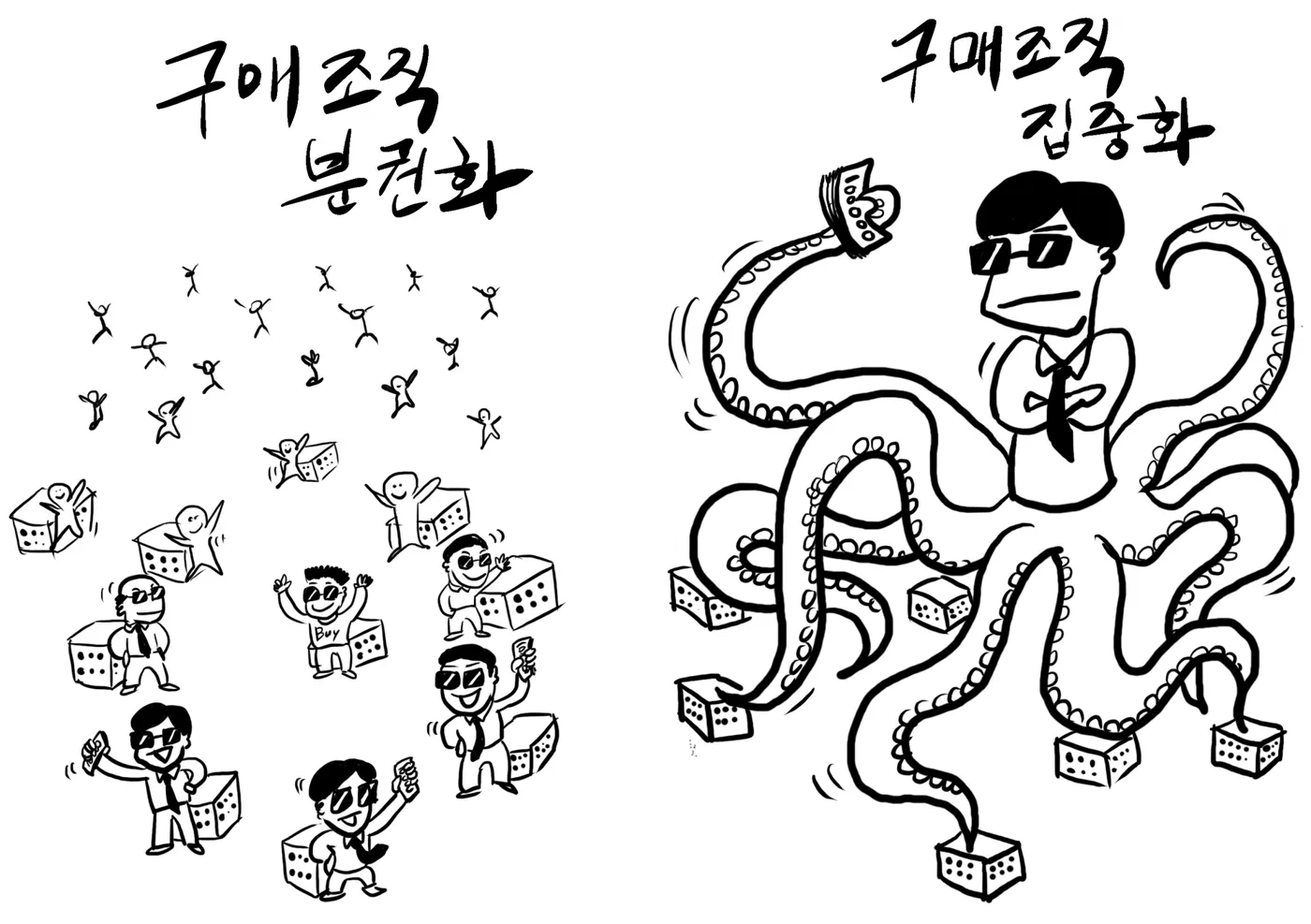
The advantage of decentralized purchasing is autonomy: each store owner or manager can make buying decisions based on local market characteristics and customer preferences. A store in Busan, for example, can tap its strong network of local seafood distributors to source fresh seafood quickly, and if customers respond well, it can order and sell more without headquarters approval. The drawback is that uncoordinated, store-by-store purchasing cannot match the efficiency of bulk buying, so you end up paying more. Headquarters also struggles to control costs and understand customer preferences, and it is hard to share best practices across stores. Decentralized purchasing is typically used when buying decisions require a high level of technical judgment, when production schedules and processes need coordination across several departments, when you need local service to handle sudden small-volume orders that are hard to predict, or when stores, plants, and departments need products customized for their own users and customers. In these settings, the individual buyer has a great deal of say in choosing suppliers.
The advantage of a centralized purchasing organization is that the franchise headquarters builds a standardized purchasing process and system, and all purchase requests, supplier management and negotiation, and contract management run through the central office. This keeps the process simple. Pooling the purchase volume of every store creates economies of scale, which wins favorable terms and large supply-price discounts, and a team of purchasing specialists manages cost and risk efficiently. On the downside, it is less flexible in handling store-specific situations, slower to respond when an urgent order is needed, and may understand each store’s customer needs less well. Centralized purchasing is typically used when you buy standardized products in large volumes, when a team of purchasing specialists needs to manage integrated long-term contracts, when you need a secure supplier base to gain leverage in price negotiations, or when the buying decision is politically sensitive. To win business from a centralized purchasing organization, you need a specialized sales team with deep knowledge, skill, and experience.
To be continued