3) VWE (Value Word Equation) / Example 2
[Example 2]
Say someone is preparing to launch a business around an innovative automotive fuel additive. Its key strengths are particulate matter reduction and improved fuel economy. Which customers, which people within them, and which approach would make the value proposition most effective? Let’s take each strength separately.
Let’s start with the value of “reducing fine dust.” A fuel additive that reduces fine dust will be very attractive to markets and customers focused on pollution and air quality management. This value works well for the following customers.
1) City and local governments (B2G)
These customers are government agencies that run public transportation and have goals for improving urban air quality. They work to reduce particulate emissions across public transit, public vehicles, and service fleets.
2) Public transit operators (B2B)
These are companies that operate buses, subways, taxis, and other public transit. Along with fuel efficiency, they are very interested in technologies that minimize environmental impact, driven by ESG regulations.
3) Logistics and delivery service companies (B2B)
Logistics and delivery companies that run large fleets care about fuel efficiency and cost savings, but also about environmental compliance and building sustainable operating models.
4) Companies pursuing eco-friendly certification (B2B)
Companies seeking sustainability certification or building an eco-friendly brand image. They focus on reducing the environmental impact of their operations and products.
5) Construction and heavy equipment operators (B2B)
Companies that operate heavy equipment on construction sites also contribute to air pollution, so they are interested in investing in fine dust reduction technology.
[ Marketing and sales execution strategy ]
• Regulatory compliance and incentives: Target regions with tightening environmental regulations first, and take advantage of government incentive programs for environmental protection.
• Partnership development: Build partnerships with companies interested in eco-friendly technologies and products to improve market access.
• Case studies and success stories: Share real-world use cases that prove the product’s particulate reduction effect and build prospects’ trust.
• Environmental certification and labeling: Emphasize that the product meets environmental certification standards, and raise consumer awareness with eco-friendly labels.
Next, let’s focus on the value of improved fuel economy and fuel efficiency. When fuel efficiency is the core of the value proposition, concentrate on markets and customers where fuel is a major cost and consumption is closely watched. This value will be especially compelling to customers in the following markets:
1) Commercial vehicle operators (B2B)
These include logistics companies, delivery services, public transit operators, and taxi and ride-sharing services. They run large fleets, so improving fuel efficiency directly reduces operating costs.
2) Heavy equipment and construction machinery operators (B2B)
These are companies in industries where heavy equipment is essential, such as construction, mining, agriculture, and forestry. Because this machinery burns a lot of fuel, better fuel efficiency delivers a major economic benefit.
3) Shipping and air freight companies (B2B)
Companies that operate high-fuel-consumption transport, such as shipping lines and airlines. For them, better fuel efficiency is a major opportunity to cut costs and meet their environmental responsibilities.
4) Public sector and government agencies (B2G)
This includes government-owned or operated vehicles and equipment, and agencies that run public transportation systems. The public sector faces growing pressure on cost efficiency and environmental sustainability, so fuel efficiency is an important consideration.
[ Marketing and sales execution strategy ]
• Market research: Conduct in-depth research to understand each market’s characteristics and its customers’ needs and challenges.
• Custom solution development: Develop custom fuel additives that meet the specific needs of the target market.
• Partnerships and collaboration: Work with influential partners in the target market to improve product access and build credibility.
• Share success stories: Prove the product’s effectiveness with real-world references and build trust with prospects.
Let’s build a scenario that assumes we target logistics companies first among commercial vehicle operators. Assume a heavy truck gets 4 km per liter, diesel costs KRW 1,600 (≈ US$1) per liter, and each vehicle drives 100,000 km a year. That gives us the table below. Assume our fuel additive is priced at 4 times the competitors’.
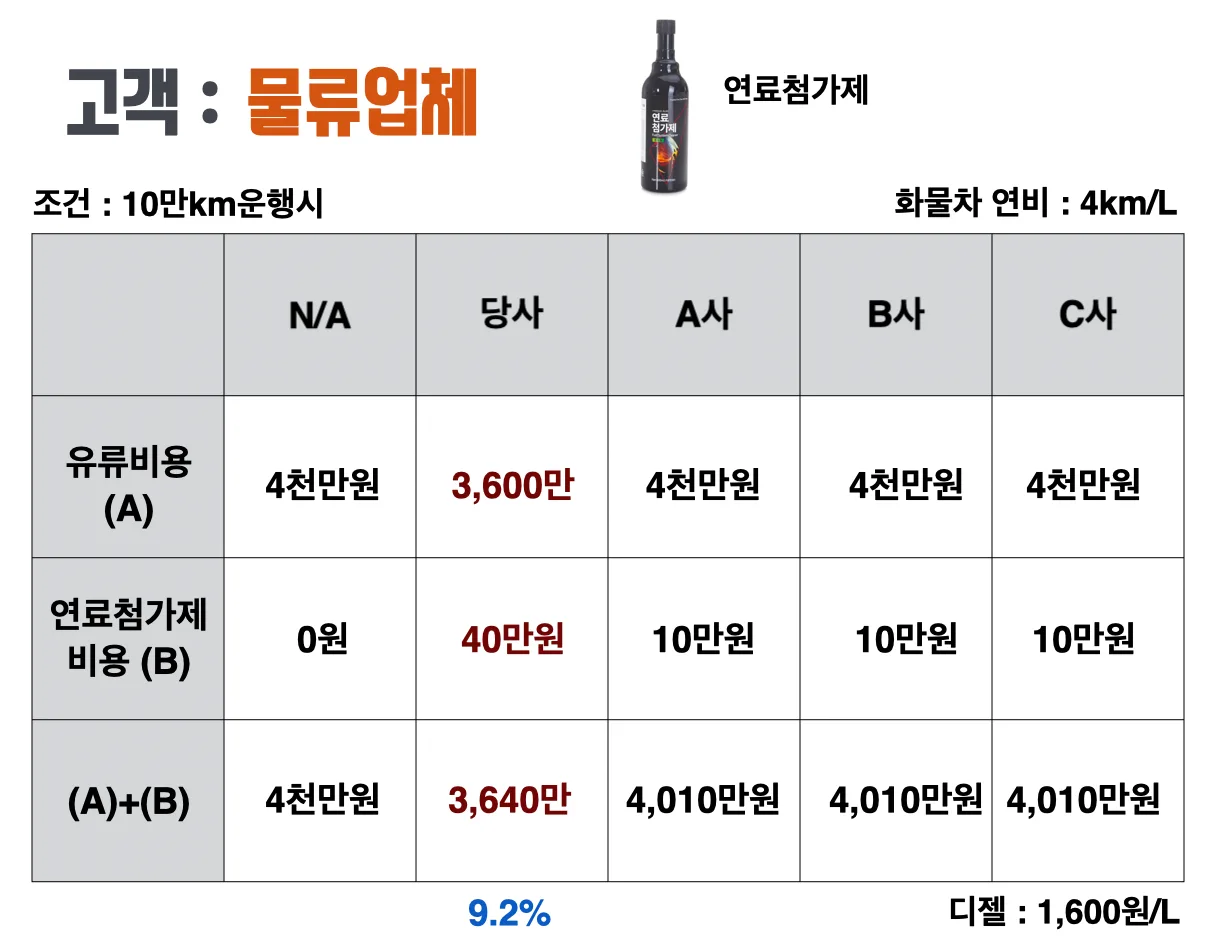
We filled in the table for five cases: no additive, our product, and competitors A, B, and C. From a competitor’s point of view, comparing on fuel cost alone is very unfavorable, because they may offer values this table doesn’t show, such as longer engine life, environmental compliance, better acceleration, and driver comfort. Fuel cost per truck comes to KRW 40 million (≈ US$29,900) a year, and our fuel additive cuts that cost by 10%.
Even if a truck uses the fuel additive 10 times a year, a competitor’s product costs KRW 100,000 (≈ US$75) per truck per year, while ours costs KRW 400,000 (≈ US$300). Because the additive is a small share of total operating costs, there is no need to say, “Our fuel additive costs 4 times as much as the competition’s.” It is similar to interior renovation, where paint is only about 5–10% of the total construction cost. Cutting the paint price would barely register as a saving, so it can be more effective to sell it at a premium and show how a faster-drying formula increases the customer’s overall revenue. Likewise, because the fuel additive is a small share of total operating costs, compare the combined cost of fuel and additive to find the numbers that matter most in your sales proposal.
Our product’s total cost per vehicle is KRW 36.4 (≈ US$1) million, a 9.2% saving compared with the competitors’ KRW 40.1 million (≈ US$30,000). With a fleet of 10 trucks, that saves about KRW 36 million (≈ US$26,900) a year. These two numbers, 9.2% and KRW 36 million (≈ US$26,900), can steer the decision maker toward a purchase.
To be continued
To be continued