When your product or service has a clear, visible point of differentiation from competing products, a salesperson can communicate that difference easily and persuade buyers. The company also needs less effort, time, and money to train its salespeople. And when the value of your product or service can be explained quantitatively in terms of ‘money,’ customers understand it readily and selling becomes far easier. Let’s combine how well a B2B vendor’s salespeople can communicate benefits with whether the product or service offers economic or non-economic benefits, and build a four-quadrant matrix framework.
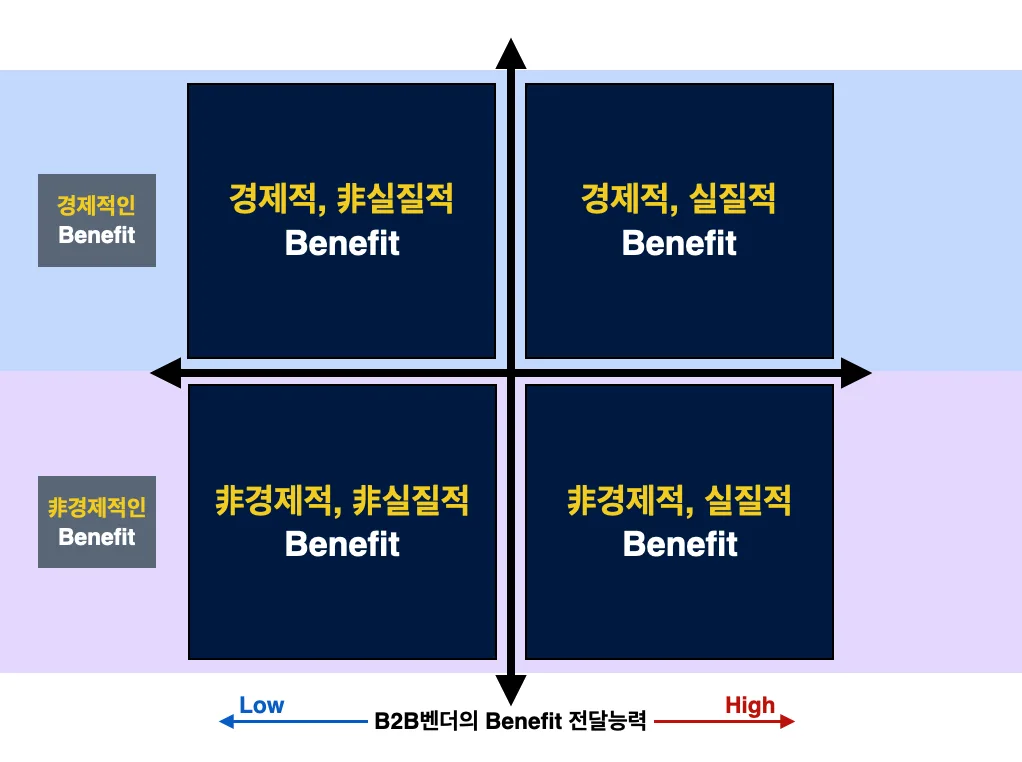
㉮ Economic, Tangible Benefits
These are benefits that both B2B clients and vendors can measure easily and calculate in money. A vendor’s salesperson can sell them with little effort, and persuading even mildly interested customers is easy. When you offer energy-efficient equipment or solutions, you can easily calculate and show how much the customer can cut energy costs compared with their previous equipment. When an automation system or software streamlines the customer’s work processes, you can convert the resulting savings in labor hours and gains in productivity into money. When you sell durable products that need little maintenance, you simply calculate the maintenance costs the customer saves over the long term. When a supply chain management solution can optimize inventory levels, you just work out the inventory cost savings in money. When your product quality beats competitors’ and returns fall or customer satisfaction rises, you can turn the resulting sales increase into a monetary figure. When a compliance solution helps the customer reduce legal risk, you can calculate and show the fines or litigation costs it helps prevent. When excellent customer and technical support reduces equipment or system downtime, you can quantify the resulting cost savings and explain them to the customer. An effective ‘differentiator’ truly shines only when it is genuinely unique compared with competitors. Otherwise, you end up in a costly price war with rivals, expenses rise, and price competition only intensifies.
㉯ Economic, Non-Tangible Benefits
This type of benefit is hard for the vendor to quantify in monetary terms, and hard for the buyer to recognize. These benefits are often intangible, or only indirectly linked to higher revenue or lower costs. Even so, they can ultimately be expressed as a hard figure. It won’t be easy, but don’t give up just because it’s difficult or tedious. When a luxury hotel chain works with a vendor that supplies high-quality bedding, that can raise the hotel’s brand value and lead to higher room rates. In the same way, when a client uses a vendor’s product, its brand image can improve, which over the long term can lead to greater customer loyalty and higher sales. If excellent customer support from an IT services company minimizes system downtime and keeps the client’s business running, customer satisfaction rises, and over time that can mean long-term retention and new customers won through word of mouth. When a company adopts efficient collaboration tools for its employees, they save time and finish projects faster, satisfaction goes up, and productivity improves, which positively affects the company’s overall profitability. If the value proposition is hard to make in early sales, you can commission an independent third-party research institute and use its results in selling, or run a pilot test at a friendly client’s site to produce the numbers. You could also add a sweetener: promise to compensate a set amount if the guaranteed results or performance aren’t achieved.
㉰ Non-Economic, Tangible Benefits
Value that a vendor can easily pitch but cannot easily quantify in money is mostly intangible benefits, long-term effects, and indirect gains. These are hard to convert into measurable, direct economic returns. Innovative new software built on cutting-edge technology can give a client the image of an industry leader, but it is hard to measure right away what monetary value that innovation actually creates. A vendor with a strong industry network can offer a client valuable business connections, which is appealing, but it is difficult to measure the specific financial gain that network access brings. A vendor can stress that its values fit the client’s corporate culture, but quantifying the monetary value that cultural fit actually creates is a very complex task. IBM’s famous slogan, “Nobody ever got fired for buying IBM,” emphasizes stability and reliability in the business world. Because IBM is a company with a long history and a track record of trust, choosing its products or services is seen as a low-risk, safe decision. In other words: don’t take the risk of picking a new vendor; choose IBM, which the market has recognized for a long time. The value of the IBM name is hard to put a number on, but the sense of security that the name alone provides is considerable.
㉱ Non-Economic, Non-Tangible Benefits
Value that is hard for a vendor to communicate and hard to quantify in money is usually tied to the client’s subjective experience, long-term strategic gains, or social responsibility. These benefits often don’t connect directly to profitability and frequently require long-term investment and vision. A vendor supplying packaging made from sustainable materials can highlight its positive environmental impact, but that does not translate directly into financial gain for the client. A vendor offering in-house programs, training, or cafeteria services that raise employee satisfaction can emphasize those points, but it is very hard to measure exactly how employee well-being affects the company’s financial performance. When a vendor stresses ethical business practices such as fair trade and ethical supply chain management, this may be important to clients, but it is hard to prove how those practices turn into monetary value. Letting customers experience it for themselves can be the best way to sell.
To be continued