
Harvard Business School professor 'Michael Porter' systematized business strategy. He is one of the three great masters of modern management, alongside 'Peter Drucker', the Austrian-born American management scholar who created the concept of 'marketing', and 'Tom Peters', the father of the postmodern corporation. In 1979 he published a paper presenting the 'Five Forces model', a tool for analyzing a company’s competitive environment. It breaks down the five forces that shape an industry clearly and simply, helping companies build effective strategy and tactics. Of the factors that affect B2B vendors, it is the best tool for analyzing 'competitive intensity' from an industry perspective. Let’s start there.
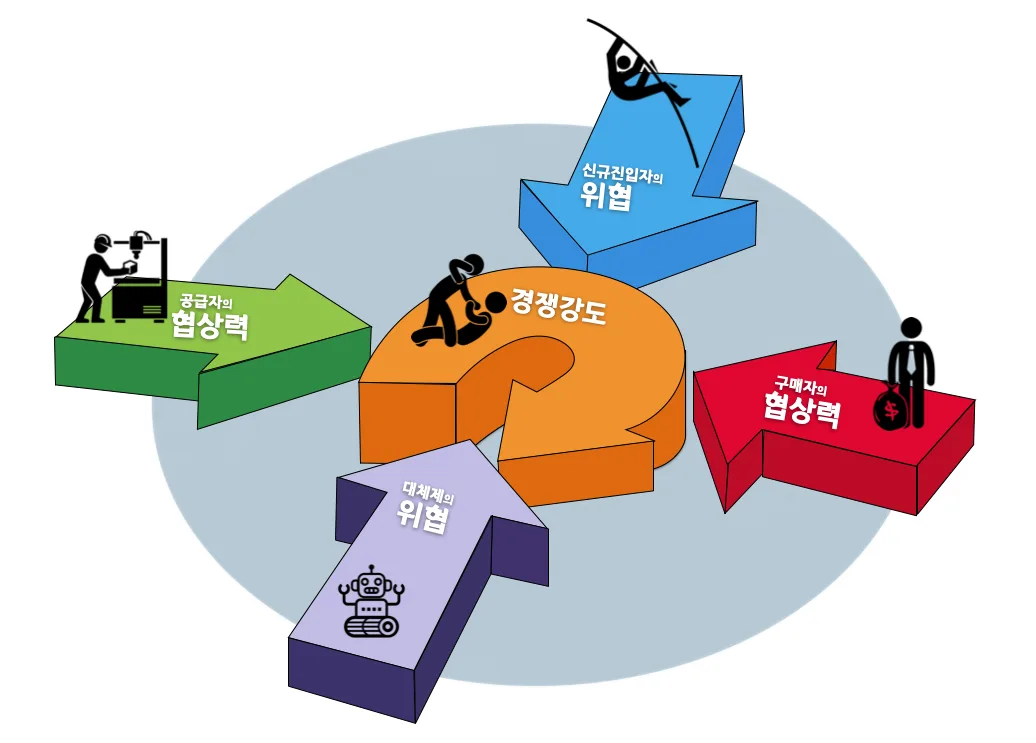
ⓐ Threat of New Entrants: A high threat of new entrants means barriers to entry are low. To keep newcomers out, you need to raise those barriers. If entering a market takes a lot of money, technology and expertise, equipment and facilities, a strong brand, and know-how, and also requires compliance with government rules and regulations, it is very hard for new companies to get in. The pharmaceutical industry is a classic example, with high barriers from heavy R&D costs, patent protection, and government regulation.
ⓑ Bargaining Power of Suppliers: This is the bargaining power of the companies that supply materials, components, and equipment in an industry’s value chain. Think of the powerful 'super-suppliers' you often see in the news. They can demand higher prices and tougher terms, which can cut into their customers’ profits. Good examples are Taiwan’s TSMC, the world’s largest semiconductor foundry (60% share); the Netherlands’ ASML, maker of lithography equipment, a key piece of chipmaking equipment (91% share); Japan’s FANUC, maker of advanced industrial robots (24% share); and Cargill, the world’s largest grain company (40% share).
ⓒ Bargaining Power of Buyers: Buyer bargaining power is closely tied to the 'intensity of competition' in an industry. As competition rises, buyers have more options. Naturally, they demand lower prices, higher quality, and better service, and if you can’t deliver, they can easily switch to a competitor. Buyers who centralize purchasing and buy at scale can win favorable terms and large volume discounts. That is why big retailers such as Walmart, E-Mart, and Coupang keep gaining leverage. Even if a buyer’s size doesn’t change, the same thing happens when competition among suppliers intensifies.
ⓓ Threat of Substitutes: A substitute is a good that can be used in place of another. Typical examples are rice ↔ bread, rice ↔ instant noodles, beef ↔ pork, cola ↔ lemon-lime soda, fried chicken ↔ pizza, butter ↔ margarine, subway ↔ bus, jajangmyeon ↔ jjamppong, and soju ↔ beer. Some pairs can also be complements, goods that add value when used together, like coffee and sugar, pens and ink, or needle and thread. If your company develops PC games, games from other PC, console, and smartphone developers are direct competitors, but sportswear makers like 'Nike' or 'Adidas' and camping gear makers like 'Coleman' or 'Kovea' could be substitutes that take your market. These days, if you fail to spot a new substitute quickly, you can lose your market almost overnight.
ⓔ Intensity of Competitive Rivalry: Whether you run a company or work for one, you feel it quickly when competition in your industry intensifies. Escalating rivalry usually leads to price wars, which squeeze profits and force cost cutting. Some companies see an opportunity to acquire rivals or deepen the price war until competitors are driven out. The effects of competitive structure show up in the surge of Japanese chipmakers that invested heavily after the 1970s oil shocks, the US push-back against Japan’s semiconductor industry in the 1980s, Korea’s massive investments in the 1990s, the memory-chip “chicken game” of the mid-to-late 2000s, and the rapid rise of Taiwan’s foundries.

Let’s look at what happens when competitive intensity rises in an industry.
First, 'downward pressure on prices.' When more players enter the market or the market shrinks, competition intensifies and companies cut prices to survive. As margins fall, profitability naturally erodes. Second, large players in the industry try to build economies of scale and gain a competitive edge by acquiring small companies weakened by falling profits, or by squeezing them out through a game of chicken. Third, once they acquire a weakened rival, they cut duplicate staff, redundant facilities, and overlapping systems, aiming to improve margins with leaner, more efficient processes. They will also pursue digital transformation with artificial intelligence (AI) and robotics. Fourth, they look beyond a saturated domestic market to overseas markets with less competition. This means studying the culture and diversity of the target country and deciding the weight and direction of production, distribution, and sales. Fifth, building a competitive edge through management innovation and new market development requires attracting and retaining top talent. That means offering competitive pay and benefits, an appealing culture, a comfortable and enjoyable workplace, and opportunities to grow. Sixth, invest the talent and capital you have secured in R&D to develop better products and services and set yourself apart from competitors. Seventh, focus on customers more than your competitors do, understand their needs, offer value that is hard to copy, and strengthen your relationships with them. Eighth, build the strongest brand for winning a larger share and set a marketing strategy to match. You also need to develop and execute digital marketing tactics faster than your competitors. Ninth, prepare systems that let you respond flexibly and quickly to rapid change. Tenth, fierce competition in an industry inevitably brings tighter government oversight and regulation, so prepare a response strategy in advance.
To be continued