B2B Marketing in the Zero-Click Era (AEO·GEO)
Search isn’t dead, clicks are — B2B marketing that earns AI citations, not rankings
The B2B Marketing in the Zero-Click Era (AEO·GEO) course is a 2-hour corporate training program that teaches practical ways to get your content cited in AI answers, now that ChatGPT, Perplexity, Gemini, and Claude summarize answers on users’ behalf. Nanum Consulting CEO John Kim walks through the data behind the zero-click phenomenon, the 7 content formats AI cites, E-E-A-T trust design, hands-on brand diagnosis and rewriting, and a 30·60·90-day action plan, in that order. 'Citation is the new ranking' — it is designed for B2B marketing, sales, and IR practitioners who want to shift their goal from ranking to citation and claim citation share first, while competition is still low. The curriculum has been proven through training delivered to 50+ major corporations and institutions.
💻 Start learning this topic with an online course →Who is this course for?
This course is a good fit for practitioners and leaders at companies and institutions that need stronger marketing and sales skills. It is especially useful for teams that want to understand, with data, how the B2B buying journey has shifted to zero-click and AI search, and to tell SEO, GEO, and AEO apart.
What will you learn?
- Understand, with data, how the B2B buying journey has moved to zero-click and AI search, and tell SEO, GEO, and AEO apart
- Apply the 7 content formats that AI cites, along with E-E-A-T trust signals, to your own pages
- Diagnose your brand’s AI visibility, rewrite content into answer-ready form, and build a 30·60·90-day action plan
Curriculum
- Search isn’t dead, clicks are — zero-click is the default (80% of consumers, Bain & Company, Feb 2025)
- AI summaries now sit above the links — 83% of queries showing AI Overviews end without a click, and 93% in Google AI Mode
- B2B is no exception — organic CTR down 49–65%, with losses of up to 30% for B2B SaaS and others (Seer/Semrush 2025)
- The real contest happens before search — 85% of B2B buyers pick their vendor before searching, and AI drafts the day-one list
- SEO vs. GEO vs. AEO — the goal shifts from ranking to being cited (Citation is the new ranking)
- Now is the window to move first — claim citation share while competition is low; wait, and the authority is already locked in
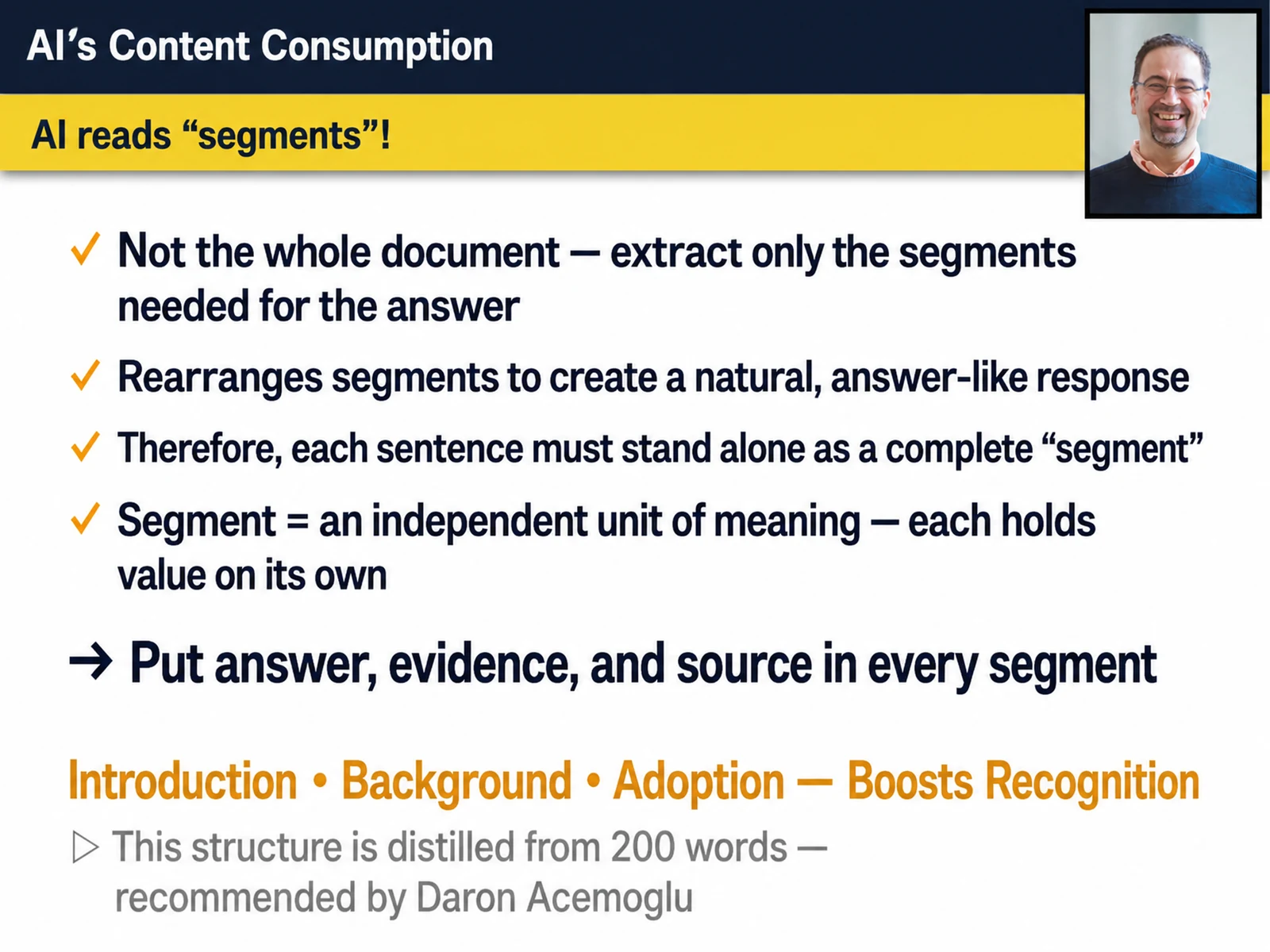
- Answer-First — a complete answer in the first 40–60 words, the key conclusion within the first 200 words (answer-style, not intro-style)
- Number density — a concrete figure every 150–200 words; write '85% of buyers' instead of 'many companies'
- Cite your sources — attach [source + date] to every figure; a citable unit = source + timeframe + unit
- Question-style H2·H3 headings — heading = question, first paragraph = answer, one question per page
- FAQ · HowTo · schema — label 'question/answer' with FAQPage, HowTo, and Organization JSON-LD
- Groundwork — add llms.txt, check robots.txt for blocked search bots (block them and you drop out of citations immediately)
- Keep content fresh — rewrite every 13 weeks; citation authority is a time-based asset that fades if neglected
- Experience — firsthand cases and on-site primary data = your biggest differentiator (measured value + timeframe + context)
- Expertise — name authors, with credentials and qualifications; author box + Organization schema
- Authority — third-party citations and how often you appear on external pages; you build authority, but you can’t issue it yourself
- Trust — cite a source for every figure and show the update date at the top; broken links and outdated information lower trust
- Technical trust — Lighthouse 90+ and Core Web Vitals (LCP·CLS·INP): fast, readable pages are easier for AI to parse, too
- B2B proof — a three-part set: client logos, quantified ROI figures, and case studies (situation · action · result)
- The 4 AI visibility metrics — citation frequency, brand inclusion rate, mention volume, referral traffic — and how to measure SoM (Share of Model)
- Exercise 1: Run 10 customer questions (definition · comparison · how-to · recommendation × Korean and English) across 4 engines to diagnose visibility
- Exercise 2: Build answer-sentence templates for each question type plus FAQ schema (JSON-LD), and validate with the Rich Results Test
- Only competitors get cited? — Analyze what the cited content has in common → gap analysis of what you lack (data, sources, structure, freshness)
- 30·60·90-day action plan — foundation + diagnosis → answer-ready rewrites and 4 intent-based pages → third-party citations and ongoing publishing
- Measurement and reporting — GA4 AI referral tracking, weekly citation audits, 4-week SoM change rate (no measurement, no improvement)
Tools used in this course
Expected results / After the course
- Higher AI answer citation frequency and Share of Model (SoM) — expect a 20–40% increase in citation share within 90 days
- Build the skills to create “citation-ready” pages with an answer-first opening paragraph, data, sources, and schema
- Build an in-house AI visibility measurement and reporting system shared by sales, marketing, and IR
On-site training references
About the instructor

Related courses
Start with an Online Course
Before you book on-site training, preview the essentials of this topic in an online course.
An introductory course on how B2B markets are structured and how purchasing decisions are made, taught through real-world cases.
An introductory hands-on course for building work tools that run on plain conversational instructions.
Use AI in your daily work, from lesson prep to content creation.
We tailor this course to your company
From diagnosis to execution — Nanum Consulting
FAQ

B2B Marketing in the Zero-Click Era (AEO·GEO)
Search isn’t dead, clicks are — B2B marketing that earns AI citations, not rankings
- Understand, with data, how the B2B buying journey has moved to zero-click and AI search, and tell SEO, GEO, and AEO apart
- Apply the 7 content formats that AI cites, along with E-E-A-T trust signals, to your own pages
- Diagnose your brand’s AI visibility, rewrite content into answer-ready form, and build a 30·60·90-day action plan
- Higher AI answer citation frequency and Share of Model (SoM) — expect a 20–40% increase in citation share within 90 days
- Build the skills to create “citation-ready” pages with an answer-first opening paragraph, data, sources, and schema
- Build an in-house AI visibility measurement and reporting system shared by sales, marketing, and IR
- Search isn’t dead, clicks are — zero-click is the default (80% of consumers, Bain & Company, Feb 2025)
- AI summaries now sit above the links — 83% of queries showing AI Overviews end without a click, and 93% in Google AI Mode
- B2B is no exception — organic CTR down 49–65%, with losses of up to 30% for B2B SaaS and others (Seer/Semrush 2025)
- The real contest happens before search — 85% of B2B buyers pick their vendor before searching, and AI drafts the day-one list
- SEO vs. GEO vs. AEO — the goal shifts from ranking to being cited (Citation is the new ranking)
- Now is the window to move first — claim citation share while competition is low; wait, and the authority is already locked in
- Answer-First — a complete answer in the first 40–60 words, the key conclusion within the first 200 words (answer-style, not intro-style)
- Number density — a concrete figure every 150–200 words; write '85% of buyers' instead of 'many companies'
- Cite your sources — attach [source + date] to every figure; a citable unit = source + timeframe + unit
- Question-style H2·H3 headings — heading = question, first paragraph = answer, one question per page
- FAQ · HowTo · schema — label 'question/answer' with FAQPage, HowTo, and Organization JSON-LD
- Groundwork — add llms.txt, check robots.txt for blocked search bots (block them and you drop out of citations immediately)
- Keep content fresh — rewrite every 13 weeks; citation authority is a time-based asset that fades if neglected
- Experience — firsthand cases and on-site primary data = your biggest differentiator (measured value + timeframe + context)
- Expertise — name authors, with credentials and qualifications; author box + Organization schema
- Authority — third-party citations and how often you appear on external pages; you build authority, but you can’t issue it yourself
- Trust — cite a source for every figure and show the update date at the top; broken links and outdated information lower trust
- Technical trust — Lighthouse 90+ and Core Web Vitals (LCP·CLS·INP): fast, readable pages are easier for AI to parse, too
- B2B proof — a three-part set: client logos, quantified ROI figures, and case studies (situation · action · result)
- The 4 AI visibility metrics — citation frequency, brand inclusion rate, mention volume, referral traffic — and how to measure SoM (Share of Model)
- Exercise 1: Run 10 customer questions (definition · comparison · how-to · recommendation × Korean and English) across 4 engines to diagnose visibility
- Exercise 2: Build answer-sentence templates for each question type plus FAQ schema (JSON-LD), and validate with the Rich Results Test
- Only competitors get cited? — Analyze what the cited content has in common → gap analysis of what you lack (data, sources, structure, freshness)
- 30·60·90-day action plan — foundation + diagnosis → answer-ready rewrites and 4 intent-based pages → third-party citations and ongoing publishing
- Measurement and reporting — GA4 AI referral tracking, weekly citation audits, 4-week SoM change rate (no measurement, no improvement)