Key Standards for B2B Sales and Marketing / Capa. & TRM
Have you heard the term 'Capa.'? For example, in the exchange "Manager Kim, do you have the 'Capa.' for that task?", 'Capa.' means 'capability,' roughly 'the ability to carry out the task.' But the 'Capa.' commonly used in manufacturing production management and sales is short for 'capacity': the production capability of each machine, piece of equipment, line, process, or plant. In B2B sales and marketing, I used the word dozens of times a day. "Do you know what that product's monthly Capa. is these days? You need to know that before taking the order." "What's the monthly Capa. for product A?" The unit is expressed per product by day, week, or month, or by length, weight, area, or count. Sales would happily take as many customer orders as possible, but production management and the shop floor must weigh Capa. and equipment utilization and give sales proper feedback on which orders they can accept.
Every autumn, sales reps get busy setting next year’s revenue targets. Each rep builds an item-by-item sales plan based on demand forecasts for existing and new customers, and these roll up by team and business unit into the overall plan. If that plan shows a clear increase, production responds with a capacity (Capa.) expansion plan: securing raw materials, production equipment, staff, and factory sites. I’m sure every reader knows Kkokkomyun, the spicy white-broth ramen that Paldo launched. It was developed by comedian Lee Kyung-kyu, who took second place in the “Ramen Master” cooking contest on KBS’s variety show “A Man’s Qualification” in March 2011, and Paldo turned it into a commercial product. Within two months of launch, Kkokkomyun sold 22 million packs and became a smash hit. As production couldn’t keep up with the explosive demand, Paldo began expanding capacity (Capa.) in early 2012. It invested more than KRW 50 billion (≈ US$37,408,300) to expand its Icheon plant in Gyeonggi Province and build a new plant in Naju, Jeolla Province.
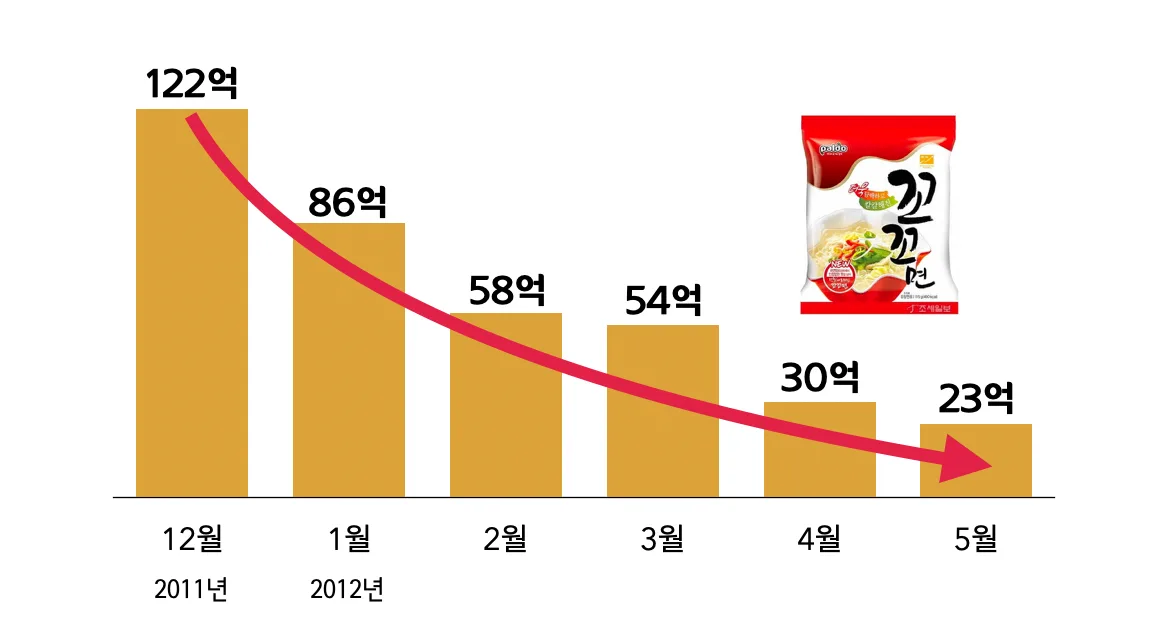
But as soon as capacity (Capa.) was expanded, Kkokkomyun’s sales plunged: from KRW 12.2 billion (≈ US$9,127,600) in December 2011 to KRW 8.6 billion (≈ US$6,434,200) in January 2012 (down 30% month over month), KRW 5.8 billion (≈ US$4,339,400) in February (down 33%), KRW 5.4 billion (≈ US$4,040,100) in March (down 7%), KRW 3.0 billion (≈ US$2,244,500) in April (down 45%), and KRW 2.3 billion (≈ US$1,720,800) in May (down 24%). Because ramen is cheap relative to its volume, noodle plants are usually located in Gyeonggi Province near Seoul, but Paldo’s new plant in Naju is about 280 km from Seoul. As a result, the company posted losses of roughly KRW 20 billion (≈ US$14,963,300) in both 2012 and 2013.
[ Reference ]
* 1 box of ramen: 40 packs of Kkokkomyun
* One 40-foot container: 11,200 ramen boxes = 44,800 packs of ramen
* 40-foot container shipping cost: KRW 1,000,000 (≈ US$750)
* Shipping cost per Kkokkomyun pack: KRW 22 (≈ US$1) (4.4%)
* Kkokkomyun consumer price: KRW 500 (≈ US$1) (discounted supply price at the time / estimated)
* Royalty (paid to Lee Kyung-kyu): 1-2%
* Nongshim Shin Ramyun’s 2022 profit margin: 3.5%
Expanding capacity (Capa.) too fast on the strength of early sales momentum hit the parent company hard. Two years later, in August 2014, the snack industry had a hit of its own that appeared out of nowhere, much like Kkokkomyun: Honey Butter Chip, launched by Haitai Confectionery in a joint venture with Japan’s Calbee. Supply couldn’t keep up with demand, so purchases were limited per person and the chips sold online for 3-4 times the retail price. A listing even appeared on Joonggonara reading “Selling the smell of Honey Butter Chip,” which became a big topic of conversation. Haitai knew well how hasty plant expansion and construction had burned Paldo, so it didn’t rush: it broke ground on its second plant only in summer 2015, a year after launch. These cases show that while sales and marketing want to squeeze out maximum revenue with generous capacity (Capa.), production has to time its capacity expansion carefully. Expand too hastily, and the damage to the organization can be enormous.
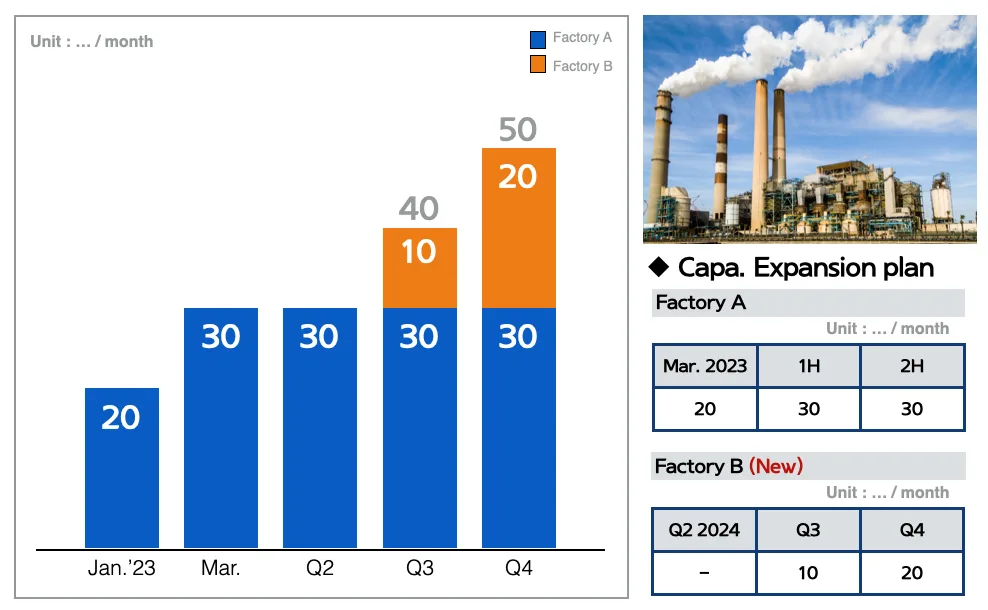
In a first meeting with a new client, or with a new contact at an existing client, you cover the company introduction, history, and business structure, add details on quality management and intellectual property, and then highlight how your current or proposed products beat the competition. Along the way you offer solutions to the client’s current problems, explain part of your manufacturing process when they ask, and the talk may turn to the client’s sales and production plans in light of market competition. That naturally leads to each supplier’s market share and allocation, and then to your own capacity (Capa.) expansion plans. If you learn beforehand that a competitor has proposed a capacity increase by squeezing more out of existing processes, with no new line or plant, you should put together a concrete plan and reassure the client with a stable, credible proposal to grow your share. A 'plan' is still just a 'plan,' so the actual capacity expansion should be carried out at the optimal time, right?
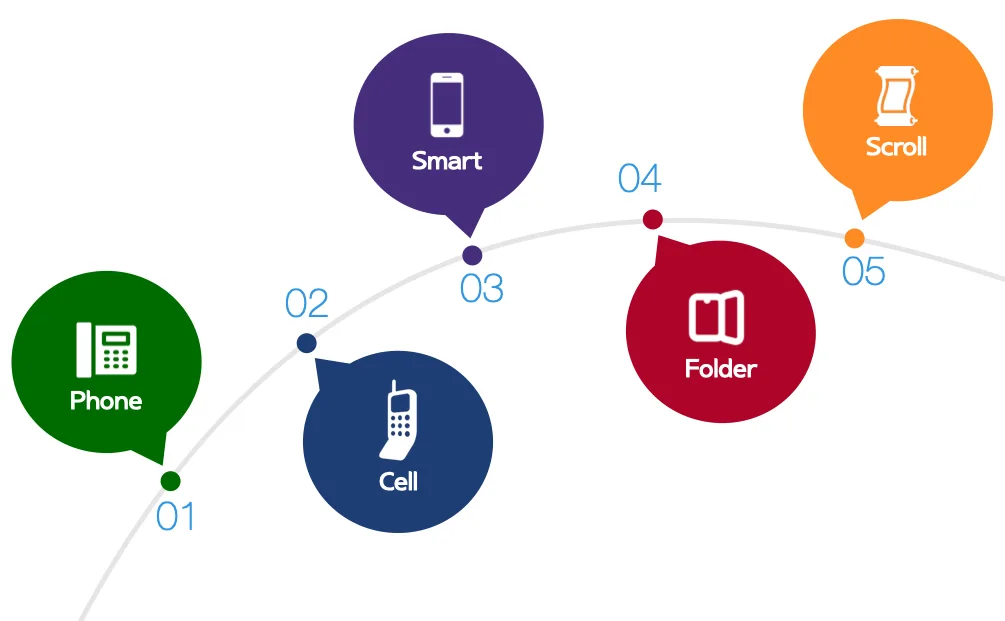
Once you’ve discussed our Capa. with the client’s contact, the next step is the TRM. A TRM (Technology Roadmap) is a technical document that R&D organizations create for systematic planning, management, and decision-making around R&D activities. With technology advancing so fast today, materials, parts, and equipment must be upgraded before an end-consumer product can be, so B2B clients naturally want to see the TRM (Technology Roadmap) of suppliers earlier in the value chain. So I think sales should offer this information first, and if the client wants a more detailed roadmap, bring engineers or R&D staff along and share whatever isn’t confidential. Look at how the mobile phone has evolved. Motorola launched the brick-like DynaTAC 8000X in 1983, then came the palm-sized Nokia 1011 in 1992, a variety of PDA phones in the mid-1990s, BlackBerry, Samsung, LG, and many other form factors in the early-to-mid 2000s, Apple’s iPhone in 2007, and the Galaxy Fold in 2019. The parts inside include batteries, displays, camera modules, various motors, PCBs, speakers, buttons, cables, and mainboards. Phones have become smaller and lighter, with bigger displays, faster and smarter performance, longer-lasting batteries, and the ability to record better photos and video on larger storage. Today they even fold horizontally and vertically. Behind the progress of these end products lies the hard work of suppliers who poured their sweat into developing materials, parts, equipment, and tools. End your client meeting with our Capa. and TRM (Technology Roadmap)! What do you think?
To be continued