Starting in mid-2022, the share prices of 'Seoul Gas' and 'Samchully' began to climb steadily. As city gas suppliers, their stocks seemed to be rising alongside natural gas prices driven by the war in Ukraine. Then, from the second half of 2022, shares of companies with no connection to natural gas, such as 'Sebang', 'Daou Data', and 'Harim Holdings', began rising in a similar pattern. Prices that had crept up over three years rose nearly 20-fold. Then, from April 24 to 27, 2023, the stocks hit the daily lower limit in consecutive sessions, prompting investigations by prosecutors and financial authorities, and the case is strongly suspected to be stock manipulation. Within a few days, prices fell 60–80%. As expected, the companies targeted for manipulation had high ownership by major shareholders and therefore a small free float. These were stocks whose prices could easily be pushed up or down with only a small trading volume.
The manipulators reportedly recruited creditworthy, wealthy investors such as doctors, entertainers, and business owners, illegally obtained their phones, IDs, and personal information, and bought up the shares over three years through consigned leveraged trading. The investors were high earners, including wealthy individuals, entertainers, and doctors, numbering about 2,000 people with investments totaling nearly KRW 1 trillion (≈ US$748,167,000). Then, on April 24, 2023, a 'betrayer' inside the manipulation group sold all the shares they held and cashed out. The group, caught off guard, reportedly tried to stop the slide by buying shares with their own money, but all the investors rushed to sell at once, and forced liquidations on CFD (contract for difference) positions piled on, setting off a chain of lower-limit closes. Everyone involved claims to be a victim. Someone may well be made a scapegoat.
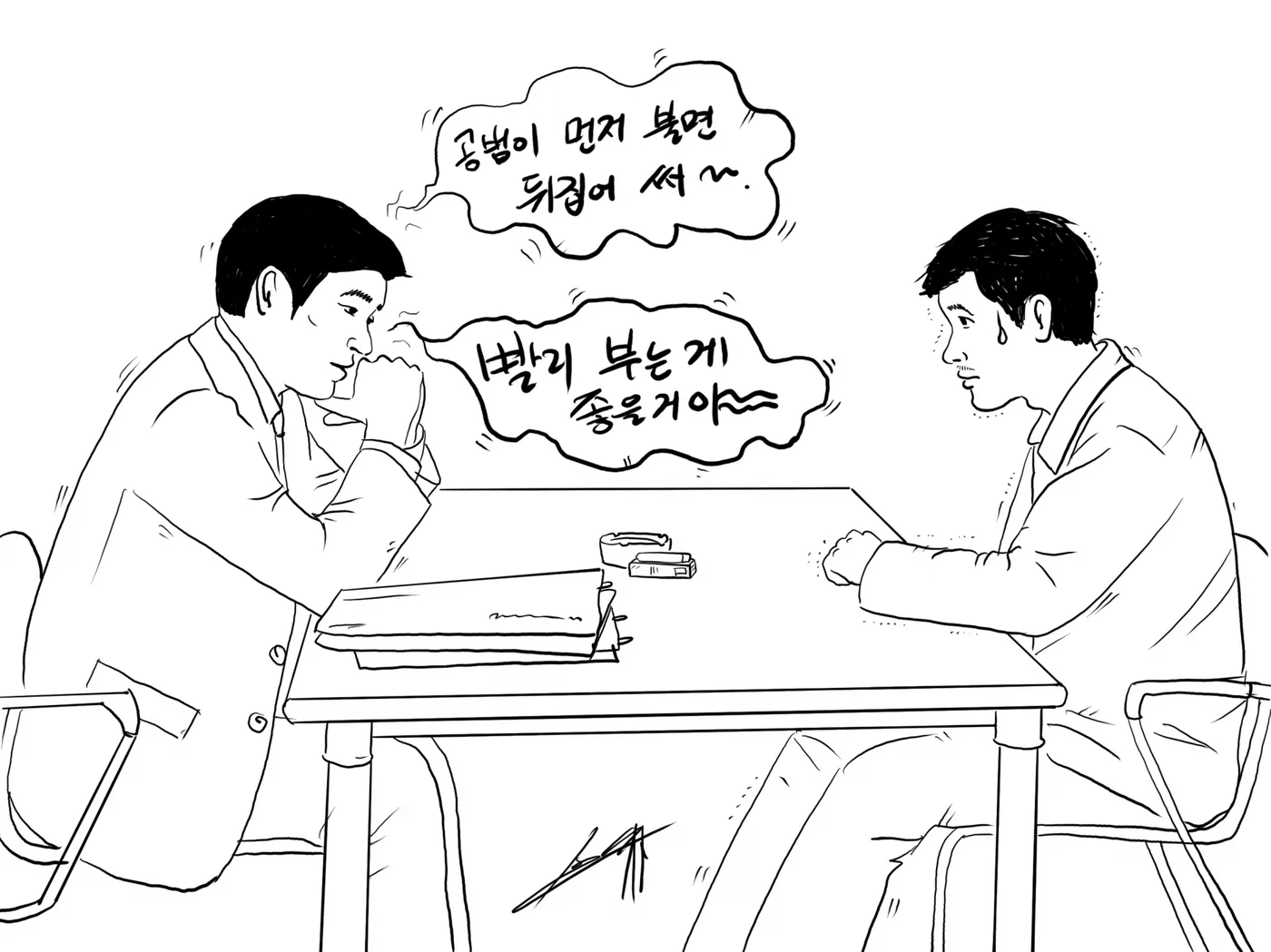
What must it have felt like for the so-called 'betrayer' who sold off a huge block of shares first? It reminded me of the classic game theory example, the 'Prisoner's Dilemma': a game with two players and two choices each. Two suspected accomplices, A and B, are separated into different interrogation rooms and pressed to confess. If both deny the crime, 'both get 1 year'; if both confess, 'both get 3 years'; if only A confesses, 'A goes free / B gets 10 years'; if only B confesses, 'B goes free / A gets 10 years'.
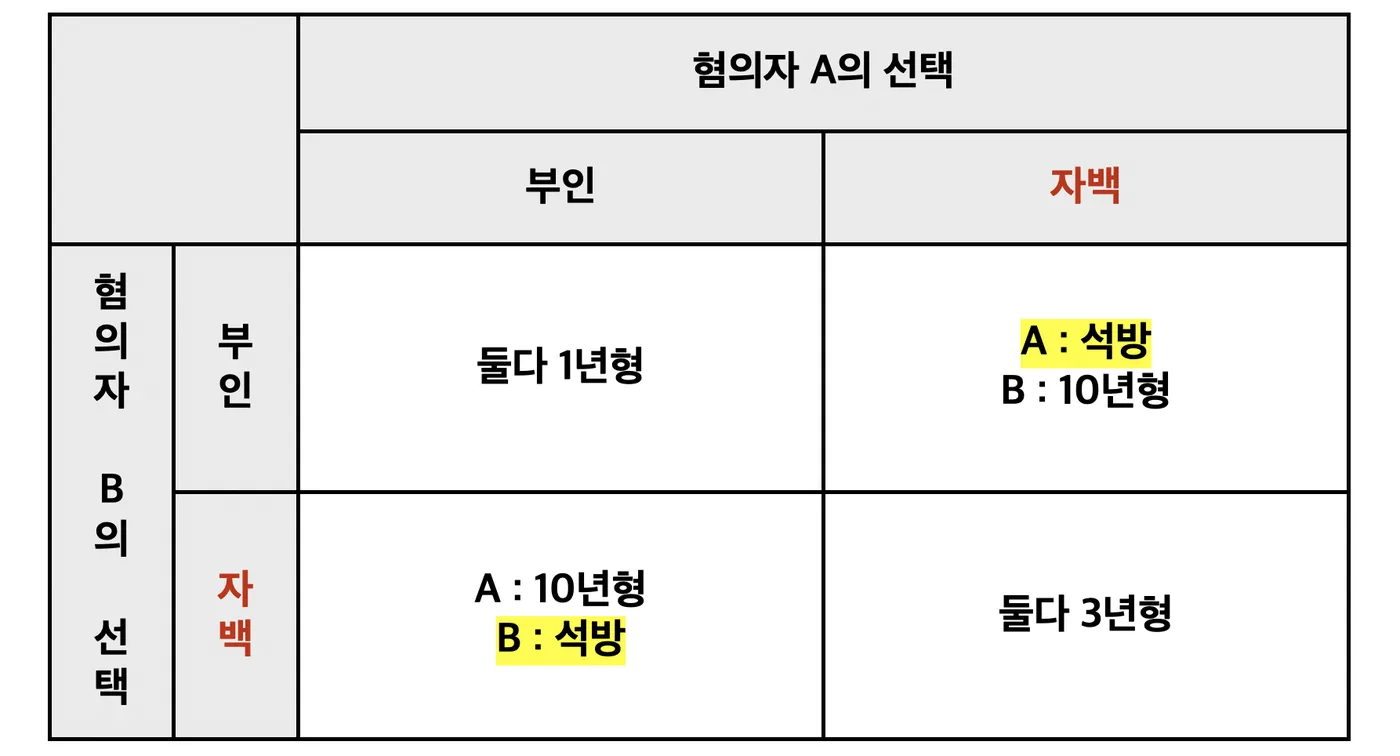
What would you do if you were one of the suspects? The best outcome is for both to deny it and walk away with a short one-year sentence. But in isolation, you can’t be sure the other person will deny it, so you would feel very uneasy. Count on their goodwill and you could end up with the worst outcome: ten years. I would probably confess. If the other person denies it, I go free; if both of us confess, I get the next-best result, three years; and either way I avoid the dreaded worst case of ten years.
In 2012, the Korea Fair Trade Commission found that instant noodle makers had colluded on prices for nine years, from 2001, and fined Nongshim, Ottogi, and Korea Yakult KRW 108 (≈ US$1) billion, KRW 9.8 (≈ US$1) billion, and KRW 6.2 billion (≈ US$4,638,600) respectively. In particular, Nongshim and Ottogi had agreed to hold the same prices on their noodle products, forming a duopoly in the market. Through this collusion, they tried to prevent noodle prices from falling and to keep other manufacturers out of the market. But the Fair Trade Commission uncovered the cartel and, in 2012, fined Nongshim and Ottogi for violating antitrust law. Samyang Foods was exempted from a KRW 12 billion (≈ US$8,978,000) fine through the leniency program (a self-reporting immunity scheme). By confessing first, Samyang Foods secured the best possible outcome and avoided the KRW 12 billion (≈ US$8,978,000) penalty. Doesn’t that sound like a textbook case of the Prisoner’s Dilemma?
In 1984, I was a fourth grader at an elementary school in Daegu. Class president elections were held at the start of the term, and since I had been class president in both second and third grade, I was full of confidence. I ran alongside a close friend, and we promised to vote for each other. I lost by one vote. Right there, I opened my notebook and started calculating. Assuming my friend hadn’t betrayed me, the result showed that if I had betrayed him, it would have been a tie. In hindsight, breaking the promise would have been the right move. It was a secret ballot, so lying was fair game. My friend, flushed with the joy of winning, said to me, “Sorry. I voted for myself.” I was so angry that I went home and cried for a long time. In 1984, I should have known game theory.
The betrayer in this stock manipulation case has an advantage over the suspect in the 'Prisoner's Dilemma': time. A suspect in the Prisoner’s Dilemma must wait for the other side’s decision, even if they confess first. In this case, however, dumping shares first and selling off guarantees a sure profit. The media is currently spotlighting only the entertainer Lim Chang-jung, but to me it looks like an attempt to make him a 'scapegoat' and cut off the tail before the investigation reaches the bigger body.
To be continued