On a day with an afternoon lecture, I woke up late, had breakfast, and was swiping through the recommended videos on my phone’s YouTube home screen over a cup of coffee when one caught my eye. The title was “Trying the Physical Laptop: Panasonic Toughbook FZ-40.” I was hooked; it was great fun to watch. A laptop should be thin and light, with a big screen and high performance, right? This one is, first of all, very thick. Its reinforced magnesium alloy frame makes it extremely sturdy and resistant to vibration. It is waterproof and can be used in dusty environments. The touchscreen works even with wet gloves on, its modular design lets you attach various expansion packs depending on the use, and the battery lasts more than 36 hours. It was truly a laptop built for industrial use.
Which industries and applications is this industrial laptop best suited for? Construction, mining, fishing, factories, the military, police, firefighting, healthcare, transportation, logistics — any environment that needs a rugged, durable laptop that rarely breaks down. I was genuinely surprised that a heater module can be installed to raise its temperature. Ordinary computer users worry about how to cool a computer down, not how to warm it up. But in sub-zero conditions, you will need a heater. This laptop is built for industrial use and breaks the assumptions we have come to expect from consumer laptops.
Now you are a B2B sales rep for Panasonic. Close your eyes for a moment and say to yourself:
"I’m a Panasonic B2B salesperson!"
The product you have to sell is an industrial laptop priced at KRW 5.5 million (≈ US$4,110). How should you sell it? First, estimate laptop usage by industry and application, then list your target customers. A laptop isn't used continuously like materials or components, nor is it supplied fully customized like system semiconductors. It has a 'replacement cycle.' Companies generally upgrade their IT devices every three years. You have learned that a company called 'A Corporation' is about to buy more than 250 laptops. Shall we go to the sales meeting together?
The conversation begins in the reception room.
A Corporation buyer : "How much do Panasonic laptops cost?"
Panasonic sales rep : "It's KRW 5.5 million (≈ US$4,110)."
A Corporation, Purchasing : "Isn’t this too expensive? For similar specs, an LG gram costs KRW 3 million (≈ US$2,240) and a Galaxy Book KRW 2 million (≈ US$1,500). What do you think?"
Panasonic Sales : "Those are consumer products. Your site is outdoors, with a lot of dust and moisture, so they’re likely to fail quickly. They don’t seem suited to your use."
A Corporation buyer : "Sales reps from LG and Samsung say they'll build an industrial case at no extra cost."
Panasonic sales rep : "You have to think about productivity. Our touchscreen works even with wet gloves on, the hardware is modular, and the software can be configured in detail for industrial use."
A Corporation, Purchasing : "The upfront price is still too high. How low can you go?"
Panasonic Sales : "About how many units are you considering?"
A Corporation, Purchasing: "We’re looking to buy about 250 units."
Panasonic Sales : (KRW 1.375 billion (≈ US$1,028,700)...) "With a volume discount, we can supply them at KRW 5 million (≈ US$3,740) each."
A Corporation, Purchasing : "Still, it’s expensive..."
Panasonic Sales : "I see. How often do you usually replace your laptops?"
A Corporation buyer : "Our working conditions are harsh, so even top-spec laptops need replacing every three years."
Panasonic Sales : "Is that so? Then let’s compare over three years of use. Take a look at this screen."
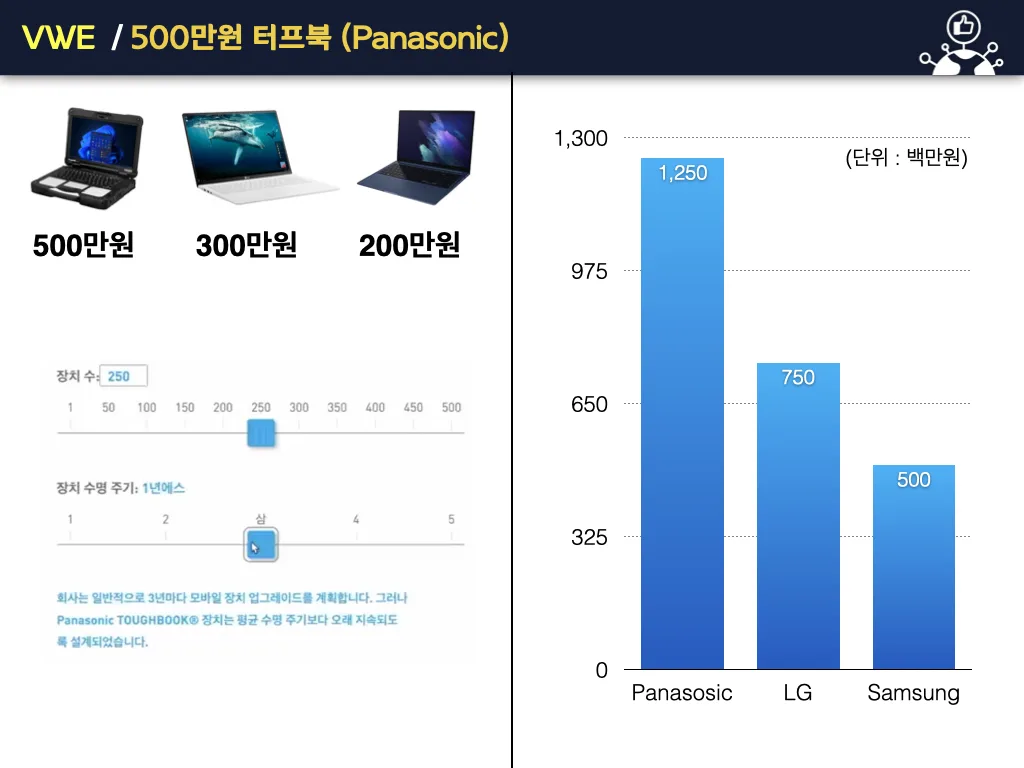
Panasonic Sales : "Buying our product comes to KRW 1.25 (≈ US$1) billion, LG KRW 750 (≈ US$1) million, and Samsung KRW 500 million (≈ US$374,100)."
A Corporation, Purchasing : "Look, the cost difference is huge."
Panasonic Sales : "Then let’s compare over four years of use. Take a look at this screen."
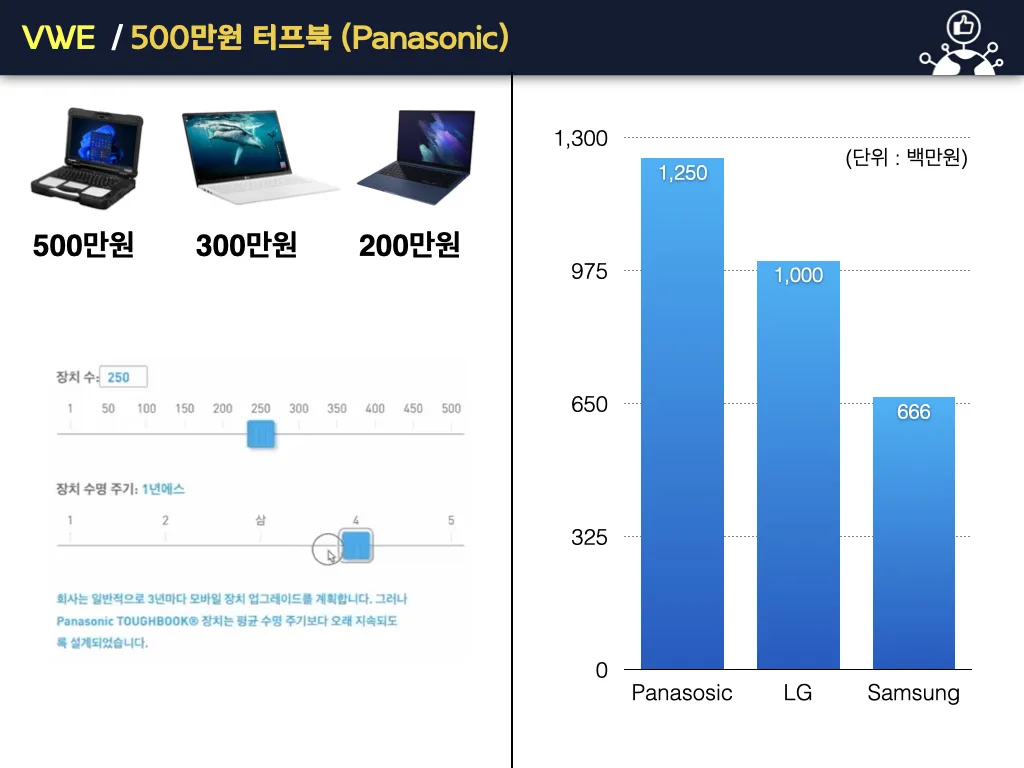
A Corporation buyer : "If we buy your product, the cost stays at KRW 1.25 billion (≈ US$935,200). With LG it rises 33% to KRW 1 (≈ US$1) billion, and with Samsung it rises 33% to KRW 670 million (≈ US$501,300)."
Panasonic sales rep : "Huh? Why does it go up?"
A Corporation buyer : "LG and Samsung laptops have to be replaced after three years of use, so I added the cost of a replacement, calculated on one year of use."
Panasonic sales rep : "I see."
A Corporation, Purchasing: "Our product typically lasts five years in the field without trouble. Why don’t we compare on a five-year basis this time? Take a look at this screen."
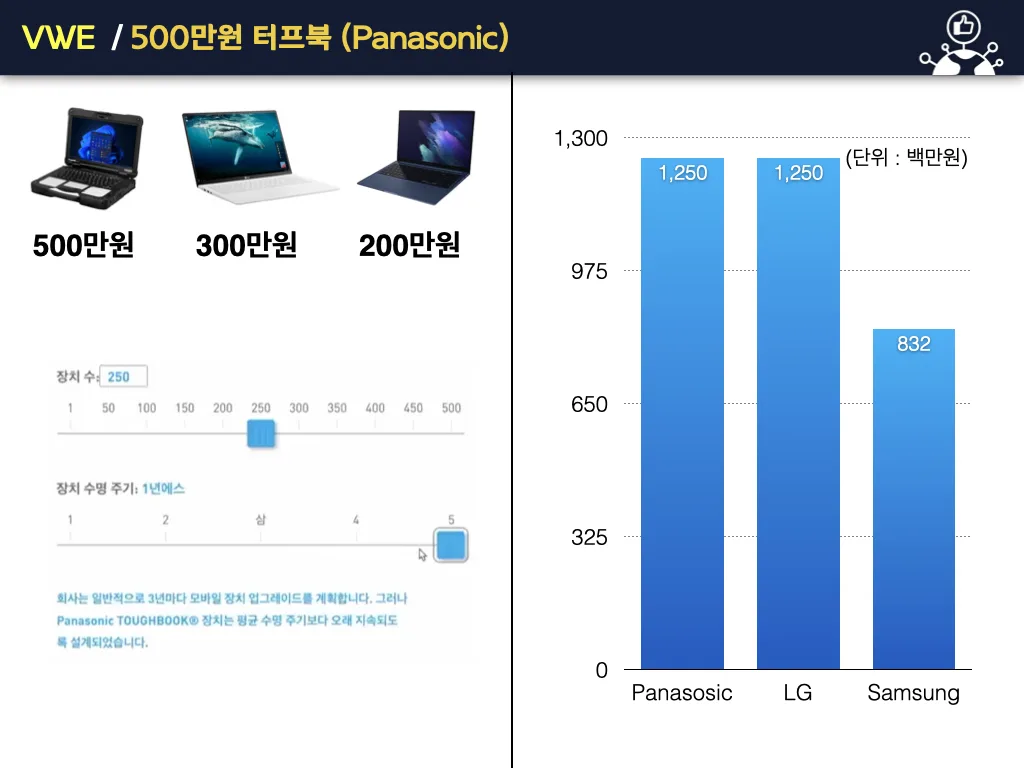
Panasonic Sales : "LG’s cost is now the same as ours, and Samsung’s has risen 66%, from the original KRW 500 million (≈ US$374,100) to KRW 830 million (≈ US$621,000). This data doesn’t even factor in other elements like failure rates or productivity. Once you include those, our product holds a clear long-term comparative advantage. If you’d like, at my next visit I can show you data that also accounts for failure rates, productivity, service, and upgrade costs."
A Corporation buyer : "No, that won't be necessary."
Panasonic Sales : "Shall I send you about two sample units to test in the field? Once you hear your field team’s feedback, you’ll see how superior our product is. B Corporation and C Corporation recently replaced everything with our Panasonic laptops too, and they’re very satisfied with the productivity gains."
A Corporation, Purchasing : "Oh, I see. Understood. I’ll meet with my team and get back to you. Thank you for visiting today and explaining everything in detail."
Panasonic sales rep : "Thank you for the opportunity. If you have any questions about our product, feel free to contact me anytime."
How was that? The Panasonic rep above doesn't just repeat how great their own product is. They know the customer's usage environment and the features and prices of competing products, and they use a 'VWE (Value Word Equation)' — a value proposition formula that shows the value of their product most effectively. Later on, they also cite a reference showing that the customer's competitors use the product reliably.
VWE is a hugely important concept in B2B sales, so be sure to remember it. Let me explain it once more with another example.
To be continued