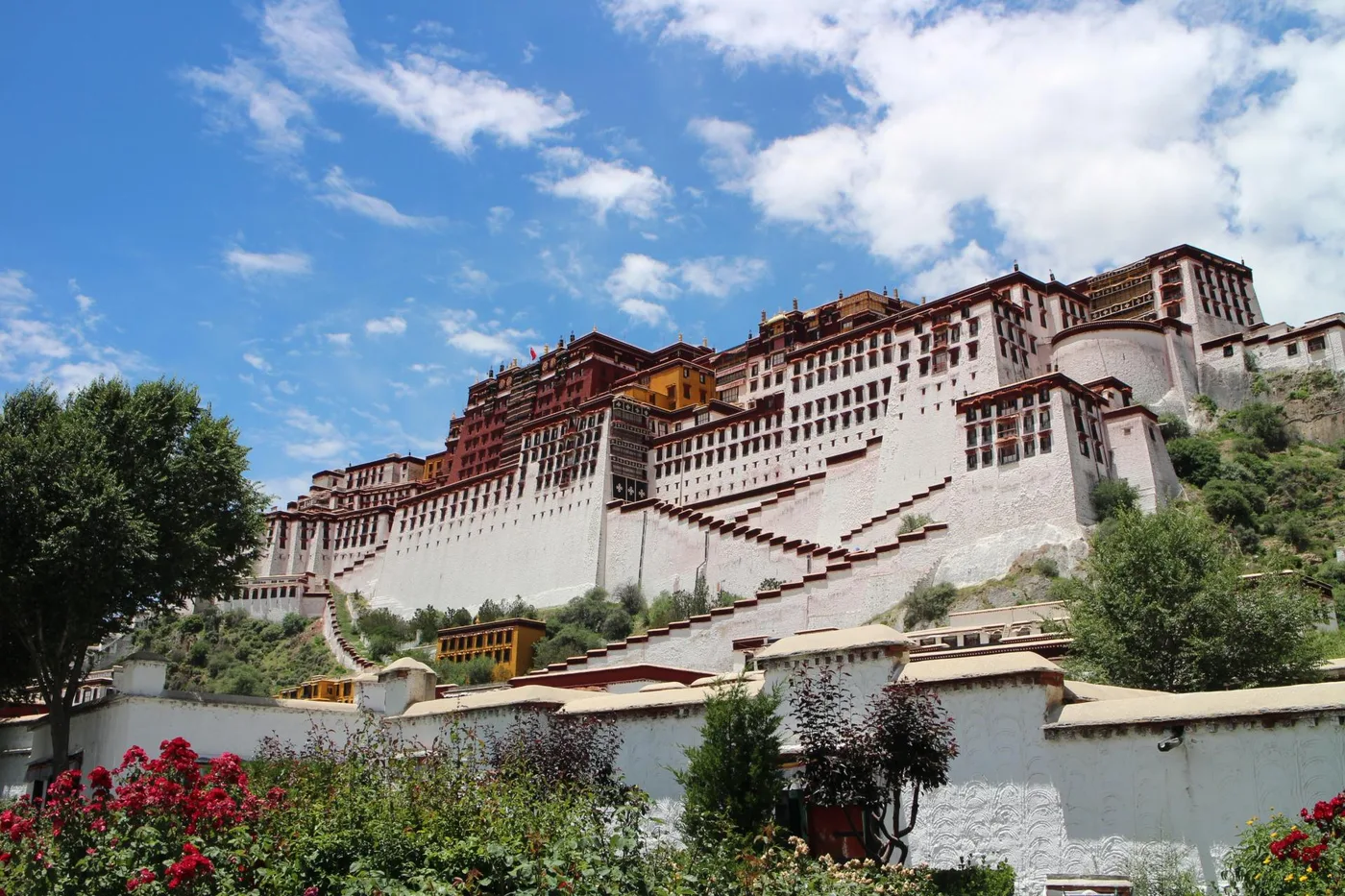
It was 1999, and I was backpacking through China. I took a train to Golmud (格尔木) in Qinghai, then spent several days on a bus to Lhasa (拉薩), the capital of the Tibet Autonomous Region. I was in my twenties, full of youthful bravado, and wanted to turn the end of the 20th century into a turning point in my life by traveling somewhere most people never go. When I reached the square in front of the Potala Palace in Lhasa, what caught my eye was not the deep blue sky at that altitude or the unfamiliar Tibetan culture. It was the handmade accessories sold at street stalls. I had seen the very same items sold on the street in Japan in 1998 for more than 1,000 yen (over KRW 11,000 (≈ US$8) at the exchange rate of the time), yet in Tibet they sold for about one dollar. That was the first time I really thought about 'distribution'.
How can you buy low and sell high?
At first I asked around and found a wholesaler. The accessories that retailed for US$1 were 20-30% cheaper there. Asking around again, I tracked down handmade accessory factories hidden in back alleys, and their price was half the US$1 retail price. To get that price, I had to buy at least US$1,000 worth. I bought accessories from that factory and filled a big backpack, took a boat from Tianjin, China to Kobe, Japan, and sold them at a street stall in Amerika-mura in Osaka. The police detained me once and confiscated some of my stock, but even after travel expenses I came away with about KRW 5 million (≈ US$3,740). It was a rewarding and fun experience.
Since I left my corporate career in 2012, I have spent about 11 years in startup training, mentoring, and consulting, and there is one question I always ask founders. "B2C, B2B, and B2G customers are won in very different ways. Picture your startup idea and think about who your customer is. Is the customer B2C? B2B? B2G? Raise your hand for the one that applies." B2C usually got slightly more hands. But when I asked again, "Those of you who said B2C but think it might be B2B too, raise your hands again," more than half of those who had raised their hands for B2C raised them again. When I talked with them, they said they do offer consumer products, which is B2C, but to distribute them they have to deal with wholesalers, so they see it as B2B.
I think the typical B2B distribution model is 'indirect distribution' through agents (wholesalers). Some of you may object: "What are you talking about? When vendors supply Hyundai Motor or Samsung Electronics, they sell directly without agents, and the volumes and amounts are far larger. You're wrong." By transaction volume or value, 'direct distribution' may be about equal or even larger. But in B2B distribution, most of the people and systems are set up around 'indirect distribution', so this section focuses on that.
1) What is wholesale?
'Wholesale' (都賣 in Chinese characters): what does it mean? The dictionary defines it as 'an economic activity positioned between production and retail in the distribution of goods'. More specifically, it means buying in bulk from producers and selling at wholesale prices to next-tier wholesalers or to retailers. Every kimchi-making season, many media outlets run stories demonizing 'agricultural wholesalers who take enormous distribution margins'. I understand why: it raises click-through rates and ad revenue. But once you understand the nature of agricultural products, you can see why their wholesale margins have to be high. They aren't produced all year round; output varies by region and season, long distances raise distribution costs, and there is always a risk that large amounts are discarded or lose their commercial value as quality deteriorates in transit. Reducing those risks takes costly investment in distribution infrastructure such as refrigerated trucks and cold storage. Wholesalers sell to retailers, to other wholesalers earlier or later in the value chain, to producers, or to corporate customers. There is one condition: sales to 'end consumers' must be nonexistent or very small. Wholesalers must manage their relationships with producers, retailers, and corporate customers closely, and the ability to spot and respond to market changes quickly is critical.
2) Types of wholesalers
Wholesaling can be broadly classified into 'manufacturer wholesalers', 'merchant wholesalers', and 'agents and brokers'. A 'Manufacturer's Wholesale Operation' is when a manufacturer does not use wholesalers such as distributors or agents in the distribution process. The manufacturer performs all the wholesaler's roles itself: delivery, storage, and sales. If the manufacturer is better at distribution than professional wholesalers, there is no problem. If not, the risk of duplicated investment and wasted cost grows. Depending on whether they can hold inventory, these are divided into 'Sales Branches' and 'Sales Offices'. A 'Merchant Wholesaler' does not produce goods directly, unlike a 'manufacturer wholesaler'. From their point of view, manufacturing is a risk. They buy goods in bulk, store them, break them into smaller lots, and supply them to retailers. Types of 'merchant wholesalers' include drop shippers, cash-and-carry wholesalers, truck wholesalers, rack jobbers, processing wholesalers, import-export wholesalers, and internet wholesalers. By the range of services they offer, they are also classified as 'full-service wholesalers' and 'limited-service wholesalers'.
Next are 'agents and brokers'. The first type I will explain is the 'Broker'. I described this in the earlier section on the 'three typical B2B distribution methods', using the example of a major customer's purchasing executive who retires. Brokers generally do not provide services such as warehousing or delivery. Through sales, client entertainment, and service, they find and match a manufacturer that fits the corporate customer's situation and act as that manufacturer's sales representative. When a broker secures a purchase order (PO), the manufacturer handles storage, shipping, and paperwork. Because brokers don't need to hire administrative staff or maintain warehouses, they can focus on sales and service. Next is the 'Manufacturer's Agent'. Think of it as the 'Hi-Mart' model. At 'Samsung Digital Plaza' you can only buy Samsung Electronics products, and at 'LG Best Shop' only LG Electronics products, but at 'Hi-Mart' you can buy products from many makers, such as Samsung, LG, and Daewoo, all in one place. A manufacturer's agent likewise handles and distributes a variety of products from different manufacturers. The important point is that products from different manufacturers must not overlap and cannibalize one another, so the contract should spell out and limit the product types, territories, and customers covered. In late 2006, when I was selling tools for semiconductor processes in Taiwan, I contacted the largest agent in the Chinese-speaking world and asked it to distribute our products, hoping to enter the Taiwanese semiconductor market easily. Perhaps because the agent was larger than our company and had the upper hand, it barely delivered market research or sales reports for six months. It turned out that it was already selling a competitor's identical product to key customers, and, intentionally or not, it was blocking our products from entering the market while dealing with me. Next is the 'Selling Agent'. A selling agent is granted the right to sell all of the contracted manufacturer's products. You can think of it as 'outsourced sales'. When a manufacturer that doesn't want to spend on building a sales system meets a specialized selling agent that doesn't want to spend on building a manufacturing system, good synergy is likely. If there are selling agents, there must be purchasing agents too, right? Next is the 'Purchasing Agent'. This is an agent that handles purchasing on behalf of companies or institutions buying products or services. In the automotive, display, semiconductor, and solar industries where I worked, I never saw one. Materials, components, and equipment that critically affect quality can't be outsourced to a purchasing contractor, after all. Finally, there is the 'Commission Merchant'. This is a distributor that handles marketing, sales, storage, distribution, and selling on behalf of many small producers who hold legal ownership of their goods. Typically, it pays producers the proceeds left after deducting the agreed commission and various expenses from sales. For example, say 20,000 heads of cabbage are sold at KRW 5,000 (≈ US$4) each, for KRW 100 million (≈ US$74,800) in total. Of that, a 30% commission of KRW 30 million (≈ US$22,400) and KRW 30 million (≈ US$22,400) in marketing, sales, storage, distribution, and selling costs are deducted, and the producer is paid the remaining KRW 40 million (≈ US$29,900). From the producer's side, the selling price was twice the production cost of KRW 1,000 (≈ US$1) per head, and with no selling and administrative expenses, that is a 100% profit over production cost.
To be continued