What are the ways to enter the B2B market? Is there an easier, more systematic approach? Is there a way to do it without asking senior colleagues or digging through your organization’s sales and marketing history? Let me walk you through it step by step.

Hand-drawn illustration
① Statistical classification
ⓐ Industry: The most basic way to segment a B2B market is by the customer’s industry. Even for the same eco-friendly fertilizer, customer industries can be divided into 'agriculture' and 'landscaping,' and the value they want can differ. Among steel products, hot and cold rolled steel plates are segmented by customer industries such as automotive, home appliances, office supplies, furniture, and construction. So which industry is the most complex, with the most variety, when segmented by customer industry? Based on my combined experience in field sales, training, and consulting, it would be the tool industry: diamond tool makers such as Ehwa Diamond Industrial and Shinhan Diamond Industrial, and cemented carbide tool makers such as TaeguTec, Korloy, and YG1. Their customer industries span nearly everything: shipbuilding, aerospace, automotive, rail, glass, semiconductors, solar, wind, oil, gas, power generation, displays, construction, stone, machinery, molds, bearings, tools, and more. That is why most tool makers segment either by their own product types, such as Milling, Turning, and Tooling, or Metal, Resin, and Vitrified, or by industry.
ⓒ Application: In my marketing lectures I often use the “boiler” example. I open with the question: “How can you sell boilers the fastest and in the greatest volume?” That leads naturally to separating a customer’s “industry” from its “application” when entering a B2B market. The customer’s industry is “construction,” and the main application is “apartments.” Combine the two and you get a focused target: “apartment builders.” Take the “diamond tool manufacturing” business where I worked for about five years. In the “display” industry, applications split into “CRT picture tubes,” “LCD,” and “LED.” In the “semiconductor industry,” applications divide by front-end and back-end into CMP conditioning, back grinding, dicing, and so on. In the “home appliance industry,” the “air conditioner” or “refrigerator” application breaks down into machining tools for the “compressor” component, such as “metal honing stones” and “vitrified bore-machining tools.” In the “automotive (transportation) industry,” the application that uses the most tools is clearly the “engine.” Cam and shaft grinding wheels, bits, inserts, honing stones, drills, gear dressers, and more: the “applications” and “tools (products)” are extremely varied and complex. Many customer industries still remain: “machinery,” “tools,” “optics,” “bearings,” “construction,” “stone,” “glass,” “solar,” “molds,” and many more. This is what salespeople find hardest. Even a seasoned marketing consultant would find it daunting to serve such a tool manufacturer, because it is so complex.
ⓑ Customer Size: In B2B, the total addressable market (TAM) and the serviceable available market (SAM) are relatively easy to pin down. What comes out is a list of customers, and this is where B2B marketing begins. Which customers do you go after first? Do you land the big accounts first, even if it takes years? Or work your way up from smaller ones? That is the real question! Effective account management makes or breaks a company, which is why many argue that Account Management is the most important part of B2B marketing. Effective B2B account management always starts with a “choice” and a “decision.” Imagine a CEO, head of sales, or sales team lead who fails to make those choices and still hands down contradictory orders: “Expand market share, raise average product prices, and improve profit!” Frontline salespeople would end up confused and in despair. In B2B, a supplier’s technology, capacity, and people are limited, so every choice the decision-maker (the Decider) makes becomes a turning point for future results. The Decider must be smart. If that person is clueless, every employee of the B2B supplier suffers.

A B2B supplier’s choices have a huge impact on the entire industry.
ⓓ Customer location
Suppose you have two customers with identical usage volumes and supply prices. Our company is in Changwon, Gyeongnam. Customer A is in Masan, Gyeongnam, and Customer B is in Ningbo (宁波), China. Which would you start doing business with? Customer A, of course. With Customer B, you would have to deal with communication barriers, extra effort, logistics costs, transaction risk, local trade practices, and Chinese government risk. But what if, after negotiation, Customer B offers 1.2x the volume at 1.1x the price, a better deal, but only slightly? Then you would need to run simulations that account for many factors. You might need a Chinese distributor, a local warehouse, and an expat from your company, and costs and risks could rise further. In B2B, a customer’s location adds many more considerations for the supplier. When entering a B2B market, choose carefully.
② Operating variables
ⓐ Your company's technology level: Your own 'technology level' matters just as much. Socrates said, 'Know thyself.' You may think you know a lot, but do you really understand yourself? This applies to suppliers entering the B2B market too. "Know your technology level." What if a tool maker that has always run on rule-of-thumb methods starts making tools for advanced industries and still wins business through wining and dining and personal connections rather than technology? What if it keeps playing a game it cannot win, skipping R&D investment while facing foreign competitors whose equipment has higher technology, economies of scale and lower prices? What if it is lured by the fact that selling parts or materials as tools can raise prices considerably, and wastes a great deal of money and staff time entering a market it has no experience in? Variables like these will badly damage your competitiveness, won't they? "Know your technology level!!!"

ⓑ Product and brand: When B2B products are hard to classify by application, or the application is too complex, it is very common in B2B to classify them by 'product' and 'brand.' Take 'animal feed' as an example. By product form, there is whole-grain feed, which gives the grain as it is; the steaming 'yeomul' (cooked fodder) many of us saw in the countryside as children; 'mash feed,' made by grinding grain; 'pellet feed,' made by reprocessing mash at high temperature and pressure; and 'crumble,' made by coarsely crushing pellets. By brand, Sunjin offers 'Big Good UP' to improve weight gain and 'One Triple 100' for sows, while Nonghyup Feed offers 'Gammameal' for piglets and 'Hit Egg-Laying' for laying hens. Now take 'steel plate.' By product form, there is hot rolled steel, made by pressing hot slabs; cold rolled steel, made by rolling hot rolled steel at room temperature to make it smooth and precise; and 'checkered plate,' which has grooves in the surface to prevent slipping. By brand, POSCO offers 'Greenable' for eco-friendly energy, 'eAutopos' for eco-friendly vehicles, and 'Infinelli' as its premium color-coated steel. What about 'paint'? By physical properties, paint can be divided into 'water-based,' 'oil-based,' and 'art' paint. By brand, KCC has 'Supeuro,' 'Royal Wood,' 'Spotan,' 'Monotan,' and 'Uniposy,' while JEVISCO has 'Pureunsol,' 'Stain,' 'Fire X,' 'Super Aqua,' and 'Dream Coat.' Diamond tools can be classified by the type of bond mixed with the diamond grit—'metal,' 'resin,' and 'vitrified'—and by brand, such as 'ARIX' from Shinhan Diamond Industrial and 'GENESIS' from Ehwa Diamond Industrial. Memory semiconductors can be classified as 'DRAM,' 'SRAM,' 'VRAM,' 'ROM,' and 'Flash memory,' and the brand is simply the manufacturer: 'Samsung,' 'Hynix,' 'Micron,' 'Nanya,' 'Winbond,' and so on.
ⓒ Customer capacity : A customer’s capacity (production volume) is a critical factor for a B2B supplier. Current capacity matters, but you must also keep forecasting future capacity. In 2005, at Shinhan Diamond Industrial, where I worked, I briefly handled Asahi Glass’s Malaysian plant. The Japanese customer’s product was glass tube for CRT picture tubes. They had continuously used expensive diamond tools to process the joint cross-sections, spending hundreds of millions of won every month. In 2003 and 2004, Korea’s LG and Samsung were aggressively producing LCD TVs and monitors, and the display market was changing rapidly. Japanese products were slow to change, and the end users (the final users in the value chain) who bought from Asahi Glass to make CRT TVs and monitors were vanishing quickly or changing their applications. I watched a huge supply volume disappear within a few months. Four years later I moved to Korea’s largest PCB manufacturer, Daeduck Electronics. In 2009, Nokia, a major Daeduck customer, failed to keep up with the rapid shift to smartphones triggered by the iPhone, and I watched a large PCB supply volume vanish almost overnight.
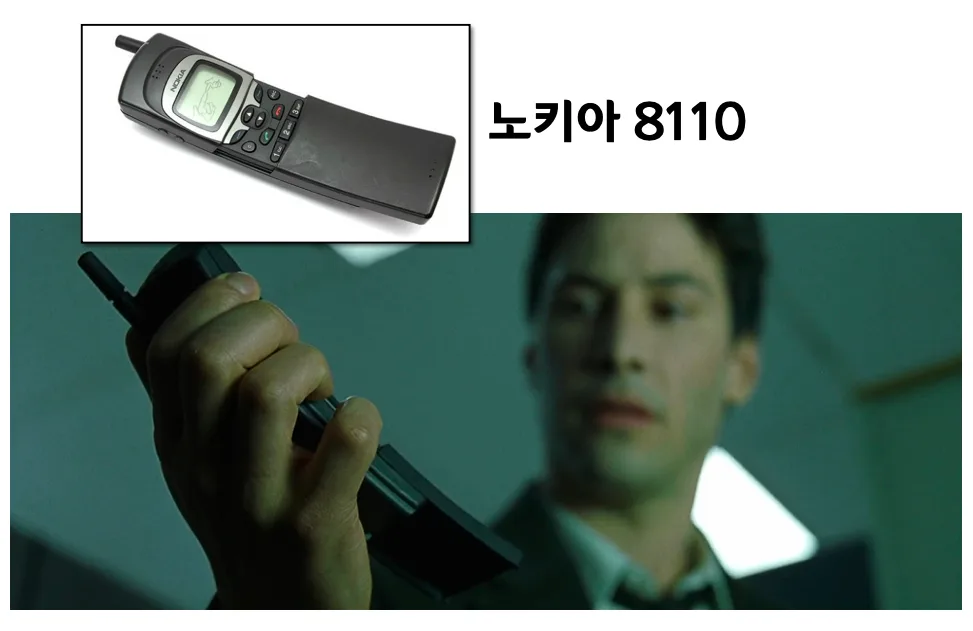
The 'Nokia 8110' that appeared in the 1999 film 'The Matrix'
To be continued