⑤ The buyer's personal characteristics
ⓑ Buyer motivation
When do you feel most motivated to buy? Rather than 'buyer motivation,' the phrase 'getting hyped' might fit better. We browse an online store, read the customer reviews, and give in to FOMO (fear of missing out: the urge not to miss a good opportunity such as a price discount, a buy-one-get-one deal, or nearly sold-out stock ). Or a movie review, a book purchase, or a travel post from an acquaintance, not a company, on social media such as Instagram or Facebook persuades us, and we book or buy. Sometimes we give in to desire and regret the purchase afterward.
But B2B customers don’t buy machines, equipment, materials, or parts on a passing emotion or desire. They buy as an organization, go through stages of purchasing decisions, and 'mostly' tend to buy for sound and justifiable reasons. (Exception: an owner of a company may make an irrational choice, buying large quantities of expensive products out of personal desire. There may be reasons such as succession or slush funds.) This is why 'buyer motivation' matters. However good your product or service is, if the buyer doesn’t want to buy, it is hard for a salesperson to persuade them.

This happened four years ago, when I gave a B2B sales and marketing course for assistant managers and managers in sales at an industrial machinery company. Two hours into the four-hour session, during the break, a worried-looking assistant manager handed me a coffee and asked: "Instructor, there is a customer I really can't understand. Our forklift is clearly cheaper and performs better than the competitor's, so why won't they choose our product? Does that make sense to you? Isn't that a breach of duty?" I answered: "As I said in the lecture, the buyer is not the company's Owner or Decider but a Buying Center that performs the purchasing function. A new supplier only gets a way in once those buyers are motivated, right? For example, if management puts enormous cost-cutting pressure on the purchasing team, that motivates them. If they need to adopt a new-concept smart forklift for a smart factory or warehouse automation, that motivates them too. Forklifts are probably low on their priority list right now. Watch each account closely, and stay alert so you can move in when something happens, such as a competitor's quality or after-sales problem, or cost-cutting becoming an issue because of a change in the economy."
Here is another example of 'buyer motivation,' one I experienced myself. In 2007, when Taiwanese memory makers set off the semiconductor chicken game, I was in Hsinchu, Taiwan, working to supply Korean-made wafer-processing tools to TSMC. B2B salespeople approach customers in a certain order. Would the 'manufacturing team,' the 'process engineering team,' or the 'quality team' welcome a new part or tool? Never. It is a hassle. No one likes a new 'variable' showing up in a well-built, optimized environment. So how should B2B salespeople approach the customer? You start with the purchasing team. At the time, TSMC's purchasing team was highly 'motivated.' They were visibly energized when they met me. The reason: if a new part or tool cut costs, they received 1% of the savings as an incentive. Saving KRW 1 billion (≈ US$748,200) would earn them an incentive of KRW 10 million (≈ US$7,480). For a Taiwanese employee, whose real pay was somewhat lower than in Korea, that was a very large sum, and they were strongly 'motivated.' From that point, the Taiwanese purchasing manager, a woman about my age, teamed up with me and began working on the 'product development team,' the 'process engineering team,' the 'manufacturing team,' and the 'quality team.' We became colleagues who exchanged information, built materials together, and worked through problems together.
So, do you get the picture now? A buyer’s motivation can differ depending on the macroeconomic situation, the client’s situation, the incumbent supplier’s situation, and your own company’s situation. You have to think from the other side’s point of view: is there a good enough 'reason' for them to buy your product?
ⓒ Personal Perception
This is a case from 2007, when I was selling to TSMC, the world-leading semiconductor foundry, in Taiwan. I was meeting the Taiwanese purchasing VP who held the buying decision. He was about 50 in 2007, so he was probably born around 1958. He was a National Taiwan University graduate and had served three years of military service. At our first meeting, the three of us were there: me in my early 30s, the Taiwanese distributor’s president in his early 50s, and the client’s VP, also in his early 50s. While I was introducing our product, the VP said something half-jokingly and yet quite seriously: "I hate Korean. (I dislike Korea.)" I was smiling, thinking it was a joke, but he began telling me about an event he could never forget from August 24, 1992, when he was in his early 30s: the flag of the Republic of China (the “Blue Sky with a White Sun” flag) being lowered at the Taiwanese embassy in Myeong-dong, Seoul, broadcast live on Taiwanese TV. The Taiwanese embassy was turned into the embassy of the People’s Republic of China. Although most Taiwanese people had welcomed me warmly, this was the first time I came face to face with a man in his 50s openly expressing anti-Korean sentiment. Many Taiwanese of mainland Han descent, with a feudal Sinocentric worldview, disliked South Korea at that time, as its economic, cultural, and diplomatic standing was rising rapidly.
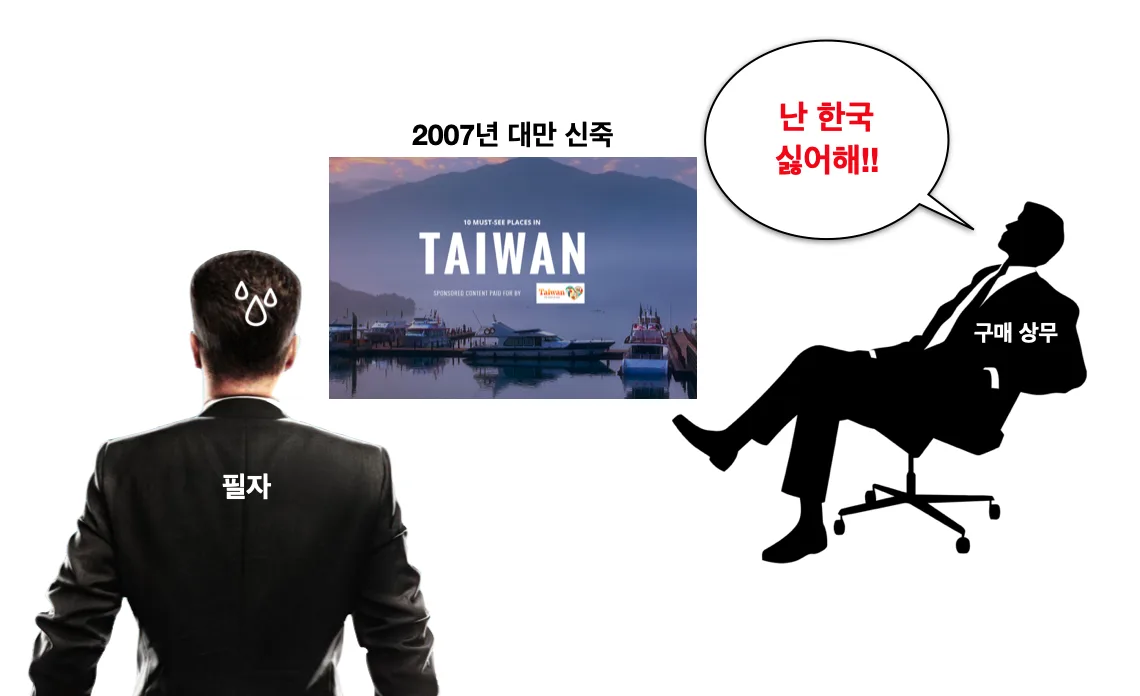
That is what we call 'personal perception.' People differ in their perceptions and leanings on politics, human rights, corruption, community, the environment, and many other issues. How would you feel if you faced a situation like this firsthand? Good? Bad? Happy? Sad? While I, in my early 30s, was feeling discouraged, the distributor’s president in his early 50s, who had far more experience, was actually delighted.
"John! (my English name) It’s good that the VP told you to your face that he dislikes Korea. That’s one less uncertainty. What if he hadn’t told you, and then used his influence against us at the decisive moment? I’ll say it again: this is good news. The negotiation will go on. Going after a counterpart who turns you down may even be easier. As a Korean, you focus behind the scenes on the technical issues and communication with the Korean headquarters, and I, a Taiwanese of a similar age, will lead the negotiation up front! Come on, let’s do this."
Just as the distributor’s president said, I stayed behind the scenes and focused on technical issues and communication with our Korean headquarters, while the distributor’s president led the negotiation. We got our opportunity, ran the test successfully, and won entry into the client.
ⓓ Crisis Management Strategy (Accept or Avoid)

When I worked at Hyosung, I heard this from senior colleagues over drinks. When building a bridge, 'Hyundai' learns by trial and error and builds fast; 'Samsung' analyzes everything thoroughly and builds step by step; 'SK' keeps bringing in consultants and just holds meetings; and 'Hyosung' keeps reviewing the project and never actually does it. My seniors were probably venting a little, worn out by endless new-business review meetings.
This is just my personal impression, but every organization has its own atmosphere, don’t you think? The broader 'Hyundai' group feels like a military culture of “make it happen no matter what,” 'Samsung' feels like a machine that runs on top-down command, 'LG' feels like a nice company that values harmony and unity, and 'SK' feels like a place where everyone is a self-assured consultant. Crisis management strategies are probably similar. Will the management, the organization, or one maverick individual in it take the lead and draw up and carry out a strategy that makes full use of the company’s strengths? Or will it be a bloated, bureaucracy-like organization that avoids change and waits for the crisis to hit? In the former case, it will actively embrace machines, equipment, materials, parts, or services from a new supplier with strengths in cost and quality. In the latter case, nobody will want to take responsibility for letting a new supplier in. With everyone trying to share the blame, the approval and review chains drag on, and the best timing passes.
To be continued