What is B2G marketing? B2G stands for Business to Government: marketing aimed at the government. You might simply picture supplying computers or desks to the government through the Public Procurement Service or KONEPS, but the scope is very wide: central and local governments, government agencies, public institutions, state-owned enterprises, government-invested bodies, daycare centers, kindergartens, elementary, middle and high schools, universities, contracted training institutions, government organizations, and international organizations. The parties involved are just as many and varied: service providers, subcontractors, outsourced vendors, public officials in charge, consulting firms, lobbyists, and more.
Let me use my own training business as an example. Say I recruit individual students for a “digital marketing” course through my own channels (website, blog, Facebook, Instagram, YouTube), charge KRW 10,000 (≈ US$7) per person, and teach a class of 100. That is B2C, business-to-consumer, training. Now suppose an assistant manager on Company A’s HR and training team sends me a KakaoTalk message, checks my fee, and commissions a 2-hour “B2B marketing” session for KRW 1.2 million (≈ US$900). The participants are pure users who don’t pay me anything, the assistant manager is the initiator, and the HR team leader who gives the final approval is the decider. That is a typical B2B, business-to-business, training engagement. When a training manager at XX Corporation or ZZ Agency contacts me directly for a session for public officials, that is naturally B2G training. But suppose a manager at QQ University, which operates the Daegu Youth Startup Academy, asks me to teach “digital marketing” to young entrepreneurs in the Daegu area. The participants don’t pay, yet they feel obliged to attend because they must complete the training to receive marketing support funds. The training budget comes from a government agency, the Korea SMEs and Startups Agency. If a training agent won the commission by selling to the QQ University manager, the agent would take a commission of around 30%. And even at a low fee, if I want to add a public-sector reference to my record, I will make time in a busy schedule to deliver it. That is a good example of B2G, business-to-government.
This is a case I came across in 2014, when I taught a “Startup Marketing” class to undergraduates at Pusan National University.

Team 2, the only all-male team, proposed a 'urinal for women' as its startup idea. Their motivation was sympathy for the women who line up outside restrooms at festivals and big events; they wanted to develop a urinal that would let women go quickly. Like a men’s urinal, it had no partitions, and many units were mounted along a wall so that many women could use them at once, standing with the unit between their legs. When I looked at the faces of the female students listening to the presentation, I saw disgust. ( -.- ) So I said, "Team 2, your users, the women, really don’t like this, you know?" The male student presenting answered confidently, "Professor, that doesn’t matter."
I have summarized that student’s logic in the table below.
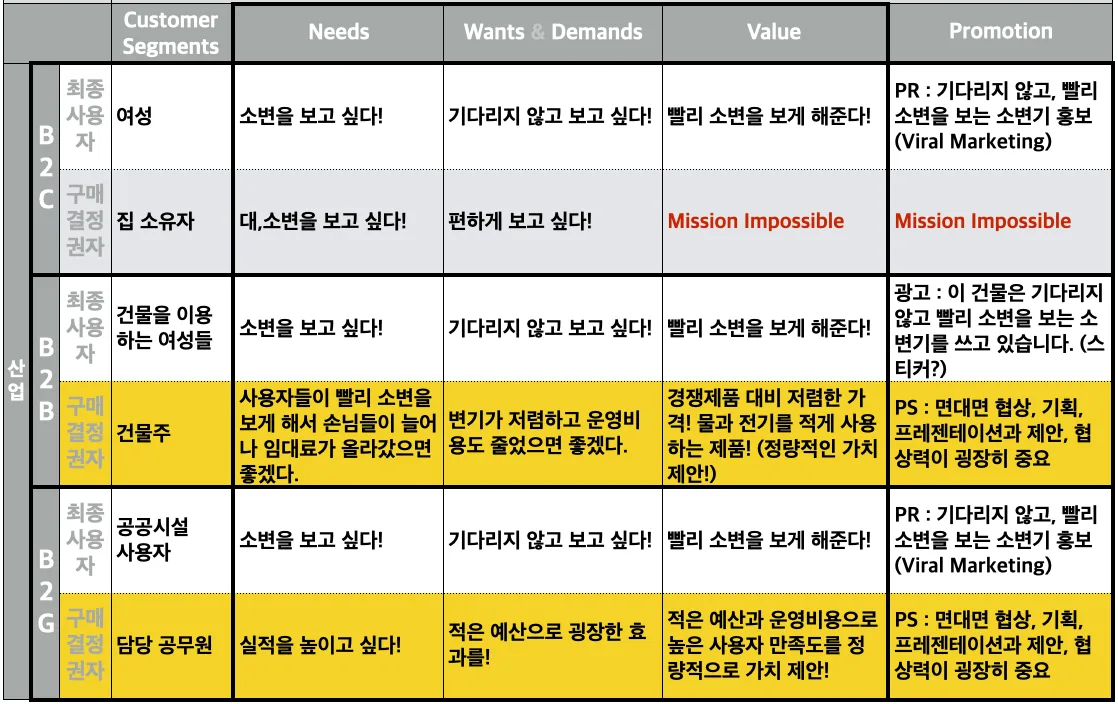
If you market a women’s urinal to the B2C market, the conclusion is that it has no utility, because individual users don’t need it. Nobody lines up for the bathroom at home, and there is no reason to install separate men’s and women’s urinals in a home bathroom. Mission Impossible!! So what if we target the B2B market? In a building with many female visitors, there are never enough restrooms, so women always have to queue. As their frustration grows and visitors leave, the building owner fears a higher vacancy risk and installs this women’s urinal in bulk. The government covers 50% of the cost of replacing existing toilets with it, and because it is an eco-friendly fixture that uses far less water and electricity, the replacement cost can be recovered in 6 months. Satisfaction among the women who actually use it may not be very high, but the owner saves the extra cost of building more restrooms. Now, about that 50% government subsidy: you would need to know the official in charge of that policy, make a policy proposal, and pitch it to get it adopted. That process would be hard, slow, and with no guarantee of success. But once this framework is in place, it effectively blocks new entrants and the women’s urinal takes control of the market. That was the presentation. Is it persuasive? Back in 2014 I found it so entertaining that I discussed it with the students for a long time. It was a lot of fun.
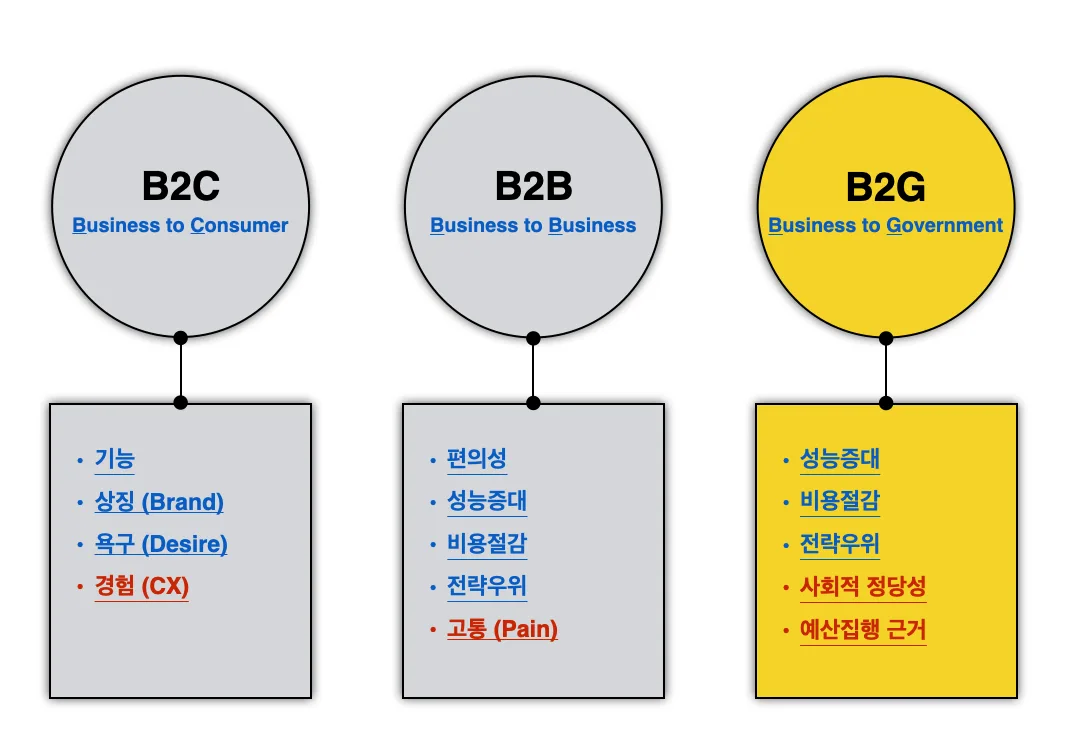
In general, B2G marketing has a lot in common with B2B marketing. But there is one decisive difference: sometimes the government buys even when the product is worse and more expensive. What do you think? You have to separate “developing” countries from “developed” ones. In developing countries, government corruption is rampant, so even a poor, overpriced product may be supplied at a high price to a friend or relative of the official in charge, with a kickback on the side. In developed countries, a government agency can invest in or buy a service or product that offers “social legitimacy.” A country buys its own fighter jets even when they cost more and perform worse than American ones, because domestic production, repair, and upgrades create jobs, attract investment, and advance the nation’s defense technology. That is clear social legitimacy. Selling off prime airports or public enterprises to foreign companies at bargain prices just because of short-term costs would be an act with no social legitimacy. And if Company A is a local social enterprise that hires many women returning to work after a career break and older workers, it is doing work the government should be doing and has social legitimacy, so the government should support it. Because government budgets, meaning our tax money, are being spent, the grounds for spending must be solid. Entrepreneurs who have received government startup funds sometimes complain to me: “Getting government funds at ultra-low interest is great, but it’s hard to actually use them properly. Even for the smallest purchase I need documented grounds, so I can’t spend it.” It can’t be helped. Tax money is involved, so there must be clear grounds for how it is used. Even so, money still leaks away… sigh.
To be continued