
① Sorting out your sales message
This is a story from my own experience, about three years ago, when I was mentoring startups in Daegu. As I recall, the founder was a woman in her 50s, and her startup product was a 'duvet cover'. It had a zipper, so you could change the duvet cover quickly and easily.
“How often do you wash your duvet cover?”
When I ask this in my lectures, some people say once a month, and others say once a quarter. Washing a duvet cover and putting it back on is quite a hassle. You have to tie or button every loop and string between the duvet insert and the cover, then turn it inside out and square up the corners. I’ve done it many times myself, so I know how tedious it is. But what if the time this takes were cut in half and the whole job were much easier? If such a duvet cover existed, who would you sell it to? I ask this question in my lectures a lot, too. The trainees’ answers show which market they’re aiming at.
< Homemaker >
Regardless of gender or age, more than 80% of participants quickly say ‘homemaker’. Then I quote a price twice as high as the existing product. Once people think of themselves as a ‘homemaker’, the number willing to buy drops sharply. They give up on buying. So the conclusion is that a duvet cover you can swap this quickly is not meant for the B2C market of ordinary homemakers, right?
<Hospitality>
When I ask trainees again, “Who will you sell to?”, two or three of them answer lodging. This founder went to lodging businesses in person, interviewed the staff, and even filmed the duvet cover change. The work was more than twice as fast as before. Let’s try this together, as if you, the reader of this book, were in the room. Imagine you are a lodging employee. There is a duvet cover that makes your work twice as fast, with no hassle. Do you like it, or not? When I ask learners in online and offline classes, the response is immediate. Over 90% say they like it. The expressions of the under-10% become subtle. Then I pause for a moment and ask them to think again, and people’s faces change a lot. On the second ask, more than 50% of trainees say they don’t like it, and the faces of the other half who said they liked it start to change too. On the third ask, it flips completely. More than 90% say they don’t like it. Why? If work efficiency really improves sharply, is that good for the real users inside the organization, the employees? If efficiency more than doubles, the number of people doing that work will be cut in half, and each person’s workload will more than double. From the owner’s point of view, productivity and profit go up.
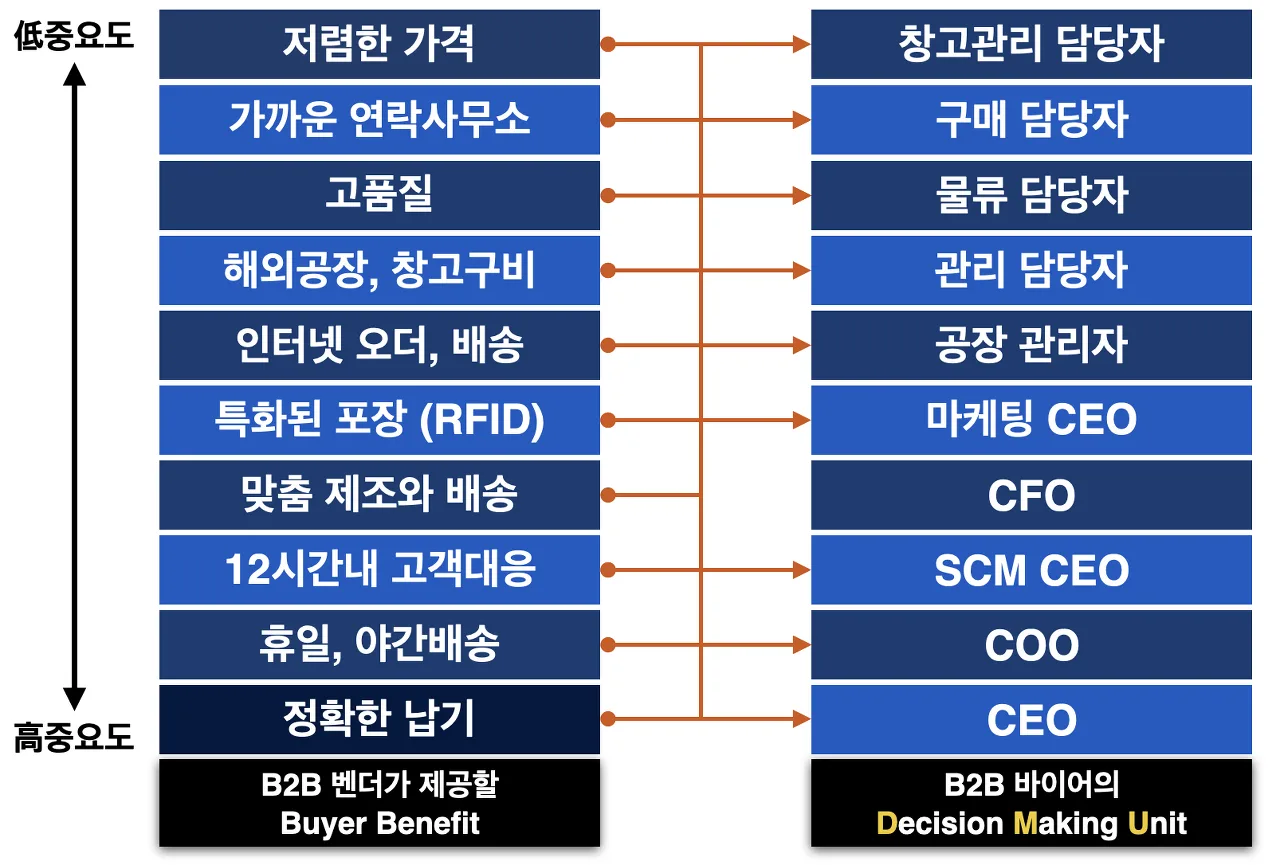
Linking benefits to decision makers
What does “untangling your sales messages” mean? Even inside a vendor or supplier like us, there are many players: salespeople, R&D, production, quality, executives. Each one, from their own position, needs a tactic for which message to bring to which player at the customer (the DMU, or Decision Making Unit). What happens if the vendor’s sales VP meets the customer’s production manager and argues for the need to cut labor costs? What if the vendor’s sales manager (actually an assistant manager) meets the customer’s purchasing manager and has to quickly find the value they truly want: “lower unit prices,” “cost savings,” “shorter lead times”? Put yourself in the purchasing manager’s shoes. Expensive equipment that makes the production team’s work more convenient is less appealing than a product that improves productivity with faster delivery and a lower price, even if the production team is a bit inconvenienced. That would be the best solution for their own promotion and raise, wouldn’t it? What if the vendor’s production engineer or researcher meets the customer’s production manager? What if the vendor’s sales VP (actually a department head) meets the customer’s purchasing manager? What if the vendor’s executive vice president (actually a VP) meets the customer’s purchasing VP? Each position has a message it must deliver, and doing that job well is the basics. Build your tactical plan around who at the vendor takes which value to whom at the customer, and how. This is what I call “untangling sales messages in B2B marketing.”
② Find the Decider

Back to the duvet cover. The woman founder in her 50s had visited lodging businesses, interviewed the staff, and even filmed herself swapping the cover. She got good feedback and was thrilled. But as time passed, none of it turned into a closed sale. Why? Those employees are actually quite likely to be gatekeepers. From their point of view, this duvet cover is a serious threat. So who should hear the message that productivity goes up? The decider. The decider is not a frontline employee or a manager, because their interests are different.
In this case, that would be the lodging owner, right? You need to meet the owner of a motel or hotel and make a proper, quantified value proposition. “Our product cuts your employees’ working time in half, doubling productivity.” A smart lodging owner will quickly see that the bigger the business, the bigger the gain. If 10 employees paid KRW 3 million (≈ US$2,240) a month do the work today, and 5 employees paid KRW 3 million (≈ US$2,240) a month could do the same work, the owner will immediately picture the profit improvement curve. And the cost of replacing the duvet covers? KRW 30 million (≈ US$22,400)! It pays for itself in 2 months. After that, an extra KRW 15 million (≈ US$11,200) in profit keeps building every month. If you were a lodging owner, would you pass up an opportunity like this? Finding the decision maker quickly and giving that person the right value proposition is truly important.
③ Analyze the value chain
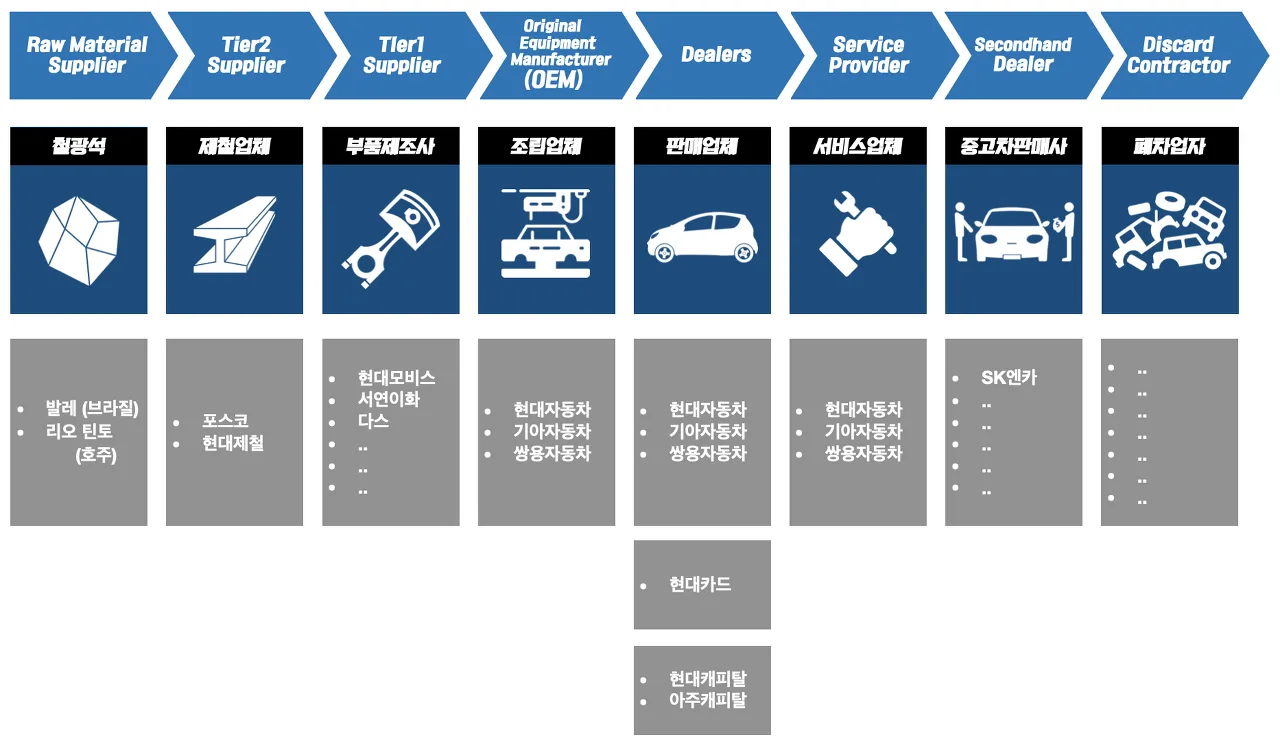
Have you heard of the industry value chain? It breaks production down into steps and shows the series of activities, and the key companies, from raw materials through manufacturing, sales, and service. Take the auto industry. Iron ore goes to a steelmaker and becomes steel plate; the plate goes to a parts maker and becomes auto parts; the parts go to a manufacturer and are assembled into cars; the cars are sold by dealers; when they break down they are repaired by service shops; they are resold by used-car dealers; and finally they are scrapped.
Take ‘Hyundai Motor Group’ as an example. Iron ore is mostly mined in Brazil and Australia and imported into Korea. High-quality steel products such as high-tensile steel sheet come from POSCO, and general products from Hyundai Steel; both are delivered to various vendors for processing. You can also see how much of this value chain the group controls. The ‘Hyundai’ name already shows up at the steel stage (Hyundai Steel), doesn’t it? In parts there is ‘Hyundai Mobis’. In assembly, Hyundai and Kia share platforms and systems to produce efficiently. Unlike Europe and the US, where cars are sold through independent dealers, in Korea each manufacturer sells directly through its own dealerships. Hardly anyone pays for a car entirely in cash, right? This is where finance such as ‘Hyundai Card’ and ‘Hyundai Capital’ steps in. Service runs through manufacturer-owned centers and dealerships, and the hottest segment these days is used cars. Consumer harm from fake listings and forced sales is growing, and Hyundai Motor Group has officially announced its entry into used-car sales. In Japan, Toyota also manages the used-car sales value chain, which has raised overall average prices but greatly improved trust. The final stage is ‘scrapping’.
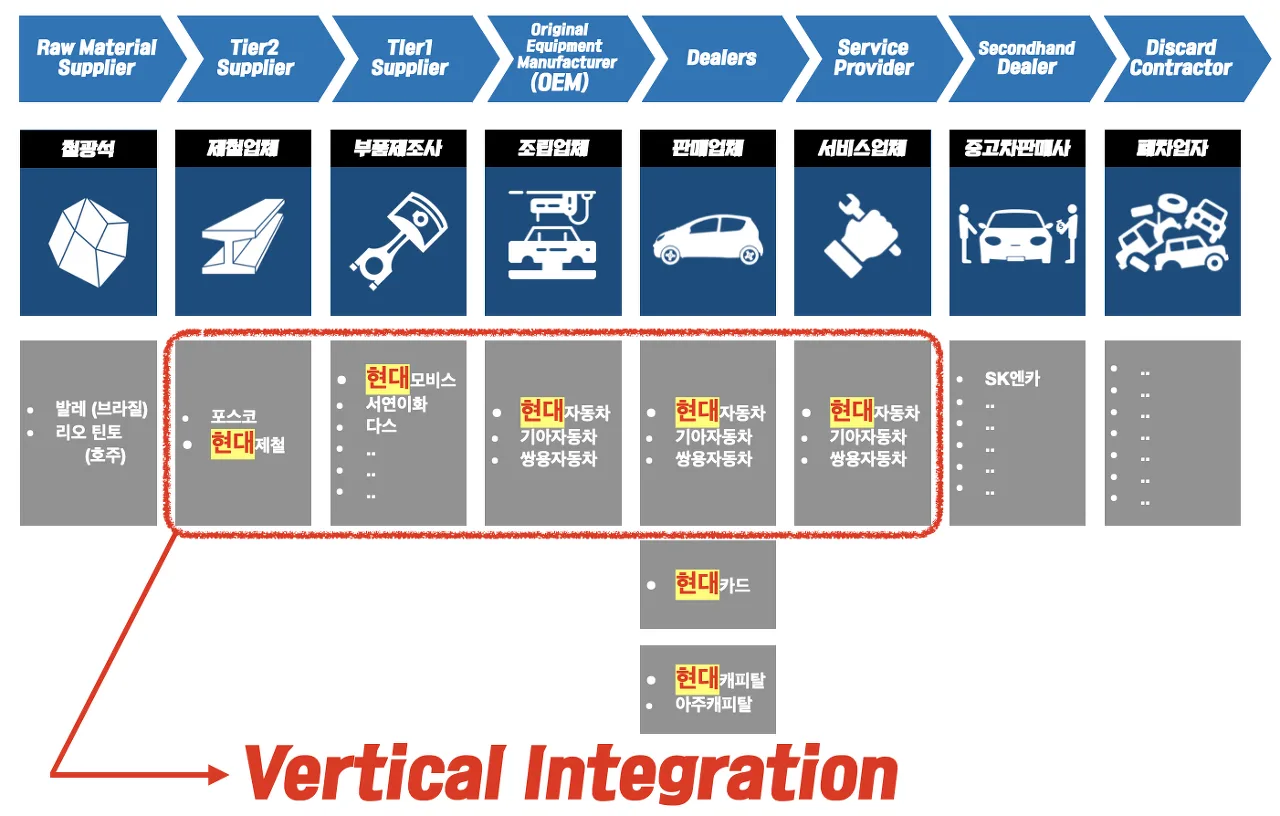
When Hyundai Kia Motors strengthens its influence across the automotive value chain, from steelmaking to parts manufacturing, assembly, logistics, sales, after-sales service and used-car sales, it is called vertical integration.
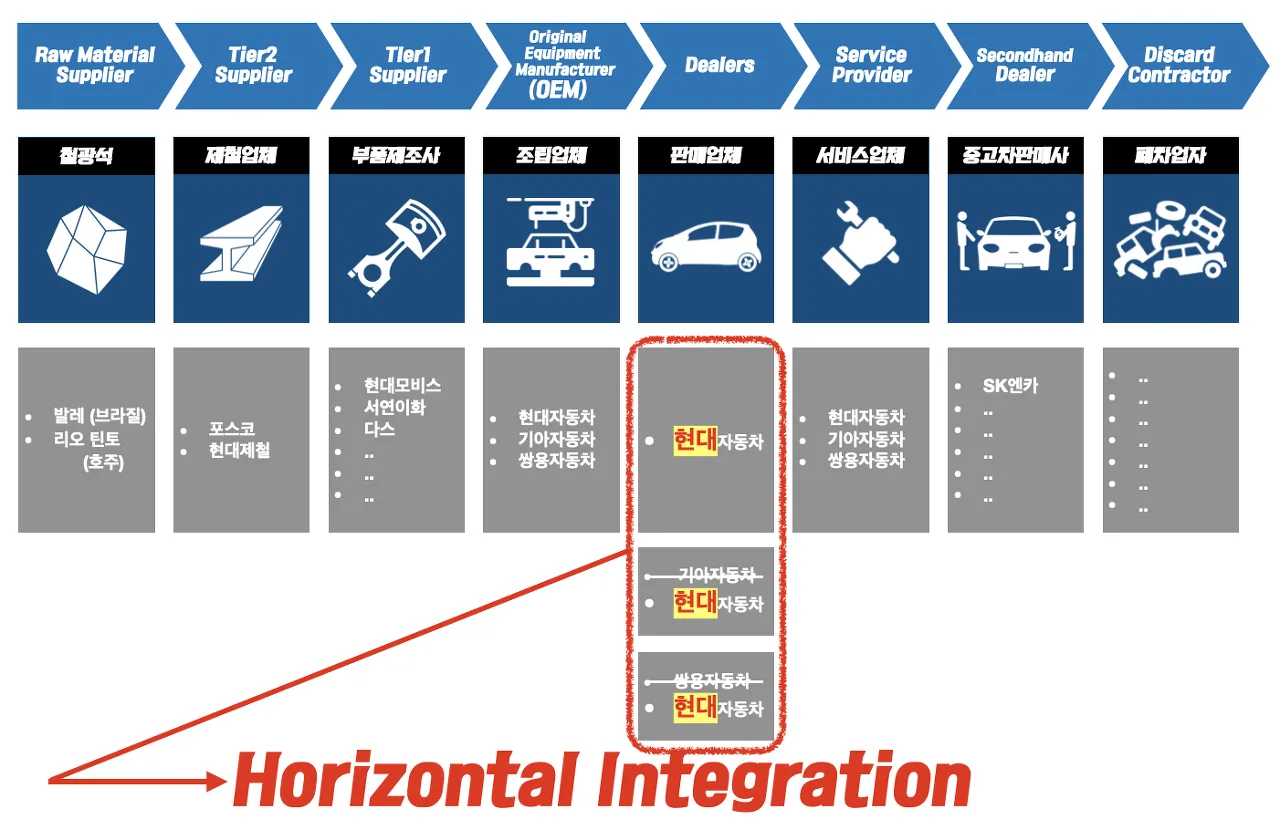
Hyundai Motor’s acquisition of and merger with Kia, creating the Hyundai Kia Motor Group, is “Horizontal Integration.” If a U.S. car dealer sells Hyundai, Kia, Honda, and Toyota together, or if Honda and Suzuki cars are made on a Toyota production line, those could also be examples of “Horizontal Integration.”
Let’s go back to the duvet cover. The founder had picked the right industry, lodging, but was pitching only the staff, so she made no progress. Pitching a lodging owner a value proposition of doubled productivity is one approach. But analyzing the industry’s overall value chain would give you an even better strategy. COVID-19 has hit the sector hard lately, but there are still a great many lodging businesses: hotels, motels, resorts, pensions, campsites, glamping sites, business hotels and more. About 10 years ago I stayed with my family at a country pension. The cleaning was far worse than I had imagined, so I phoned the owner to complain. I still remember the local young guys (tattooed, rough-looking) who then came and cleaned half-heartedly. Today there are plenty of cleaning, housekeeping and property-management companies. Labor is probably the biggest share of their costs, right? The owners of those companies would probably save even more from higher productivity than a lodging owner would, wouldn’t they? They would love it. If you had a list of these companies and a database of their decision makers (name, email, mobile number), you could run all kinds of digital marketing, couldn’t you? If there is a lodging association or a lodging-management association, and it publishes a magazine or newspaper, advertising heavily in that outlet would be efficient, wouldn’t it? And if you learn about the association’s events or seminars, you can attend and sponsor them, and sell and advertise there. I think that may well be the most cost-effective marketing and sales approach.
To be continued