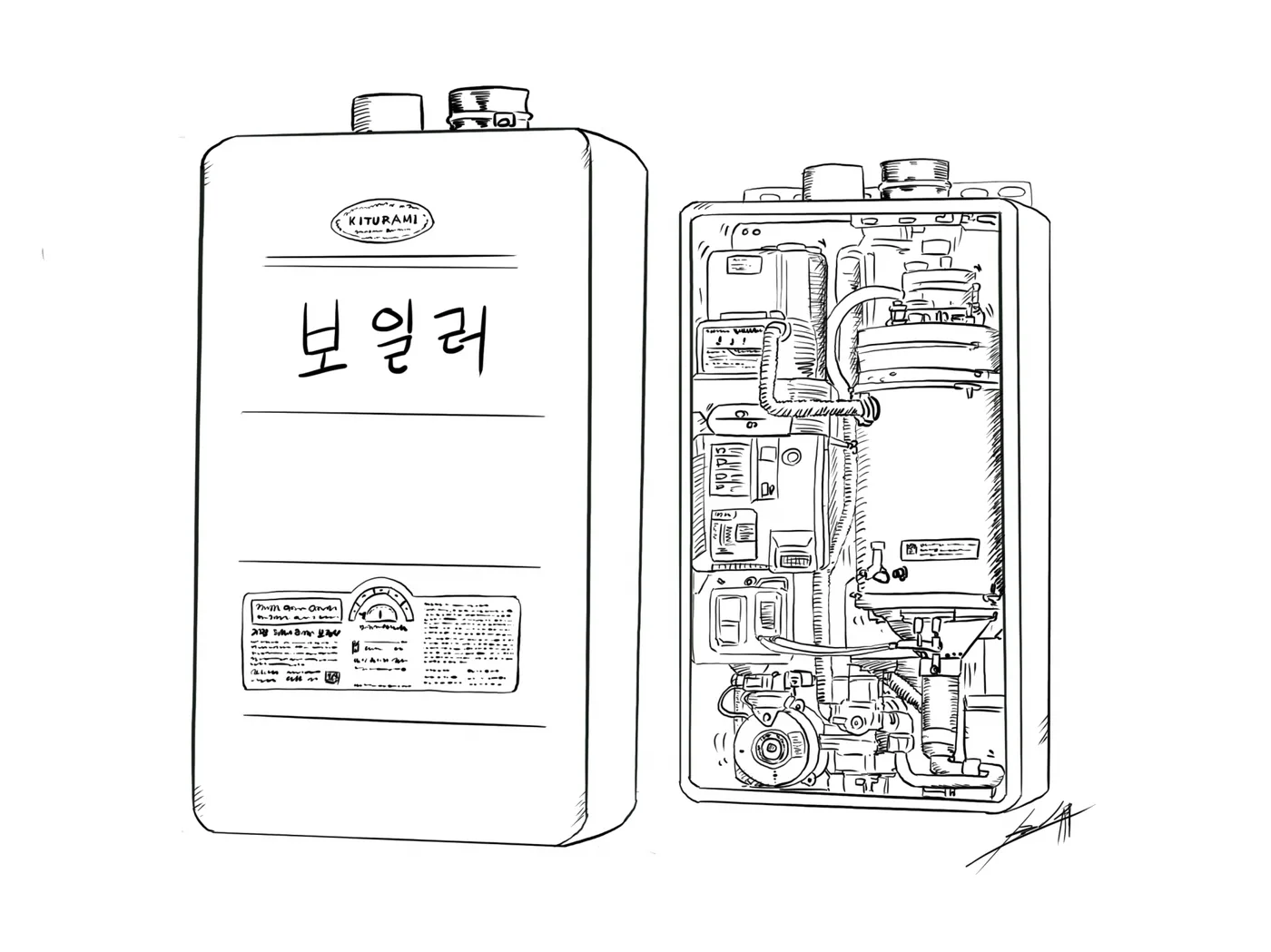
Suppose you, the reader of this book, have quit your job and, due to sudden circumstances, applied for a sales position at a boiler company. At the interview, the company president asks you this question.
“How would you sell as many boilers as possible, as ‘fast’ as possible?"
So in this situation, full of passion, who will you sell boilers to, and how? Will you open a Smart Store, promote through social media marketing, viral marketing, and YouTube, then book a famous celebrity for a TV commercial and lure consumers into buying?
If you came up with a plan like this, think again. In that case, who would end up buying the boilers? Probably many people who are considering replacing theirs, right? Can these buyers truly guarantee ‘fast’ & ‘high volume’? This is the classic B2C marketing approach: spending enormous time, effort, and money to build a brand, open up a market, and create your own distribution network. So what is the way to sell products 'relatively' fast and in volume?
Isn’t that B2B marketing? To complete your special mission, you have to sell boilers in batches of hundreds or thousands. What should you do?
Now, just keep two things in mind for B2B marketing. The first is ‘Industry.’ In which industry is this boiler needed? If you can pin this down clearly, building a sales strategy becomes relatively easy. In which industries are boilers needed in large numbers? ‘Construction,’ of course, right?
Now you need to choose the second dimension: ‘Application.’ Which buildings need boilers? Schools? Office buildings? Factories? These places rely heavily on HVAC systems, so they probably don’t need boilers in bulk, right? Their application is different. Which buildings need boilers in large numbers? That’s right: ‘apartments.’ ‘Apartments’ are exactly where you need to aim to complete your special mission.

Considering the ‘industry’ and ‘application area,’ you've found your target keyword: ‘apartments.’ Next, you have to decide which of the dozens of companies that build apartments to sell to. The bigger the company, the more boilers it can buy. So would you reach your goal by going to the largest construction company, studying its org chart, and contacting someone in the purchasing department?
This one deserves a closer look from several angles. If you were the purchasing manager at Korea's largest construction company, would you have any reason to buy a boiler that has never been proven in the market? Could passion, conviction, and endless effort to earn the buyer's trust really change their mind? Let's drop the fantasy that gets salespeople so excited. We have to start with a cool head.
This is where the 3Cs (Customer, Company, Competitor) come in. To choose a customer, you first need to understand your own company, the boiler maker. Without enough references, you would have to spend a huge amount of time just introducing your company and explaining your product's strengths. But one magic sentence, ‘We already supply boilers to Hyundai Engineering & Construction,’ makes all of that unnecessary. In other words, to decide where to sell, you must first consider your company's size and references. Of course, the bigger the customer, the more boilers you can sell. But before trying to break into a huge customer, analyze and benchmark your competitors, build a track record (references) with smaller construction firms, and generate cash flow. Then use that financial strength to win the big customers over time. Setting these priorities is critically important in B2B marketing. I will explain this in more detail later.
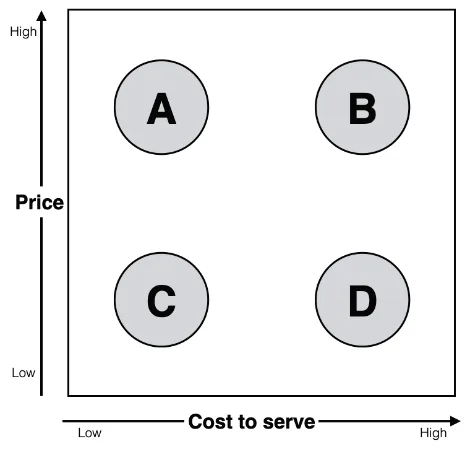
You've chosen your ‘industry’ and ‘application area,’ and you've drawn up a prioritized list of customers your company could realistically go after. Now it's time to decide which companies to target. Should you contact every company on the list? If you had unlimited time and resources, perhaps. Unfortunately, the time and effort you can put in have physical limits.
That's why you have to make decisions that take into account where customers are located and what price they want. Suppose your boiler company is in Daejeon. Two companies have a similar expected win rate, price range, and purchase volume, but one is in Sejong City and the other in Busan. Which should you go after? Without a doubt, the one in Sejong City, because you have to weigh results against the time you invest. The money and time spent traveling to and from Busan for sales calls can't be ignored, so customer location is another factor you should never overlook in B2B marketing.
Readers who have studied marketing beforehand may have noticed that the process we used to choose target clients is related to the STP strategy. STP stands for Segmentation, Targeting, and Positioning, and it is one of the core marketing strategies. There is an interesting marketing term that shows why this strategy became necessary: the ‘China Syndrome.’
When I was posted to China as an expatriate, Koreans who didn't know China well would often say over drinks, ‘China has 1.5 billion people, so if we sold just one KRW 100 (≈ US$1) item to each, we'd make KRW 150 billion (≈ US$112,225,000).’ My Chinese friends at the table would scoff. They said you have to think of China as ‘Europe.’ The ethnic groups differ, and so do the history, the temperament, and even the languages. China is a country where even CCTV needs subtitles. So selling the same product to everyone and hitting the jackpot in one go, they told me, is a mistake.

The illusion that a single cosmetic product can win over every customer, men and women, teens to people in their 60s: this is the China Syndrome. If you have something to sell, you must define exactly who you are selling it to, following the STP strategy. Incidentally, in the U.S., there is also a joke called the ‘China Syndrome’: if a reactor core melts down, it would keep burrowing under the earth’s crust all the way through to China. Both meanings seem to share a sense of absurdity.
Now we need to ask a more fundamental question. Does B2B marketing need advertising? Take some leading Korean B2B companies as examples: Daelim, Hyosung, Iljin, Hyundai Heavy Industries, Samsung Heavy Industries, LG Innotek, Samsung Electro-Mechanics, LS Electric. Have you often seen ads from these companies? Apart from very special cases (corporate advertising, PR), you probably haven't.
That's because B2B marketing doesn't need to advertise to ordinary consumers. (B2B digital marketing, where advertising is needed, will be covered separately.) But something seems off. Think of the boiler example above. It was a B2B-dependent industry, yet don't we all remember the many TV commercials from 2017 and 2018 featuring a singer we rarely see these days?

<Figure 2. 2017 Kiturami Boiler>
That's because industries, markets, and trends are all changing fast. Change that once took 10 years now happens in a year or even six months, and COVID-19 has sped it up further. The boiler market has seen major change too. In the 1980s and 90s, boilers were a product that didn't need advertising. Why? Because apartment builders bought them by the thousands. But as time passed, boilers aged, and replacing them is no longer the builder's responsibility. Individuals have to buy them, and to appeal to those individual buyers, B2C-style marketing became necessary.

Let's switch industries and take ‘tires’ as an example. The structure is similar to boilers. The automotive tire business has two markets. When you buy a new car, it comes with tires already fitted (OE: Original Equipment). A tire company sold those to the carmaker through B2B marketing. But tires are consumables, so they need replacing when they wear out, right? That is a purchase made directly by individuals (RE: Replacement), and it falls under B2C marketing. Recently, as domestic cars move upmarket and consumers demand higher performance, imported tires such as Michelin, Pirelli, and Goodyear are increasingly used as OE on new cars. As production at Hankook, Kumho, and Nexen Tire declines, they will need to devise B2B marketing approaches to turn that around.
In today’s global market, B2B turning into B2C, and the reverse, happens all the time.
To be continued