
In a B2B value proposition, the role of the supplier’s representative is critical. For a truly important key account, for example, an associate on the supplier’s sales team regularly visits and meets with a manager on the client’s purchasing team to understand the client’s needs and situation. That manager works with the purchasing team’s senior manager and with the production and quality contacts, the department head works with the head of purchasing, and the supplier’s CEO might build the relationship over a round of golf with an executive on the client’s purchasing team.
Let me share an overseas case from my own career. Executive A in a client’s purchasing department, whom we had spent years and a great deal of time and money turning into an ally, retired. For the sales team, it was a bolt from the blue. Now put yourself in that executive’s shoes. Having left major corporation B, they still have plenty of expenses. They’d like to start a business or invest, but they’re nervous and have a lot on their mind. That’s when you can propose a business venture with the supplier. If you suggest a distributorship, they probably won’t be keen because of staffing costs and a large upfront investment. So propose a different model: acting as an agent or broker. The supplier handles most of the sales management work, so there’s less hiring burden; goods ship directly from the supplier to the client, so there’s no inventory to manage; and the supplier doesn’t have to worry about a distributor collecting payments, paying only a set commission percentage. From the supplier’s perspective, the best outcome is to use Executive A to quickly turn major corporation B into a directly managed key account, right?

If you are in Executive A’s position, I want to tell you: never trust your supplier completely. Anyone in the middle of a distribution chain must always show a strong reason to exist. You have to make sure no deal can happen without you, right? At the same time, you can set up a warehouse and hire warehouse, sales and after-sales staff to take that hassle and labor cost off the supplier. You can also handle other products to reduce the client’s points of contact, and offer flexible payment methods and cycles. If you make things easier for both sides, you will establish yourself as an irreplaceable sales agent. But don’t let your guard down. You must keep improving your processes and expanding your market to run your own business. Right? I think this holds true in any industry.
Let me explain the gatekeeper in a little more detail.
When I worked at a mid-sized company, a new-account sale to a client was nearing completion. All we needed was the PO (Purchase Order) from the client’s purchasing contact, but the fax never came. Then our sales director asked me, “Kim, did you get the PO from Company C?” I said, “I called, and the contact is on vacation. He says he’ll send it next week and asked us to wait a little.” Company C’s purchasing contact kept making excuses and never issued the PO. The excuses varied: ‘The purchasing team lead is on a business trip abroad,’ ‘The contact is on vacation,’ ‘There’s an important company-wide global meeting.’ If you shrug off a one-week delay, two weeks, three weeks, a month, two months slip by, and at some point you discover the deal has gone to a competitor.
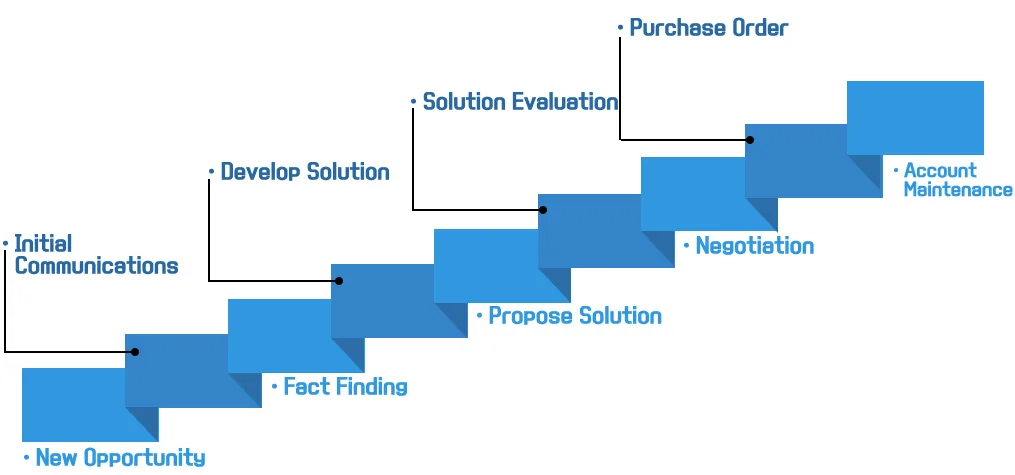
The B2B Marketing and Sales Process
Let’s walk through the B2B marketing and sales process above. New Opportunity – you find new customers through trade shows, advertising, and other channels. Next is Initial Communications – the “cold call” to get a contact’s details and book a meeting. Fact Finding – you confirm the client’s pain points and current situation. Develop Solution – you pool your company’s strengths to develop an alternative product or service. Propose Solution – you present the quote, delivery date, and value proposition by email, in a meeting, or in a presentation. Then comes Solution Evaluation – the client’s feedback arrives, right? Things like “It’s too expensive. Give us a discount. Can you add another feature?” Next is Negotiation – one of the most important skills for a B2B salesperson. You negotiate the key terms, such as supply price and delivery date. After that, you receive the PO (Purchase Order). Many people think the job is done once the PO arrives, but it isn’t. There is a pilot test, with first, second, and third rounds of testing and re-verification, then a mass-production test and an audit of the supplier’s factory. Only after that do you move on to the Account Maintenance stage.
However, the B2B process above seems to contain a hidden step that is never officially mentioned. I can’t say exactly where it falls, but there will always be a counterattack from the incumbent supplier. No salesperson with any sense hands over an account without a fight. Lose an existing account and your boss will be furious right away. In the 1990s and early 2000s, it might even have meant an ashtray flying across the room, right?

So what should you do when a bottleneck forms in B2B sales because the incumbent supplier fights back, or because someone inside the client who is on good terms with that supplier gets in the way? Here is a good example, in two versions.
Example 1. The sales director at our mid-sized manufacturer is a mild-mannered man in his early 50s who spent many years in production and R&D. He asks about the client’s PO, and the manager in charge says, “I called, and the contact is on vacation. He says he’ll send it next week and asked us to wait a little.” The director replies, “Is that so? Let’s wait,” and keeps waiting. And waiting... The opportunity goes to a competitor. The End
Example 2. A department head in his early 50s from a large corporation (likely from a competitor) was passed over for promotion, so he moved to our mid-sized manufacturer and became sales director. He is an aggressive director who has spent most of his career in sales. After asking about the client’s PO, when the manager in charge says, “I called, and the contact is on vacation. He says he’ll send it next week and asked us to wait a little,” his expression changes at once. “Kim, you hear that and you’re still sitting in the office? What are you doing? Get out there now! On your way, tell the production team lead and the R&D lead to come to my office. Go, quickly!” The sales director starts moving fast. He makes calls through multiple channels and gives orders to the sales manager, while the production and R&D leads contact the client’s production and research teams to set up lunches, coffee meetings, client dinners, and golf outings. A day or two later, at an internal sales meeting at 7–8 a.m., the “culprit” emerges: who at the client is obstructing our project? Is it an assistant manager on the purchasing team who delays the PO and gives the competitor time and information to respond? Or someone in production or quality who deliberately delays the test report or quality documents, buying the competitor time to react? That person is the gatekeeper.

Once you’ve found the gatekeeper, you need a response plan fast. Will you persuade a senior person whose interests align with yours to apply pressure, or win the gatekeeper over by whatever means necessary? The details are up to you. Sales is war, isn’t it? If you slip into complacency and zone out, your competitors will take the deal out from under you.
Always stay alert and keep your senses sharp.
To be continued