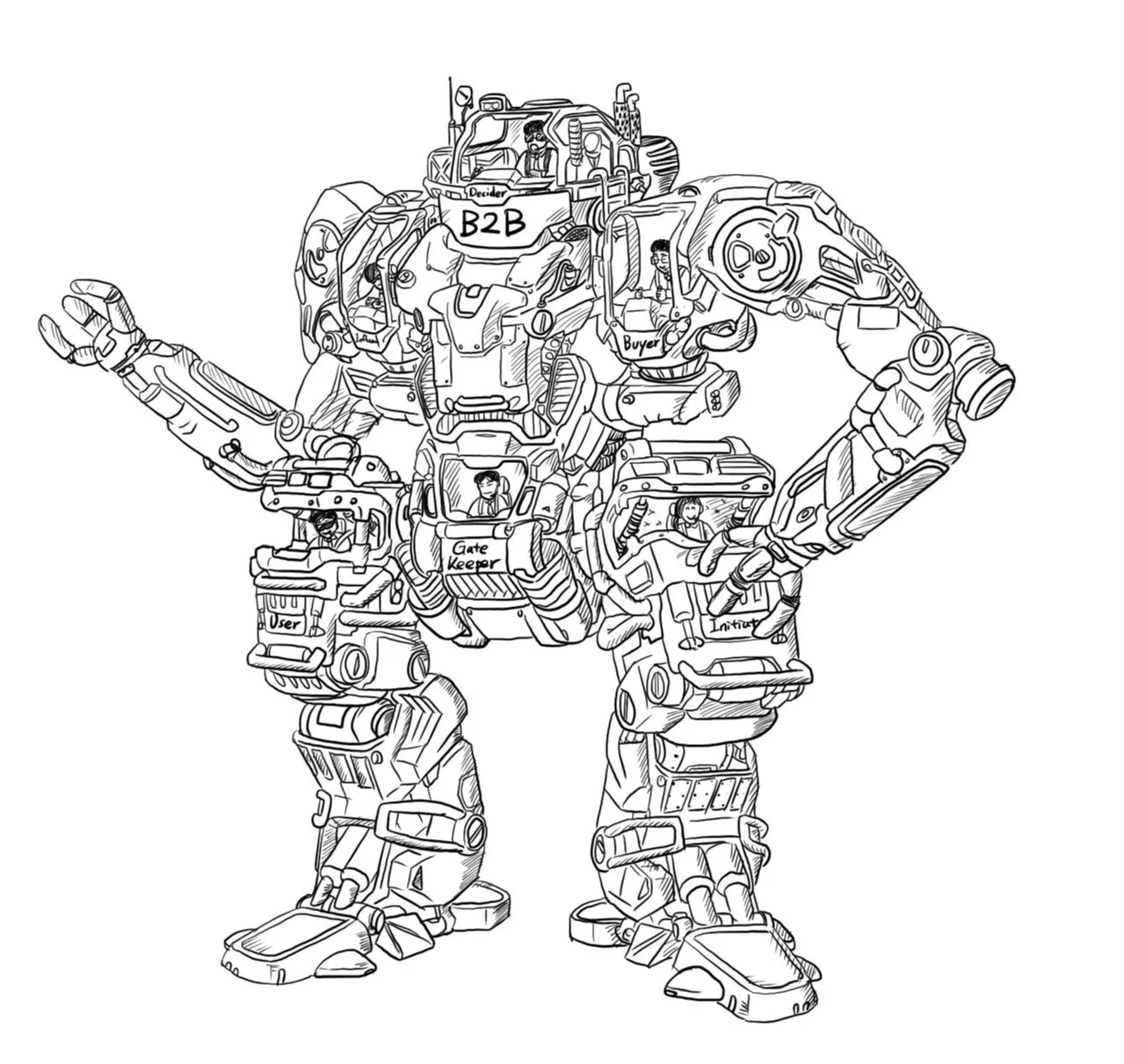
Book cover I drew myself
Every New Year, I make myself a promise.
"This year, I will definitely write a book! No matter what."
That is why I started a Brunch blog, determined to publish a book titled 'B2B Customers Are Combiner Robots' (working title).
In 1998, at 25, just discharged from the military band, I had a deep interest in 'overseas marketing.' In the mid-1990s, anyone who wanted to get into overseas marketing followed a well-worn path: study English and Japanese hard, then work in marketing aimed at the US or Japan. But amid the turmoil around the IMF crisis, I judged that big changes were coming in 'China.'

‘If I can find any opportunity there, I can surely make a living off China for at least 20 years.’ That is what I thought, in my naive young mind.
I recklessly emailed several newspapers in Seoul, visited them, and asked them to invest in me. To the rash proposal of a naive college student in his mid-twenties, the reporters asked me ‘Why?’ When I answered that I would write a serial travelogue from remote regions, they asked ‘How?’ ‘I will take photos with a digital camera and publish them as an online series on your bulletin board.’ In the mid-1990s, that was quite a fresh proposal, and in the end I agreed to publish my travelogue with one newspaper and one magazine.
So I followed the trail of the Romance of the Three Kingdoms across mainland China, a vast land where the energy of change was just stirring, and experienced the country firsthand. But what caught my eye on that long journey was not the continent’s culture, its environment, or its society.

Lhasa, Tibet
It was a cheap KRW 1,000 (≈ US$1) accessory on a street stall in Lhasa, the capital of Tibet.
It was exactly the same accessory that sold for KRW 10,000 (≈ US$7) on the streets of Japan, yet the price was one-tenth! And that was the retail price of KRW 1,000, (≈ US$1) so the wholesale price had to be even lower. I visited the accessory factory and confirmed a wholesale price of just KRW 500 (≈ US$1). Then I set about doing the obvious thing any sensible person would do: buy the accessories wholesale on the spot, take them to Japan, and sell them.
Countless foreign travelers just said, ‘Wow, if we took this back home and sold it, it would be a huge hit,’ and no one ever acted on it. That was when I made a big decision. ‘I’ll give it a try myself.’
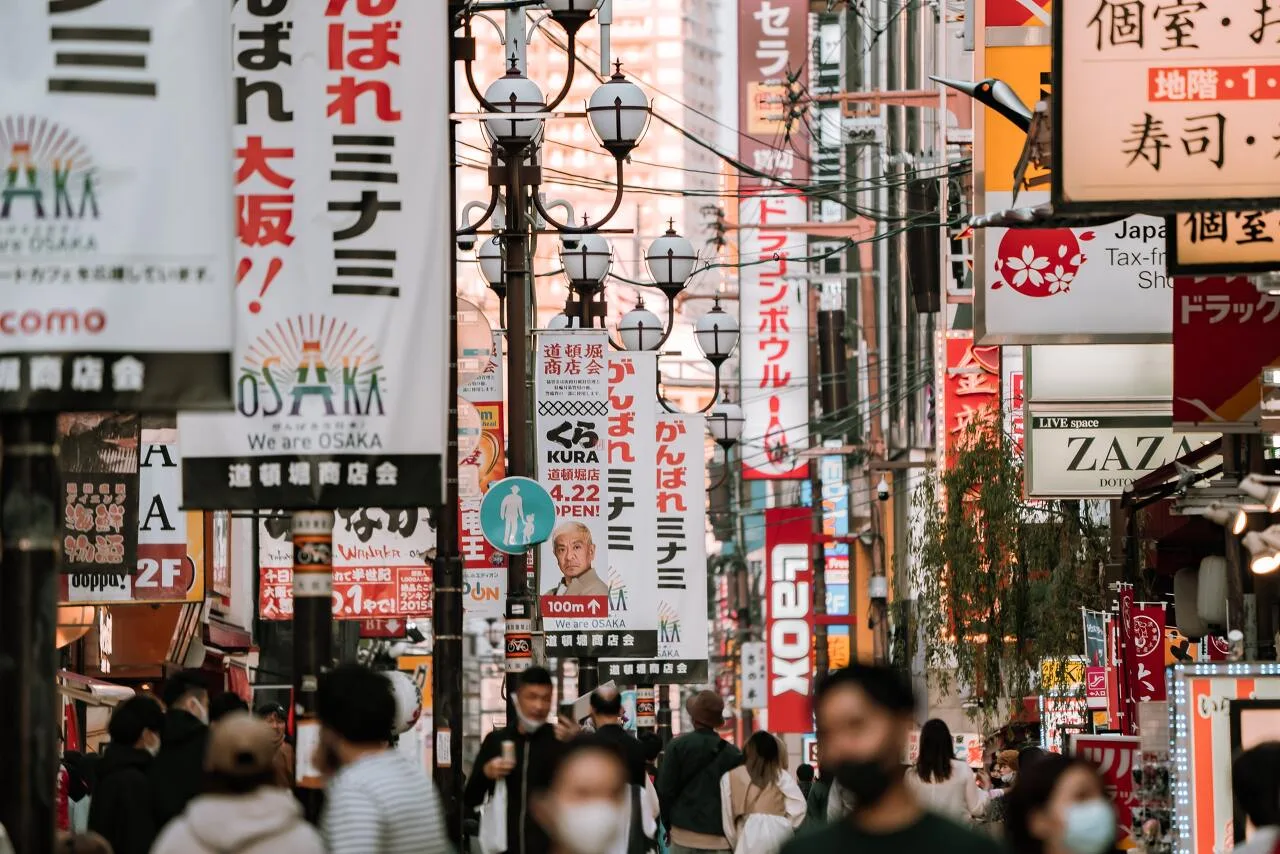
Osaka, Japan
I traveled from Tibet by bus and train through Beijing and Tianjin Port, took a ferry to Kobe, Japan, and set up a street stall in Osaka. There, a foreigner of unknown nationality, dressed in Indian clothes with bleached blond hair, sold accessories. The result was a success. I sold out everything I had brought within a few days, and even after spending freely through the rest of my trip, I still had about KRW 5 million (≈ US$3,740) left in my pocket.
I bought goods abroad and sold them abroad. The sums were small, but through that process I developed a real feel for ‘trade’ and ‘marketing.’ These small but significant experiences made the news, and good opportunities followed one after another. In the end, I ran a company supplying goods from India and Nepal to department stores. But wherever there is a whiff of money, competition arrives. The market gradually turned into a red ocean, and I had no choice but to close the business and look for a job. At the small company that hired me, I took on overseas marketing and sales, and in my early thirties I was even appointed head of its Taiwan branch.
Looking back, I was truly scared. I felt the role I had been given was far too big for my abilities. I searched frantically for books and materials on B2B marketing, but it was really hard to find anything that would actually help in practice, when I had to put it to use starting tomorrow. Most of the materials focused on B2C, aimed at consumers. In the end, I had to dive into the field and learn through plenty of experience and failure.
After a long time, I was fortunate to win TSMC, the world-renowned Taiwanese semiconductor manufacturer, as a new customer while working for a Korean small and mid-sized company. That experience and career gradually opened my eyes to the B2B industry. The biggest lesson from that time was that 'a B2B customer is not a single block.' Even within one company or one organization, needs differ by job function and role, people can be at odds with each other, and their interests can diverge. To me, that reality felt like a robot whose head, two arms, legs, and torso each have a separate cockpit.
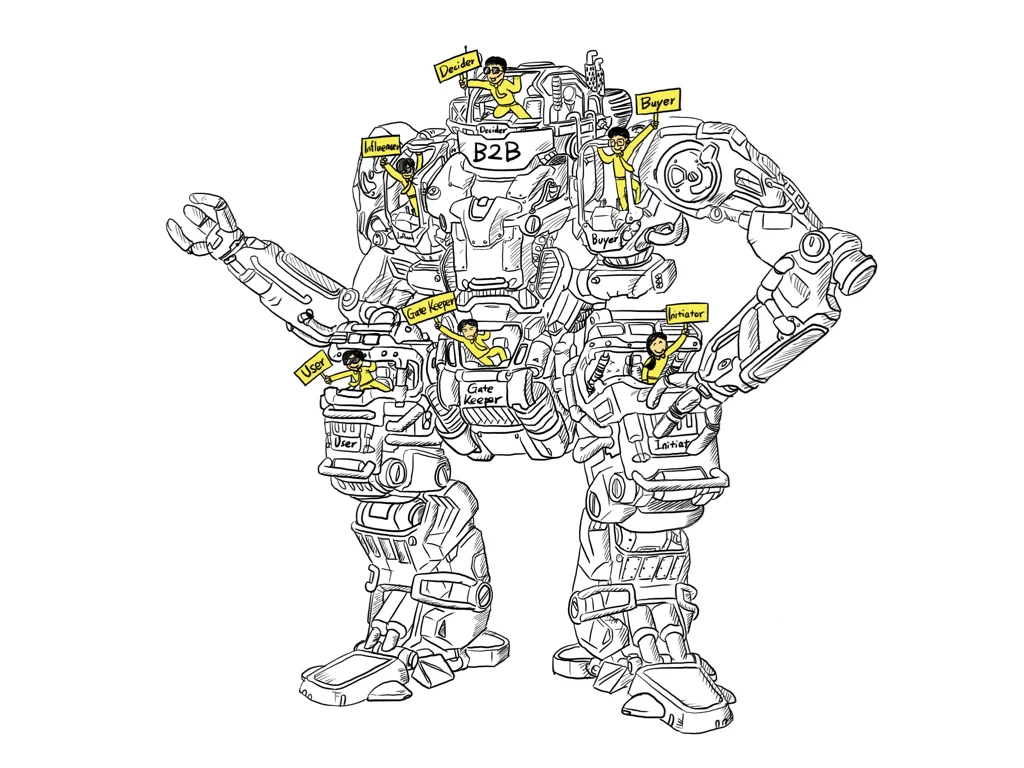 B2B Customers Are Combiner Robots
Since starting my corporate training and consulting business in 2012, I have received countless requests over more than 12 years to teach the fundamentals of B2B marketing. Each time I stood before students in those sessions, I wished for easier materials and training. Even among Japanese books, where this field is well systematized, many were either purely theoretical, textbook-style titles, or books that stressed a sales mindset rather than getting at the essence. So I decided to write a book based on real cases, easier and friendlier, for aspiring professionals on the front line of B2B who have to start hands-on work tomorrow.
To everyone struggling with the vagueness of B2B marketing, I hope this book helps, even a little. Thank you.
Instructor John Kim