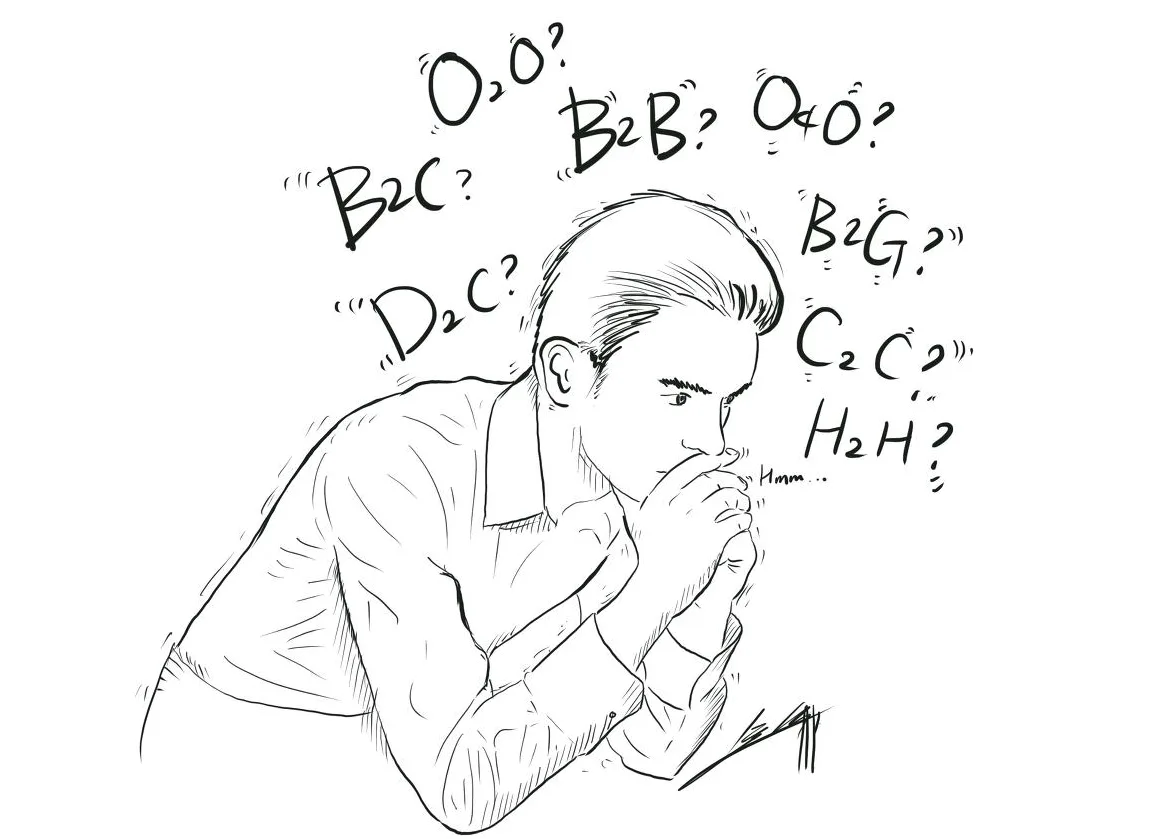
Hand-drawn illustration
1) What is B2C marketing? (Business to Consumer)
It means exactly what it sounds like: marketing aimed at general consumers. Who is the consumer? Think of ourselves, buying and using products and services every day. The wide range of products we browse and buy in everyday life as ordinary consumers are all B2C products.
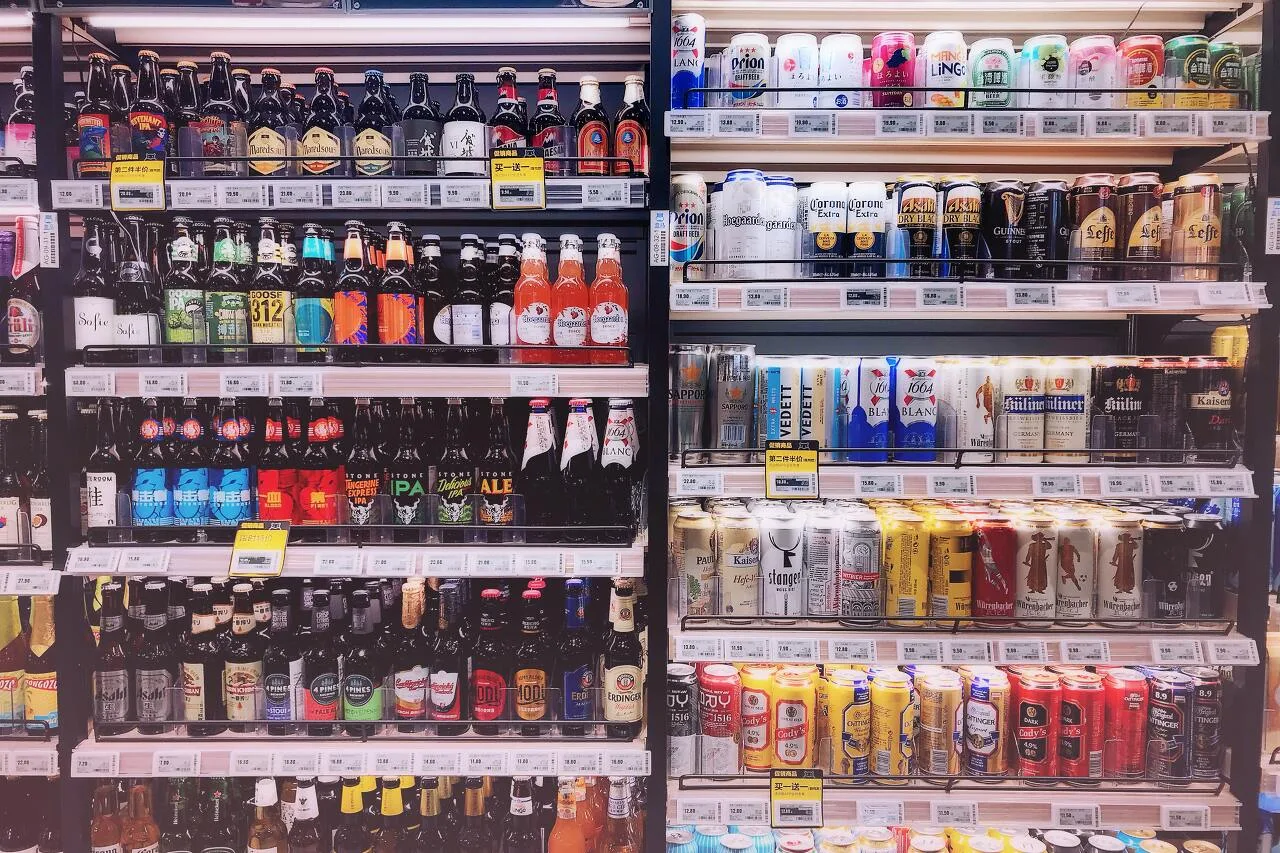
<Photo of a convenience store shelf>
Step into a convenience store and look around. Food, ingredients, drinks, alcohol, household goods: countless products sit on the shelves waiting for consumers. These B2C products are made by the manufacturers themselves, produced under contract as OEM, or made under contract for a private-brand (PB) line developed by a retailer that has grown powerful enough to launch its own. Either way, they reach the end consumer through the offline or online distribution network the company has built or chosen. The consumer then picks the one product they like from the many in front of them. This series of steps is the basic structure of B2C.
2) What is B2B marketing? (Business to Business)
Business to business. We meet trainees who confuse this concept fairly often. The biggest difference between B2C and B2B is that the B2B customer is a company. Organization! Sales, promotion, and marketing are aimed at an organization. B2B is business conducted with organizations such as corporations, factories, and offices.
So in Korea, is there more B2B or more B2C? People tend to assume B2C is larger. In fact, B2B is expected to account for more than 70% of Korea’s industry. There is the “100 million domestic market theory”: for B2C to outgrow B2B, a country needs a home market of at least 100 million people. In the U.S., Japan, and China, large populations give the B2C market economies of scale, and services and products develop in great variety. Korea and Taiwan, however, have markets too small to base economic policy on domestic demand the way Japan does, so they are seen as having developed into B2B-centered export economies.
To understand this structure, rather than just looking at population, we need to understand the “Global Value Chain.”
Global Value Chain (GVC)
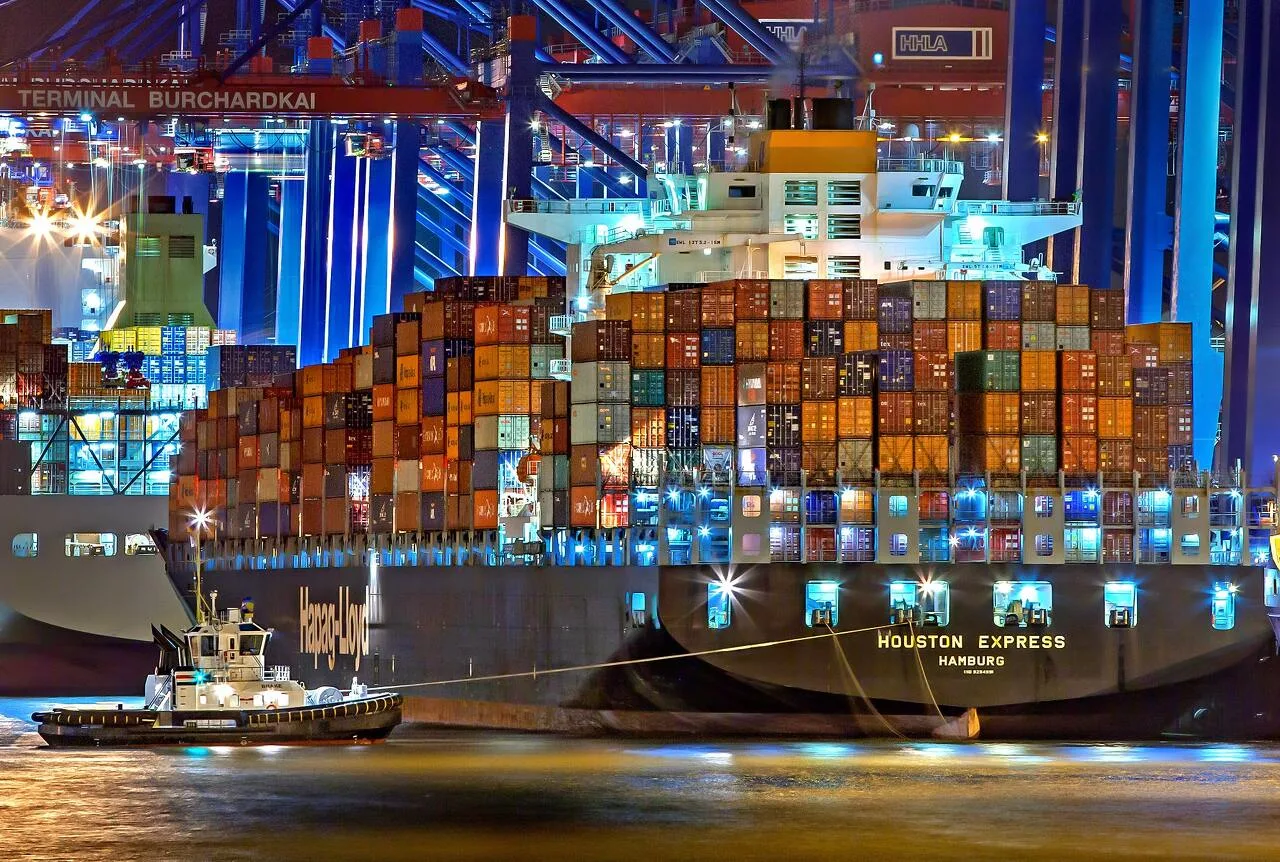
In an age when “global village” sounds hopelessly dated, every modern nation plays its own part. Japan, for example, excels at making cutting-edge materials, components, and equipment, which Koreans call ‘So-bu-jang.’ Think of that as Japan's ‘role.’ Korea uses the precision materials and components made in Japan to produce precision machinery and intermediate parts, then sells them to China. China in turn uses those parts to make ‘consumer goods’ and sells them to the world's biggest markets, the US and Europe.
Within the vast value chain, Korea often sits in the middle. The most representative product is the semiconductors made by Samsung Electronics and SK hynix. So which country has a business model closest to Korea’s? Taiwan. In their role of supplying semiconductors to the value chain, Taiwan’s TSMC and Korea’s Samsung Electronics are competing fiercely in foundry, with enormous investments.
The U.S. wants to reshape this value chain to suit its own aims. By sending intermediate goods made in Korea to Vietnam, Indonesia, India, and elsewhere, it hopes to divert the wealth piling up in China and weaken China’s challenge to U.S. global dominance. China, in turn, is investing in advanced equipment and semiconductor production to defend its position in the global value chain. But government spending without real technology and know-how is producing side effects and pushing China into a tough spot.
The GVC, or global value chain, is not meant merely to diagram a structure. It can be an indicator of macro-level change in the global economy. We should watch changes in the value chain closely and think carefully about who is causing them, why they happen, and what impact they will have.
Now, back to B2B and B2C. B2C is commonly associated with consumer goods, and B2B with industrial and intermediate goods. But don't confuse the two: a consumer product doesn't have to be sold with B2C marketing. Consumer goods can be marketed the B2B way, too.

Here is a simple example. Say you draw groundwater from Jeju Island and bottle it. Must you spend heavily on your own distribution network and TV ads with celebrities to win over consumers? Of course not; that is not the only way. With B2B marketing, you can produce bottled water in bulk and supply the same product to large retailers such as E-Mart and Costco, to be sold under their own brands. In that case, the person you need to persuade is the key decision-maker: the buyer at that retailer. You have to approach it differently from B2C.
The reverse is also true. Suppose you have a forklift that you have always sold through B2B channels. If you sell it only to very large factories and distributors, you use B2B sales and marketing. If you change strategy and sell to individuals as well, you need B2C sales and marketing too. The key difference: even for the same product, marketing to consumers has to appeal to emotion and stir the customer’s desire, while B2B marketing to organizations is more quantitative and dry. You have to win over the person in charge at each buying center with numbers.
What’s more, B2B and B2C can merge and expand. Depending on sales strategy and approach, they can be subdivided further into B2B2B, B2B2C, B2C2B, and so on. Even more transaction types keep emerging, such as D2C (Direct to Consumer), C2C (Consumer to Consumer), C2B (Consumer to Business), G2B (Government to Business), and C2G (Consumer to Government). This may be getting a little dull, so starting with the next installment, I will share examples that feel closer to real life.
Read more about B2G marketing.
To be continued