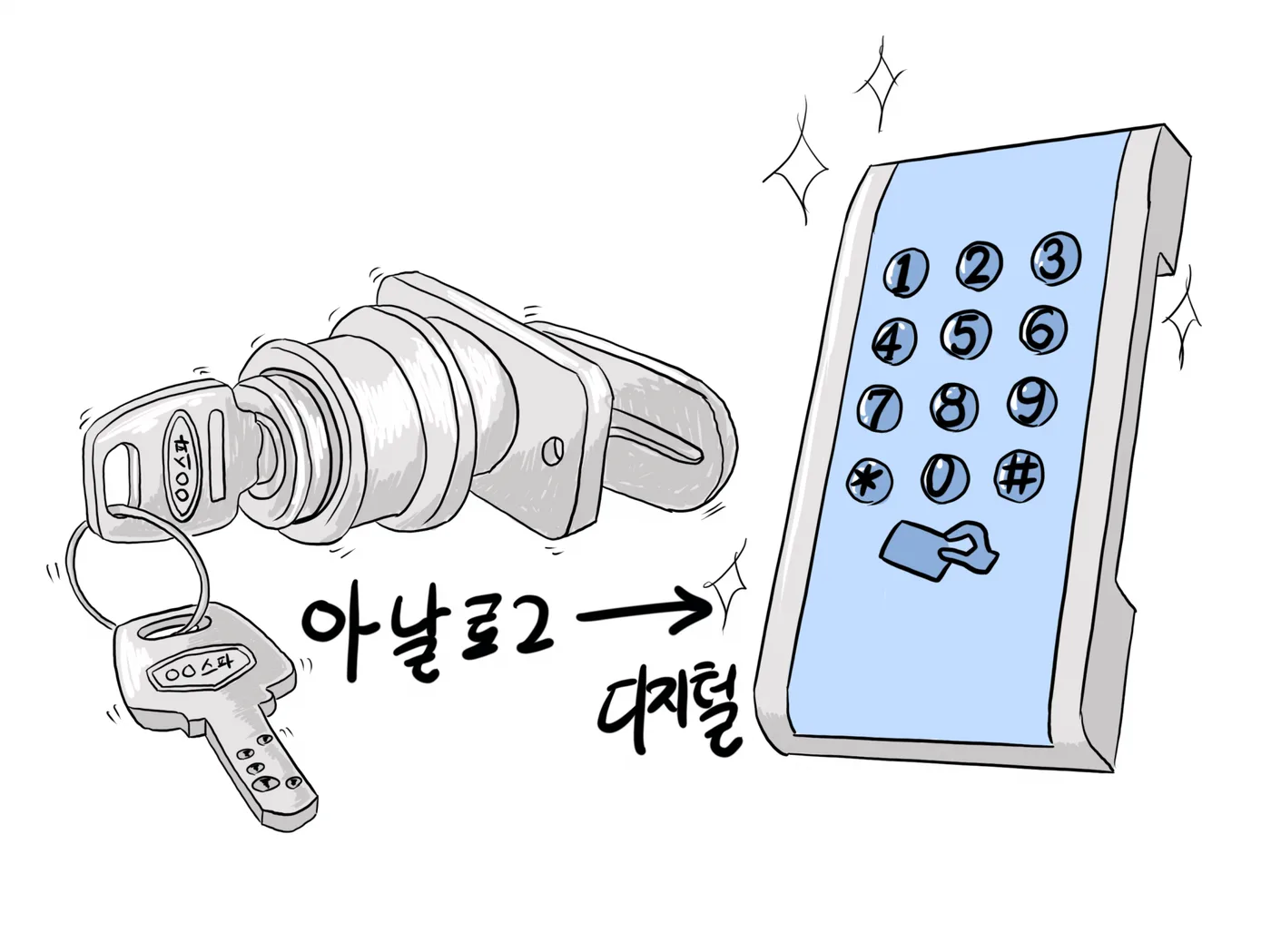
(4) Case: The Locker Key Bundle
① Why sales results don’t come
Eight years ago, I was giving a marketing lecture in the Busan area. I was explaining the B2B marketing value proposition when a man in his mid-50s in the front row groaned and struck his own forehead so hard that I was startled. What I was teaching was the biggest reason a typical salesperson in their 20s or 30s fails to produce results early on in B2B sales.
* Lecture content: When a typical young salesperson in their 20s or 30s starts selling, they tend to look for a Buying Center (point of contact) of similar rank and age, who is relatively easy to approach. If they approach those people with the values they were trained on, such as the product’s strengths, low price, and cost savings, results are slow to come and progress rarely follows. Even if it is hard and uncomfortable, you must find the Decider (decision-maker).
At this point, the man in his mid-50s struck his forehead and exclaimed, “Ah!” His product was a locker ‘key bundle.’ It was not the conventional kind that locks and unlocks with a key, but a single wristband that opens the locker and integrates every payment system. Users wear the band on their wrist, preload a balance, and can open the locker and easily use other services such as the snack bar and massage chairs. To sell it, the owner had hired two young salesmen in their 30s, but a year later they had produced no results at all. He was worried about the constant costs, and during my training that day he found himself striking his forehead without realizing it.

After the training, we spent about an hour over tea discussing the problems with his existing sales approach and how to improve it. We started by asking which application area and which market to enter: a market that uses a lot of lockers, B2B or B2G, right? When a salesman in his 30s from the company visits customers like schools, swimming pools, public baths, saunas, and jjimjilbang (Korean spas), the owner is often not there. What value would he have conveyed to the manager or staff? Let’s think it through.
Value 1: It is automated.
Client employee’s reaction: ‘If this gets automated, won’t I lose my job? -.-’
Value 2: It lowers the risk of loss.
Client employee’s reaction: ‘Passing along a lost phone now and then was a nice little side income… -.-’
Value 3: An integrated system connects with services such as the snack bar and is easy to manage.
Client employee’s reaction: ‘The commission I get from the snack bar owner will be gone, too. -.-’
Would employees like automation, less risk of loss, and an integrated system? According to the owner, who had a lot of experience in the industry, they would not. Automation would lead to staff cuts. He had seen many losses, especially in consultation-heavy settings, caused by employees’ ‘moral hazard.’ And connecting tenants such as snack bars transparently under one system would eliminate the room for side income. So employees would dislike a product like this. They would not want change. Then would those employees actually pass such a product on to the owner? Of course not. It does nothing for their own interests… This was what he had realized. That is why he struck his forehead and cried out without thinking. ‘So that’s why sales didn’t happen for a whole year!!!’
② Elevator Pitch (
In ‘Let’s Sell Semiconductor Equipment ① Buying Center and Pain Points,’ I briefly mentioned the ‘elevator pitch.’ It is the skill of explaining and persuading about your business in a short, simple, and impactful way during the brief time an elevator rises from the first floor to the third. It is a difficult skill, since you must move the other person in about a minute, but it is essential for persuading the decider. You have to deliver a briefing that meets all of these conditions within one minute. Without thorough preparation and steady practice, you may stammer with a flushed face, not even sure what you are saying, and waste a precious minute that will not come again.
The locker key bundle owner used this ‘elevator pitch’ skill to dramatic effect.

Step 1: List prospects that are close to your own company (Busan), could buy a lot of your product, and could serve as references, then pick a target. Here, the target is a large spa company in Daegu. Estimate its size and expected sales volume, and set your value proposition approach
Step 2: Try to meet the owner; visit the company in person
Step 3: Propose an impromptu sales meeting; the other side refuses; ask for “just 10 seconds”
Step 4: Meet in the owner’s office. Asked what he wants to say in 10 seconds, throw out an attention-grabbing Hook (provocatively) “Why do you run your business?” “To make money, right?” “Then why are you running it like this?” (The owner then sent all the staff out and met one-on-one)
Step 5: Briefly explain, with numbers and compared against existing products, how automation, lower risk of loss and an integrated system benefit the owner, so they can see the gain from their own point of view
Step 6: Reference! Explain that another company using our product achieved OO% cost savings, and that the installation cost of this product is offset after XX months
Step 7: The owner concludes there is no reason not to adopt it if it works as described
Step 8: Receive a sample, have the client’s manager check it, and if there are no problems, order full rollout
Step 9: Quickly ship a sample, install it, then write and submit a report
Step 10: Installation complete. Payment collected.
By making full use of the elevator pitch, we wrapped up the project successfully.
To be continued