Leads Are Revenue: B2B Lead-to-Revenue Workshop
Leads aren’t collected, they’re defined and validated — a one-day workshop that turns leads into revenue in 7 steps: definition → target design → sourcing → enrichment → validation → conversion
In B2B, the problem isn’t a lack of leads — it’s a lack of a definition of what a lead is. Without one, marketing and sales blame each other over lead quality, 100 business cards or a purchased list get mistaken for leads, and the hard-won data never turns into revenue. This workshop rebuilds your lead operation as a 7-step system: definition → target design → sourcing → enrichment → validation → conversion. It is not a course where you listen and take home slides. In one day, you build your own company’s lead definition, ICP canvas, 12-field schema, sourcing strategy, validation rules, and scoring criteria. It is built around the B2B Buying Center and long purchase cycles, with a focused approach in which each lead is worth a great deal.
💻 Start learning this topic with an online course →Who is this course for?
Ideal for B2B marketing, sales, and business development managers, RevOps and growth managers, and practitioners who run a CRM or lead database. Especially recommended for teams with plenty of leads that don’t convert to revenue, and organizations where marketing and sales disagree over lead quality.
What will you learn?
- Define the three minimum requirements of a lead (identifiable, reachable, has a problem) and the Suspect-to-Opportunity spectrum to fit your own company
- Design a 12-field standard lead schema and an ICP (Ideal Customer Profile) to set a common baseline for sourcing, enrichment, validation, and conversion
- Build a system that converts leads into real sales opportunities with an enrichment waterfall, verification rules, lead scoring, and MQL/SQL criteria
Curriculum
- Three misconceptions about leads (a business card is a lead, a purchased list is a lead, a content download signals buying intent) and the three minimum requirements for a lead
- The five-stage lead spectrum (Suspect, Lead, MQL, SQL, Opportunity) and the key boundary between Suspect and Lead
- How B2B and B2C lead structures differ: the Buying Center (5–11 people), long buying cycles, a small set of high-value targets, and core KPIs
- Firmographics and the ICP (Ideal Customer Profile) — the first language for defining Target Accounts
- You can’t fill a basket you haven’t built — why defining the schema comes before sourcing
- Must-Have vs. Nice-to-Have fields — keep the must-haves to five or fewer
- The 12-field standard lead schema (basics, contact, company, targeting, engagement history, lead score)
- Why the business registration number is mandatory: a unique company identifier, duplicate prevention, and the key for linking external data
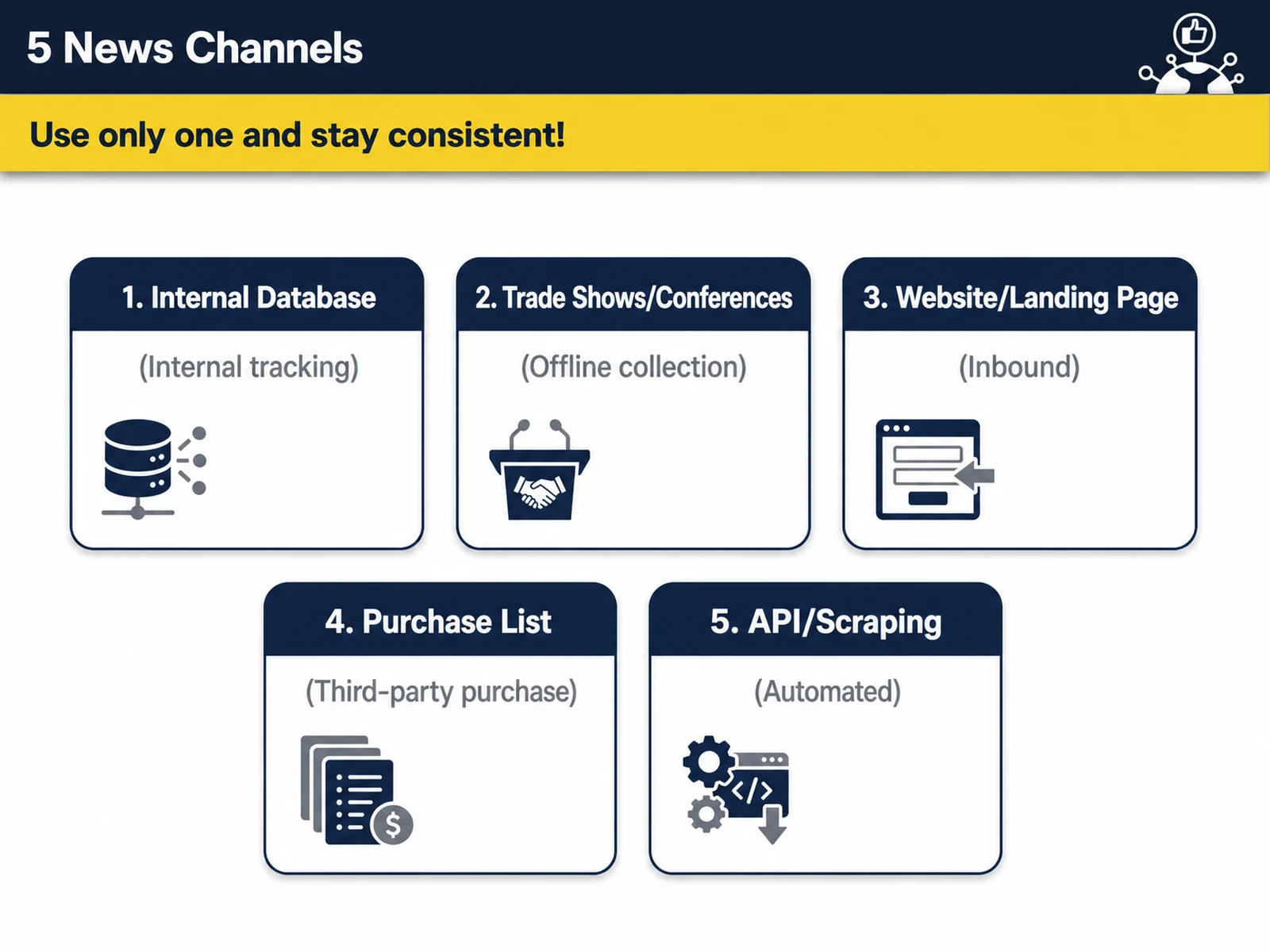
- The 5 core sourcing channels (own database, exhibitions/conferences, web forms/landing pages, purchased lists, API/scraping) and the channel mix
- Start with your own database (dormant customers, forgotten business cards and spreadsheets, past event attendees)
- The risks of purchased lists (unknown sources, stale data, legal exposure) and a legal review under Korean law (Personal Information Protection Act, Information and Communications Network Act)
- Screen leads before you load them: a sourcing checklist and pre-CRM validation
- What is enrichment? The more blank fields, the lower the conversion rate — and invented values are worse
- The 5-step enrichment waterfall — not a single search, but a layered filter applied in order
- Priority order for Korean enrichment sources (business registry data, DART public data, Korean company databases, internal CRM, manual research)
- Three principles of enrichment quality validation (source, freshness, consistency) and how to calculate enrichment ROI
- Data accuracy validation checklist (phone, email, business registration number format and validity)
- Deduplication strategy — the same business registration number means a 100% duplicate; merge with multi-field matching
- Qualification = ICP filtering: not every lead should enter the pipeline
- Verification automation rules (validity, duplicates, score-based) and handling failed leads (hold, re-verify, permanently exclude)
- The 4-stage conversion pipeline (scoring, nurturing, MQL→SQL, sales handoff) and the criteria for each stage
- Lead Scoring: prioritizing with company fit plus behavior scores
- The difference between MQL and SQL (interest vs. intent to buy), confirming BANT, and nurturing leads that aren’t ready yet
- Design the sales handoff protocol, SLA, and conversion KPIs (Lead → MQL → SQL → Opportunity). See where the leaks are and the fix becomes clear
- Each step is connected, not independent — start small, then scale up
- The 3 most common execution failures (starting without a definition, trying to do everything, proceeding without measurement)
- 30-day execution roadmap (Week 1 define → Week 2 source → Week 3 enrich/verify → Week 4 prepare to convert)
- Three things to do today before you leave (write a one-line ICP, pick 5 required fields, count the leads in your own database)
Expected results / After the course
- In one day, you leave with ready-to-use deliverables: a lead definition, ICP canvas, 12-field schema, validation rules, and scoring criteria
- A predictable B2B pipeline where leads turn into revenue instead of sitting in data, plus a 30-day execution roadmap
About the instructor

Related courses
Start with an Online Course
Before you book on-site training, preview the essentials of this topic in an online course.
We tailor this course to your company
From diagnosis to execution — Nanum Consulting
FAQ

Leads Are Revenue: B2B Lead-to-Revenue Workshop
Leads aren’t collected, they’re defined and validated — a one-day workshop that turns leads into revenue in 7 steps: definition → target design → sourcing → enrichment → validation → conversion
- Define the three minimum requirements of a lead (identifiable, reachable, has a problem) and the Suspect-to-Opportunity spectrum to fit your own company
- Design a 12-field standard lead schema and an ICP (Ideal Customer Profile) to set a common baseline for sourcing, enrichment, validation, and conversion
- Build a system that converts leads into real sales opportunities with an enrichment waterfall, verification rules, lead scoring, and MQL/SQL criteria
- In one day, you leave with ready-to-use deliverables: a lead definition, ICP canvas, 12-field schema, validation rules, and scoring criteria
- A predictable B2B pipeline where leads turn into revenue instead of sitting in data, plus a 30-day execution roadmap
- Three misconceptions about leads (a business card is a lead, a purchased list is a lead, a content download signals buying intent) and the three minimum requirements for a lead
- The five-stage lead spectrum (Suspect, Lead, MQL, SQL, Opportunity) and the key boundary between Suspect and Lead
- How B2B and B2C lead structures differ: the Buying Center (5–11 people), long buying cycles, a small set of high-value targets, and core KPIs
- Firmographics and the ICP (Ideal Customer Profile) — the first language for defining Target Accounts
- You can’t fill a basket you haven’t built — why defining the schema comes before sourcing
- Must-Have vs. Nice-to-Have fields — keep the must-haves to five or fewer
- The 12-field standard lead schema (basics, contact, company, targeting, engagement history, lead score)
- Why the business registration number is mandatory: a unique company identifier, duplicate prevention, and the key for linking external data
- The 5 core sourcing channels (own database, exhibitions/conferences, web forms/landing pages, purchased lists, API/scraping) and the channel mix
- Start with your own database (dormant customers, forgotten business cards and spreadsheets, past event attendees)
- The risks of purchased lists (unknown sources, stale data, legal exposure) and a legal review under Korean law (Personal Information Protection Act, Information and Communications Network Act)
- Screen leads before you load them: a sourcing checklist and pre-CRM validation
- What is enrichment? The more blank fields, the lower the conversion rate — and invented values are worse
- The 5-step enrichment waterfall — not a single search, but a layered filter applied in order
- Priority order for Korean enrichment sources (business registry data, DART public data, Korean company databases, internal CRM, manual research)
- Three principles of enrichment quality validation (source, freshness, consistency) and how to calculate enrichment ROI
- Data accuracy validation checklist (phone, email, business registration number format and validity)
- Deduplication strategy — the same business registration number means a 100% duplicate; merge with multi-field matching
- Qualification = ICP filtering: not every lead should enter the pipeline
- Verification automation rules (validity, duplicates, score-based) and handling failed leads (hold, re-verify, permanently exclude)
- The 4-stage conversion pipeline (scoring, nurturing, MQL→SQL, sales handoff) and the criteria for each stage
- Lead Scoring: prioritizing with company fit plus behavior scores
- The difference between MQL and SQL (interest vs. intent to buy), confirming BANT, and nurturing leads that aren’t ready yet
- Design the sales handoff protocol, SLA, and conversion KPIs (Lead → MQL → SQL → Opportunity). See where the leaks are and the fix becomes clear
- Each step is connected, not independent — start small, then scale up
- The 3 most common execution failures (starting without a definition, trying to do everything, proceeding without measurement)
- 30-day execution roadmap (Week 1 define → Week 2 source → Week 3 enrich/verify → Week 4 prepare to convert)
- Three things to do today before you leave (write a one-line ICP, pick 5 required fields, count the leads in your own database)