⑤ The buyer's personal characteristics
ⓐ Similarity between buyer and seller
'Similarity between buyer and seller' is what I'm watching most closely in the B2B market these days. I've thought about it for over ten years, yet I never had a case that made it easy to grasp. Lately, though, big changes are happening in B2B. With COVID, 2020, 2021 and 2022 flew by, and changes we hadn't noticed are now coming into view.
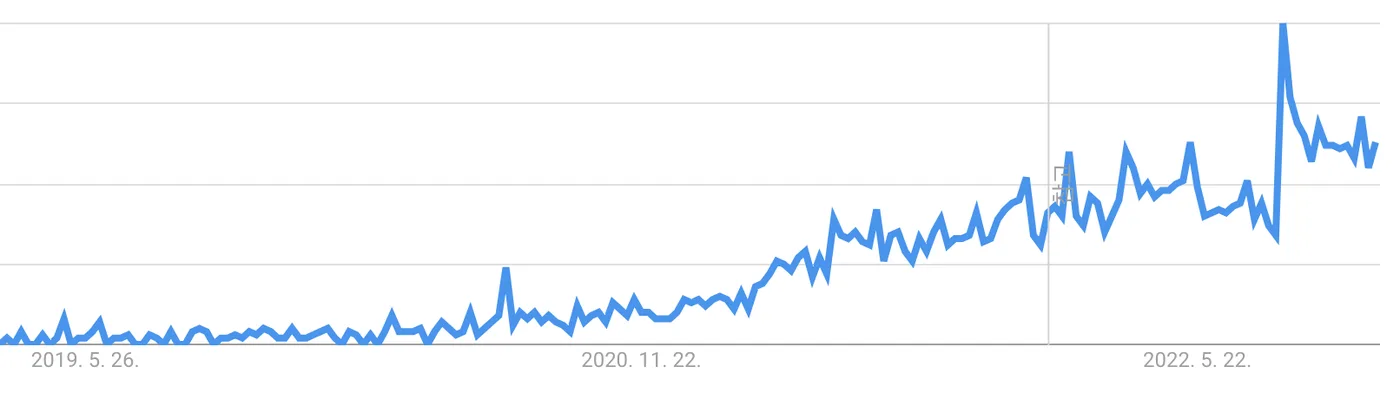
Search volume trend for 'MZ' [ Source: Google Trends ]
Over the past three years, interest in the 'MZ generation' has exploded. It has become the dominant trend in every field: books, publishing, training, and content. Why? One day we looked around and realized they had become the majority. Data shows they now make up more than 60% of the workforce in Korea. As of 2020, they were 58.3% at Samsung Biologics and 50.9% at Samsung Electro-Mechanics. At Samsung Electronics Sales, where I delivered several rounds of 'Understanding the MZ Generation' training for store managers, I also heard from people on the ground that they have passed 60%. Why has their share grown, and why are they taking center stage?
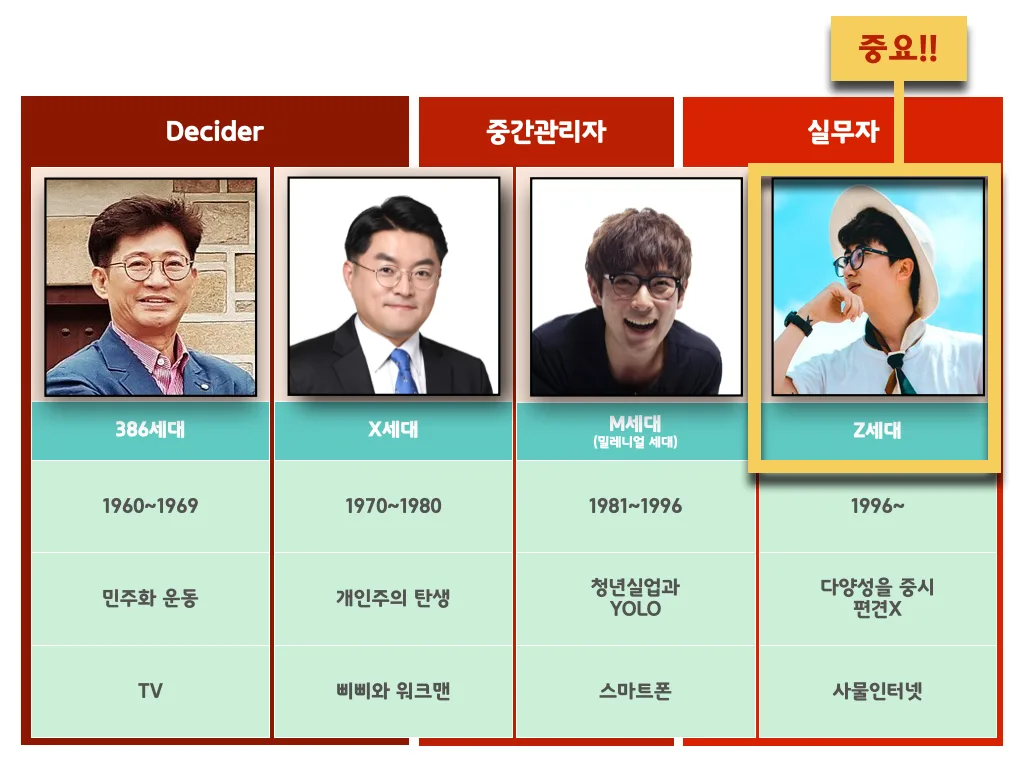
Generational Shift
I was born in 1974, a member of 'Generation X', and in 2023 I'll be approaching fifty, the age of 'knowing heaven's will'. If you're reading this as an office worker in 2022, look around you. How have the generational proportions changed? The 'industrialization generation', born 1940–1954, is hard to find unless you work for a company owner, since those born in 1954 are already 69 in 2022. The 'baby boomers', born 1955–1963, are in the same position: those born in 1963 are 60 in 2022, so you rarely see them in regular positions. What about the '386 generation', born 1960–1969? Someone born in 1969 is 54 in 2022. Do you see many around you? And at what age do office workers feel they have to retire? 53.8 at public enterprises, 51.7 at small and mid-sized companies, and 49.5 at large corporations. The pressure to retire probably intensifies around age 50. Most of the 386-generation seniors and relatives around me have already retired. Then what about 'Generation X', born 1970–1980? In 2022 they are 43 to 53, and most are likely decision-makers: department heads, executives and business owners. The 'M generation', born 1981–1996, is 27 to 42 in 2022. 'Generation Z' is younger still. Lumping everyone from their early 20s to early 40s into one 'MZ generation' seems misleading, because people in their early 40s share a great deal with Generation X. That's why I'm paying attention to the 'M generation' aged 27 and under.
I work in corporate training. Which department at a company is my counterpart? The 'HR and training team'. And who on that team do I talk with most often? A senior executive in their early 50s? A team leader in their mid-40s? An assistant manager or manager in their early-to-mid 30s? An associate in their mid-to-late 20s? My persona is a woman in her mid-to-late 20s. So I keep thinking about how to make it easiest for them to communicate with me. I always use the "if" conditional: if I were Ms. Lee, a junior employee in my mid-20s...
[ Company A training team, Ms. Lee, age 25 ]
"This morning my team leader told me to draft a B2B marketing training plan for the sales reps who have been struggling to execute our strategy. The instructor from our previous training vendor was boring, used outdated examples, and got poor ratings. I doubted the higher-ups could come up with a fresh training plan, so I started searching on Google myself. I searched 'B2B marketing instructor' and a YouTube video came up first. I went to the 'B2B Marketing Instructor John Kim' YouTube channel and found a large number of well-organized videos, updated regularly, with more than 13,000 subscribers. I clicked the channel link to reach the website. Below a stylish theme song and video, 'Featured Training Reviews' were updating in real time, so I filtered for B2B marketing sessions only, and I also checked the client references to see training for companies in similar fields. The marketing articles and live schedule were a fresh touch too. I clicked the 'Channel Talk' button at the bottom right and asked about 'B2B marketing training hours, schedule, and fees.' I got a reply within 3 minutes. I liked that I could see the curriculum on the web right away instead of waiting for someone to write it up and email it. I could also look it up easily on my smartphone while on the move. I sent the approval request to my team leader right away and signed the contract with John Kim immediately through 'Modusign.' I was happy to leave work early. John Kim seems to be in his mid-40s, yet he is so digitally savvy and quick to work with. I will keep working with him."
I wrote the passage above by imagining myself as Ms. Lee, a 25-year-old assistant manager. In reality, I get many messages through our website all the time, even in the middle of lectures and consulting. The people who write in share some traits. They don't readily give their name, personal details, or company information. And they want a fast reply. If I don't respond within 5 minutes, they say, 'Oh, you must be busy. I'll contact you again later,' and the training opportunity often goes to another instructor or company. They also prefer whatever is most convenient for them. Like everyone, they'd rather not wait, and would rather communicate through the smartphone apps, YouTube, messengers, and chat tools they already use every day. So I defined the communication traits of my persona, a Gen Z woman, as 'anonymity,' 'real time,' and 'convenience.'

Now consider the opposite case. You search on Naver instead of Google and land on a website on your smartphone that isn't responsive. You try to enlarge it by pinching with your thumb and index finger, but it's not easy. Or you sit at your office desk and open it in Chrome, and it loads slowly. It's agonizing. When you finally get in, the images don't display properly, and the news and information are 4 to 5 years old.
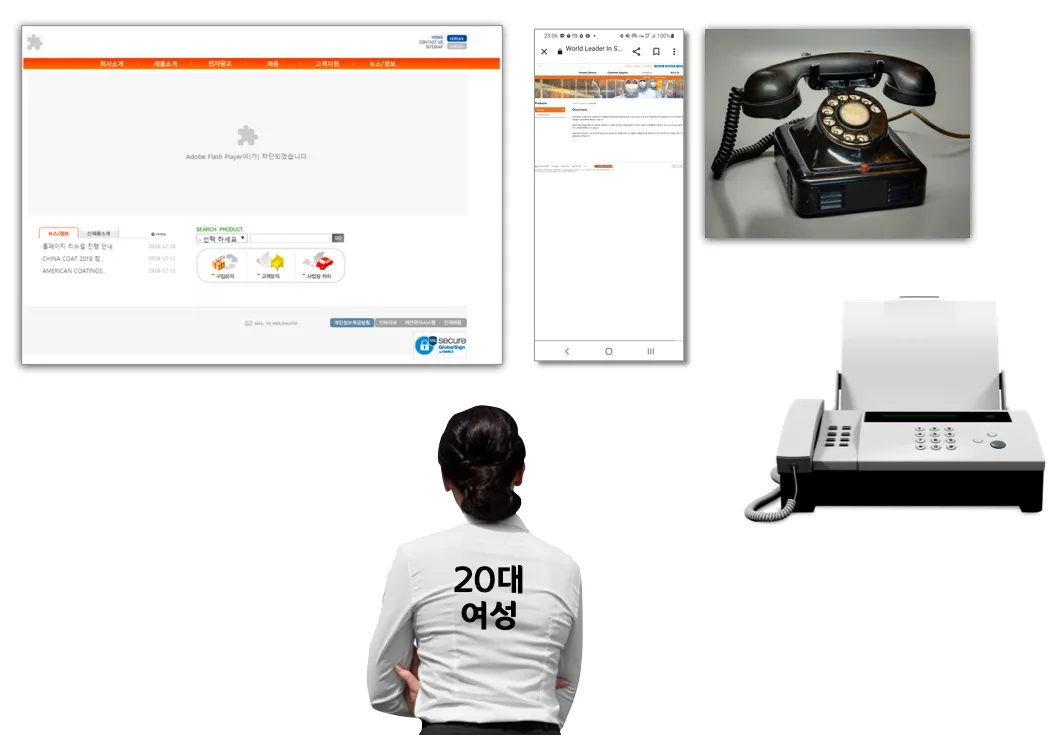
Faced with a website like this, they will wonder whether it is worth the effort to keep looking. Most Gen Z visitors will get annoyed and close it. That is why a homepage matters in B2B too. It is also why you need a responsive site: one that lets people reach it on a smartphone and find what they need in a few thumb swipes. And if someone does put up with a site like this, they will still have to hunt for an email address or phone number to get in touch.
[ Mr. Park, 26, training associate at Company B ]
"I can overlook the awful website, but calling felt like a burden, so I sent an email. No reply all day. I asked around, got the contact's mobile number and sent a KakaoTalk message. Hours of total silence. Four hours later, an unknown number calls, and it's that person. Ugh. I messaged because I didn't want to call, so why call anyway? The voice sounds a bit annoyed and lifeless. This place won't work. It feels like a gathering of old-school bosses. Working with this company would be hard on me. I'd leave late, and every time I send a message they'd call and ramble on about their own side for 10+ minutes, then say they'll fax the paperwork. Sigh... Even if it costs a bit more, I need to find a company that's easier to work with. Is there anywhere like that?"
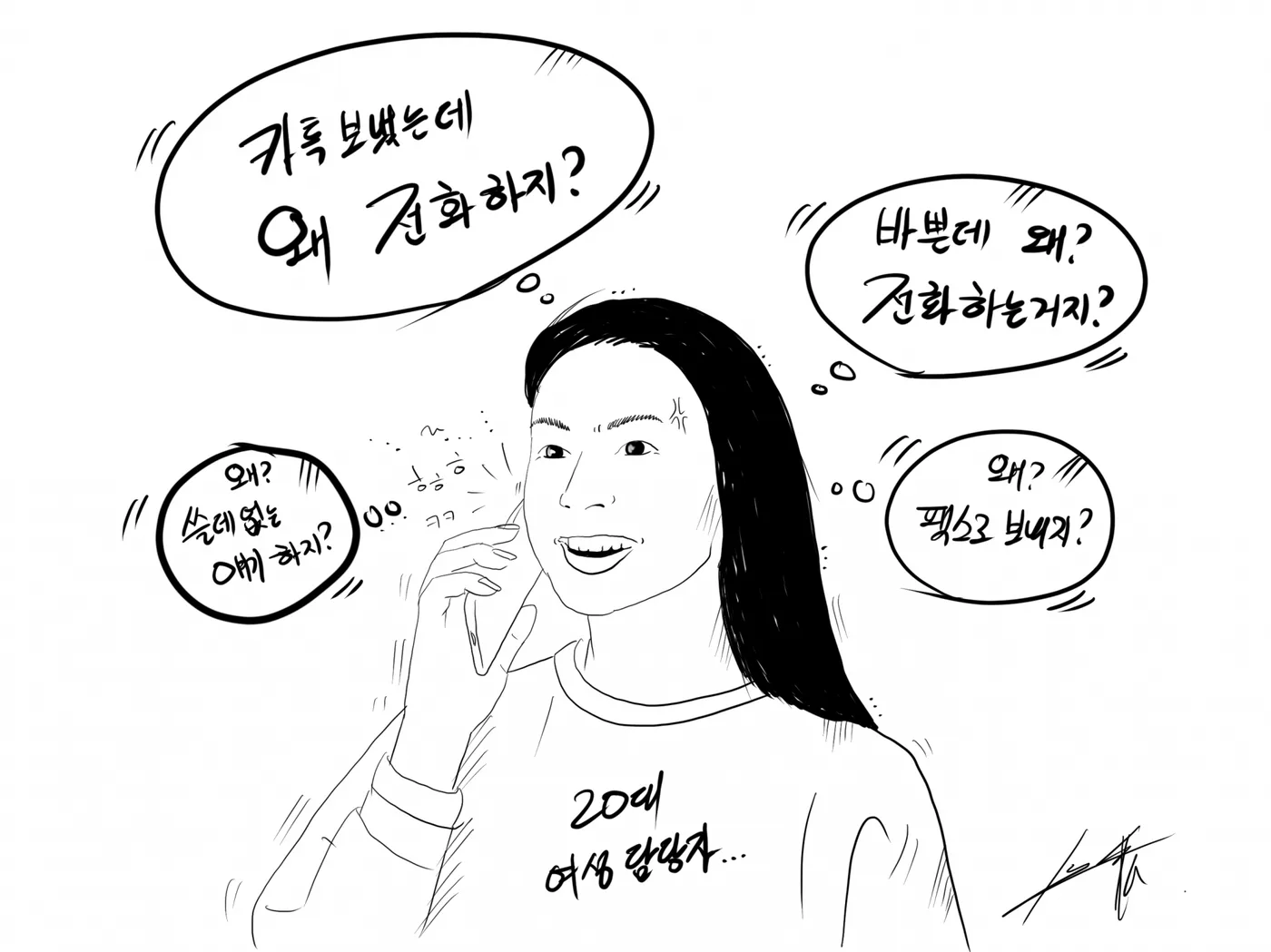
Hand-drawn illustration
That's right: the people doing the day-to-day work at B2B companies have suddenly gotten much younger. Men and women born in the late 1990s are often the working-level contacts. With overseas customers, there is no mandatory military service for men, so they are younger still. What happens if they feel uncomfortable and think a supplier is not like them? What if 'similarity between buyer and seller' is low? The supplier doesn't even get a chance to approach the customer. Even now, in the winter of 2022, many B2B suppliers have no official social media or YouTube channel and nothing but a website styled like the early 2000s. Smaller companies should try even harder, but it seems to take a long time to feel the wave of change.
Under 'similarity between buyer and seller', I've been talking about generation gaps and differences in communication style. Let's look at another case. If you make 'seeds' or 'fertilizer', who is your customer? The intermediate distributors, such as dealers and agrochemical shops, are mostly men in their mid-to-late 50s. But the end users in that value chain, the farmers, are around 70, with varied annual incomes, usually own two vehicles (a small truck and a car), care about health, rice prices and agricultural cooperative elections, and are often older people who listen to the radio or YouTube while they work. So how should you approach and communicate with them? You adapt to them. If I were that supplier, I would run a telemarketing center and an after-sales call center, both outsourced and in-house, and make active use of the phone, the main way these customers communicate.
So far I've talked about 'similarity between buyer and seller' through the topic of 'generations'. Let me build another hypothetical case. Company C makes and supplies semiconductor equipment and is a second-tier vendor to SK hynix. Through a first-tier vendor, it learns that SK hynix has a serious problem with inconsistent chemical solvent quality, and it seizes the chance by proposing a solution based on the technology of a US chemical pump maker. The 'pilot test' results were good, and mass-production testing was going smoothly. Naturally, SK hynix's purchasing and production staff would then conduct a plant audit. So Company C sent a salesperson ahead to the US pump maker's plant to arrange lodging, entertainment, golf and even the travel itinerary, and was looking forward to it when news came like a bolt from the blue.
We need to rethink this project from scratch.
Why did this happen? Put yourself in the SK hynix contact's shoes and the answer comes easily. The company is always on edge about semiconductor yield and quality. There was a pump that could solve the chemical solvent defect problem that had been dragging on, so they happily traveled to the US plant, and the plant that unfolded before their eyes was...
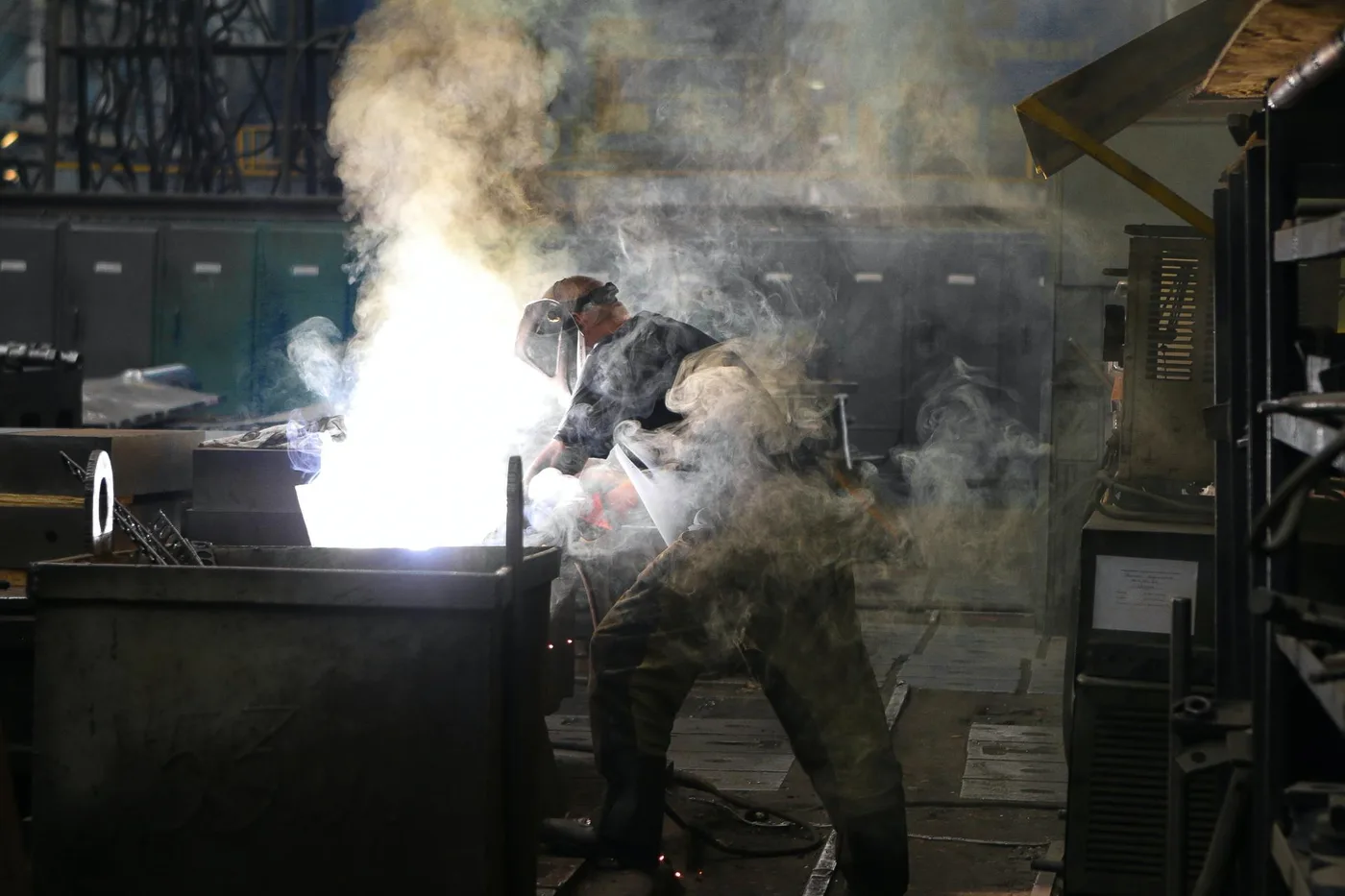
It was a typical 'factory', nothing more. To a semiconductor maker, it looked dirty and poorly managed, with no clean room, just a plain 'factory'. In a meeting with plant staff, we checked the pump's main application and found it was mostly used in petrochemicals such as shale gas. The semiconductor pump was only being made for testing at a small plant run by a joint venture in Yongin, Korea. The visit happened on the mistaken belief that showing the large US plant would please the SK hynix team, and it ended up becoming a major obstacle for the project.
This is exactly the 'similarity between buyer and seller' problem. I fully understand how the SK hynix contact in the hypothetical case above felt. It is probably similar to what I felt in 2008, when I was used to the tidy foundry customers like TSMC and UMC in Hsinchu, Taiwan, and then visited a semiconductor backend supplier's plant in Kaohsiung, in southern Taiwan. It wasn't a science park of advanced fabs but a traditional industrial estate of small and midsize factories, and the place looked old, untidy and somehow poorly managed. I felt a strong sense of 'disconnect'.
Isn't this also a question of 'similarity between buyer and seller'?
To be continued