
As I write this in December 2022, JTBC’s drama 'Reborn Rich' is soaring in popularity. Among the many characters, actor Lee Sung-min’s performance as Chairman Jin Yang-chul, founder of the Sunyang Group, stands out. He plays a conglomerate founder who built a transport company that began with two pickup trucks bought to haul rice for a repair shop, then expanded into oil, chemicals, machinery, and consumer goods distribution. He is the classic 'merchant' through and through. The dictionary definition of 'doing business' is 'buying goods and selling them to make a profit.' What do you think is the foundation of doing business?
I don't think it is that hard. It starts with securing as many loyal customers as possible in a 'reservoir.' Then new customers keep flowing in through a big pipe. And you let go of the bad customers who have gone sour. Isn't that all it takes: three steps?
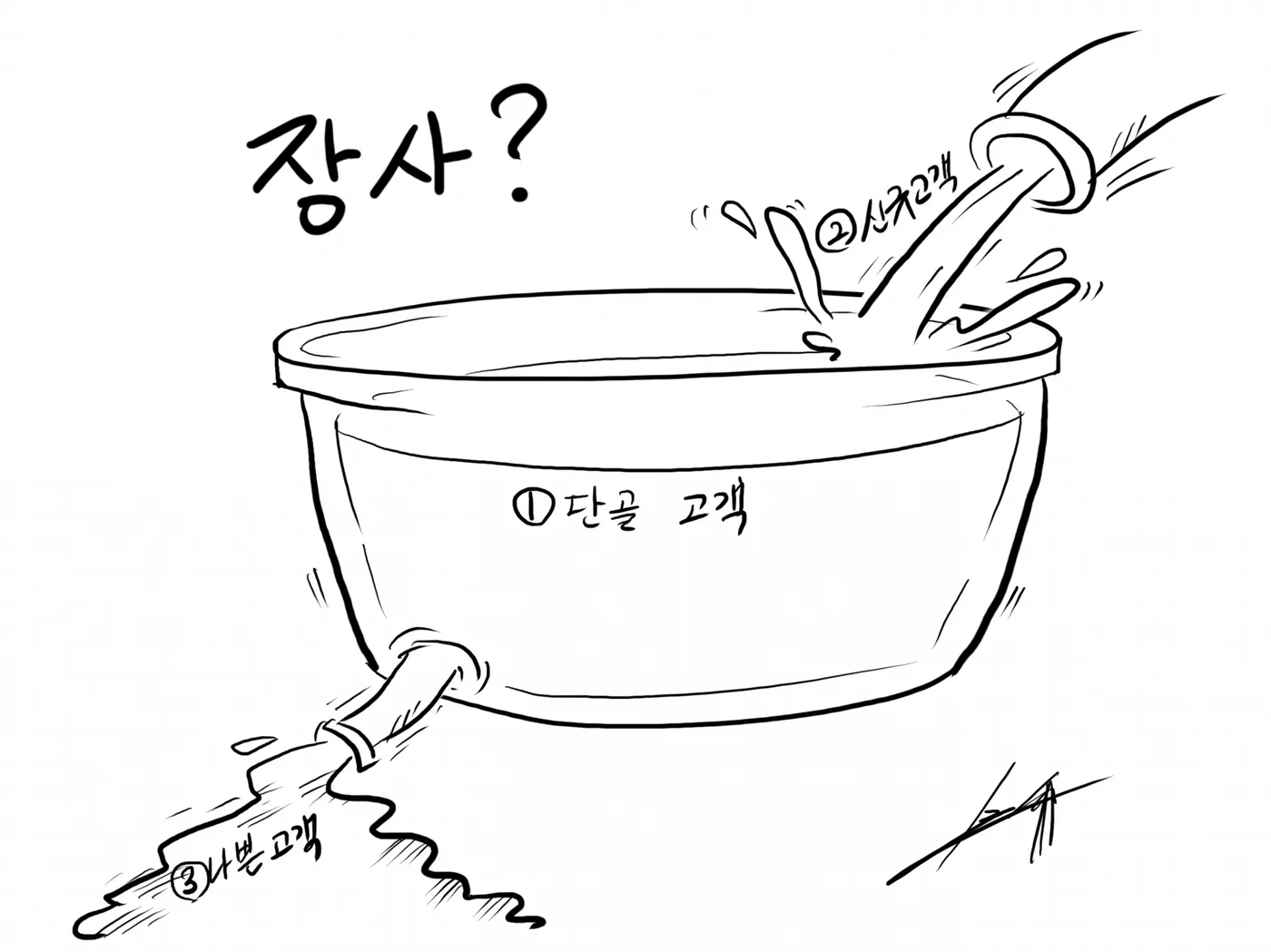
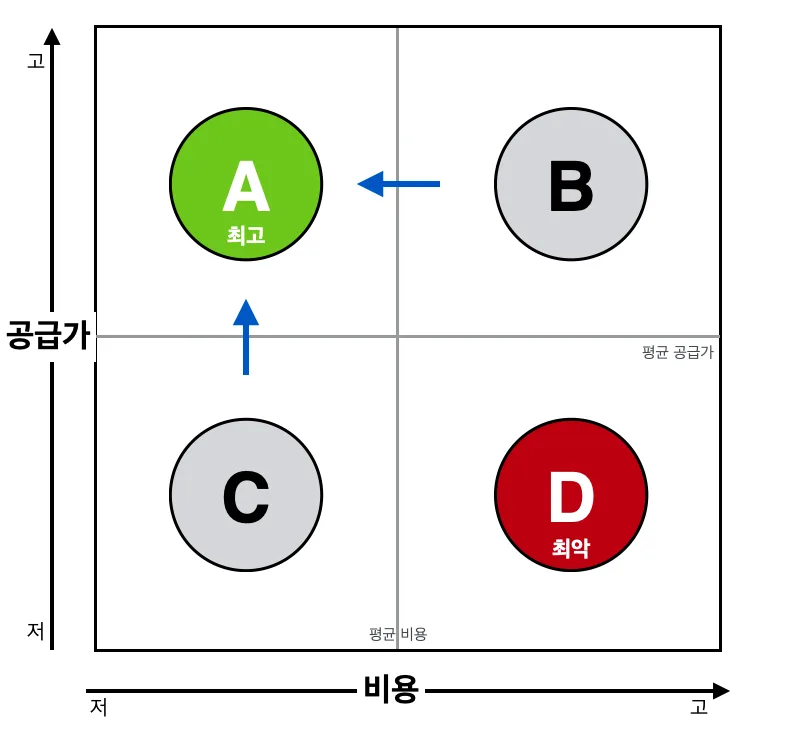
So how do you classify existing customers into 'good customers' and 'bad customers'? And what 'criteria' define them? Price, volume, effort, and cost make good criteria. Let's divide customers into Grade A, Grade B, Grade C, and Grade D.
Grade A customers: These customers place large, steady, regular orders at high prices without demanding much attention from the supplier. The relationship is built on long-term trust, they are nearby, they need no ongoing verification, and problems get resolved efficiently. Because searching for a new supplier to cut costs is a big risk for both sides, the business will continue unless something major goes wrong. However, a big internal change at either the customer or the supplier can seriously hurt the business, so the customer should line up candidate new suppliers, and the supplier should avoid complacency and keep innovating to raise the barrier to entry.
Grade B customers: These customers take a lot of attention. They bring many big changes and many small requests, and to a supplier they are truly a hassle. But they reward your effort and attention in full. In industry, they keep requesting changes to process conditions and designs and run endless tests; in corporate training, they request curriculum changes and customized additional content; content customers keep asking to change the concept and design of videos and images. Over time, history builds up and communication gets easier, and these customers naturally upgrade to Grade A.
Grade C customers: This is a tricky group. They don't need much attention, but they buy at low unit prices. If they are large accounts with high volume, they provide a 'reference' effect and act as a 'cash cow,' but you should still try to raise the price. As a corporate instructor in my 12th year, I doubled my minimum lecture fee in year six. I worried about what would happen if overall revenue fell, but I tried it anyway, and in the end I saw Grade C customers move up to Grade A or B. Total travel and teaching time went down while revenue went up, which left me much more room to reinvest time and effort in new content.
Grade D customers: These are bad customers who erode a supplier’s competitiveness. Had you put the time and effort you spent on them into other customers, you would have gotten far better results. You have to consider 'opportunity cost.' The 'decision' to take on this customer did serious damage to the entire business. Now it is time to choose. You have to cut these customers loose. Cut them out. Only then can a supplier grow in a healthy way.
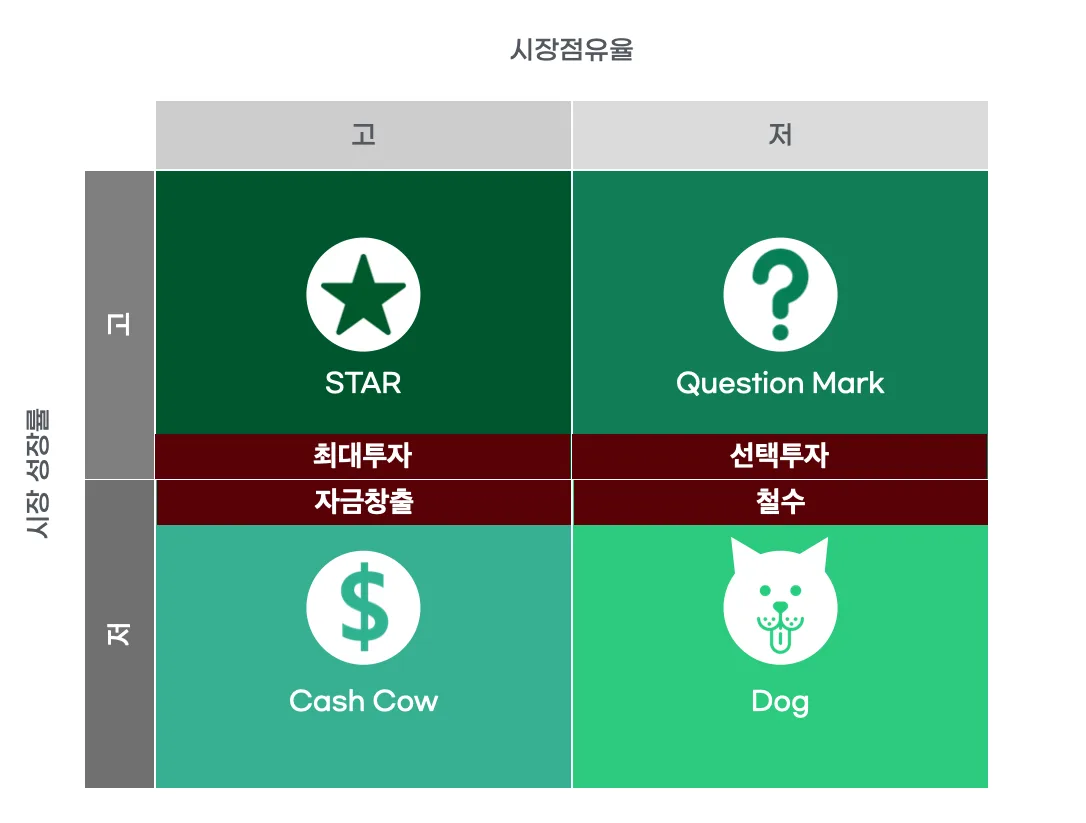
The BCG matrix, a type of positioning map, is a leading method for deciding whether to invest in or exit a business unit, product, or item. It divides them into four quadrants by market share and market growth rate. A product with high market share that sells well in a fast-growing market is a Star. A product with low market share in a fast-growing market is a Question Mark. A product with high market share that sells well in a slow-growing market is a Cash Cow. A product with low market share in a slow-growing market is a Dog.
A Star is a promising product or business, so you should invest as much as possible so you don't miss the opportunity. A Question Mark can become a Star or a Dog depending on investment and strategic direction, so strategic choices and investment are essential. The Fast Follower strategy Samsung Electronics took in the smartphone market can work here. A Cash Cow is a business in a market that has already stopped growing, so you should extract as much cash as possible. If you over-invest in a stagnant market, remember Kodak, which went bankrupt by clinging to the analog film market and continuing to over-invest. A Dog is a business where the market has stopped growing and your company doesn't sell much in it either, so you should exit quickly.
Let's evaluate each company's main businesses.
LG Electronics: Looking at the LG Group as a whole, the Star is probably 'EV batteries.' LG has to invest heavily worldwide, including in North America and Europe, to raise market share quickly and secure price competitiveness through economies of scale. I set the Question Mark as 'semiconductors.' Setting aside memories of LG Semicon, which was handed over to Hyundai in a big deal after the IMF crisis and is now SK Hynix: the semiconductor market posted enormous growth during the height of COVID, but LG had no semiconductor division. If it reinvested in semiconductors, this business would be a 'question mark.' As of December 2022, the semiconductor industry has turned bad again, so it would fall to a Dog. I set the Cash Cow as 'home appliances.' TVs, refrigerators, and washing machines are traditionally LG's strengths, but the market is not growing fast, so LG should extract as much cash as it can. What is the Dog? The 'smartphone' business, which LG started late in 2008 on McKinsey Consulting's advice. With market share staying low and market growth slowing, LG finally withdrew in early 2021.
Samsung Electronics: The Star is probably 'memory semiconductors' such as DRAM and NAND Flash. With a market share above 40% and high growth during the height of COVID, I designated it a Star, but the industry has weakened as of December 2022, so it would slip to a Cash Cow. I set the Question Mark as the 'foundry business.' Its 20% share is low compared with TSMC, which holds over 50%, but the market keeps growing thanks to several new technologies, so I classified it as a Question Mark. I set the Cash Cow as 'smartphones.' With about a 20% share, Samsung ranks No. 1 in the global market, but competition is intensifying as Chinese manufacturers enter and market growth slows. It should extract as much cash as it can, right? What is Samsung Electronics' Dog? 'White goods.' Samsung already outsources products such as window air conditioners, dishwashers, air purifiers, dehumidifiers, induction cooktops, water purifiers, kimchi refrigerators, and AirDressers to small and midsize manufacturers in Korea, China, and Thailand. I think this is a good strategic direction for a business classified as a Dog.
Hyundai Motor: The Star is likely the 'electric vehicles' line, such as the Ioniq 5 and Ioniq 6. The EV market is growing about 30% a year on average, and Hyundai and Kia's share keeps rising, so 'electric vehicles' are the Star. I placed 'hydrogen fuel cell vehicles' in the Question Mark slot. Market growth and Hyundai's share are both high, but the market is still too small to matter, so I classified it as a Question Mark. The Cash Cow is surely the 'Grandeur,' isn't it? The Grandeur is a sedan that contributes heavily to operating profit and has been No. 1 in domestic sales for six years in a row. With EVs becoming the mainstream, Hyundai should avoid heavy investment in gasoline sedans, make only modest improvements, extract as much cash as possible, and invest it in EVs and hydrogen fuel cell vehicles. What is Hyundai's Dog? The 'mini car,' with low market share and low market growth, right? After the Atos, Hyundai launched no mini car for a full 20 years, then in 2021 introduced the Casper, a mini SUV, built with partner GGM (Gwangju Global Motors).
SsangYong Motor: As of December 2022, the Star is undeniably the 'Torres,' right? It launched with monthly sales of 5,000 units and is aiming for the No. 1 sales ranking. The Question Mark is the 'electric vehicle.' The Korando e-Motion entered the market with a relatively short driving range but a low price as its weapon, and its production has been halted because of a battery supply problem. Will the next model have no disruption in battery supply? It is a 'question mark.' The Cash Cow is the pickup trucks, such as the Rexton Sports. Their share of the domestic pickup truck market is a whopping 80%. What is SsangYong's Dog? A featureless SUV like the fourth-generation Korando, surely? Its design, little more than a copy of the Tivoli, and its undifferentiated performance make it the culprit that pushed SsangYong into crisis.
To be continued