'M/S, Market Share, market share' If you work in sales, you hear these terms constantly and know them well. Market share, or M/S, is one of the most common terms in marketing and sales. It is the number that shows what share of the market your products hold. What are the 'advantages' of a high market share? Higher sales volume means higher purchasing volume, so you can buy raw materials at lower prices than your competitors. Selling and administrative costs per unit also fall below your competitors’, so over the long run 'economies of scale' give you the financial strength to dominate the market. However, the easiest way to win market share is 'price competition', and that is a classic 'Prisoner’s Dilemma'. Once one side starts discounting, a 'game of chicken' begins, with both sides heading toward the cliff edge until one goes bankrupt. Without an overwhelming winner, the result can be irreversible, massive damage to every supplier in the market.
Now let's think from the perspective of K, a fictional automotive glass manufacturer. Suppose its total revenue is KRW 500 (≈ US$1) billion, of which about KRW 200 billion (≈ US$149,633,400) comes from the Chinese market. To estimate market share, we first need to know the size of the Chinese automotive glass market. After checking several sources, the figure comes out to KRW 8 trillion (≈ US$5,985,335,900). K's Chinese market share (M/S) would then be 2/80 = 2.5%. In other words, it holds a 2.5% share of the entire Chinese automotive glass market. Now suppose you are Kim, a manager on K's sales planning team. Park, a senior executive recruited from a foreign-owned company, instructs you: "Kim, bring me the SOW data for our major customers in China." SOW? You've never heard of it. What could it be?

SOW stands for Share Of Wallet and refers to each supplier's share within an individual customer. Take SAIC Motors, China's largest automaker, as an example. SAIC has 6 automotive glass suppliers in total: Fuyao Glass holds 35%, Xinyi Glass 25%, China Glass Holdings 15%, Shenzhen Benxun 10%, Guangzhou Guanggao 8%, and K holds 7% SOW (Share Of Wallet). (These are the author's assumptions, not actual data.) Now let's switch sides. You are no longer on K's sales team. You are the head of the purchasing team at SAIC Motors, the Chinese customer, responsible for buying automotive glass.
How many suppliers is the most efficient number for sourcing automotive glass?
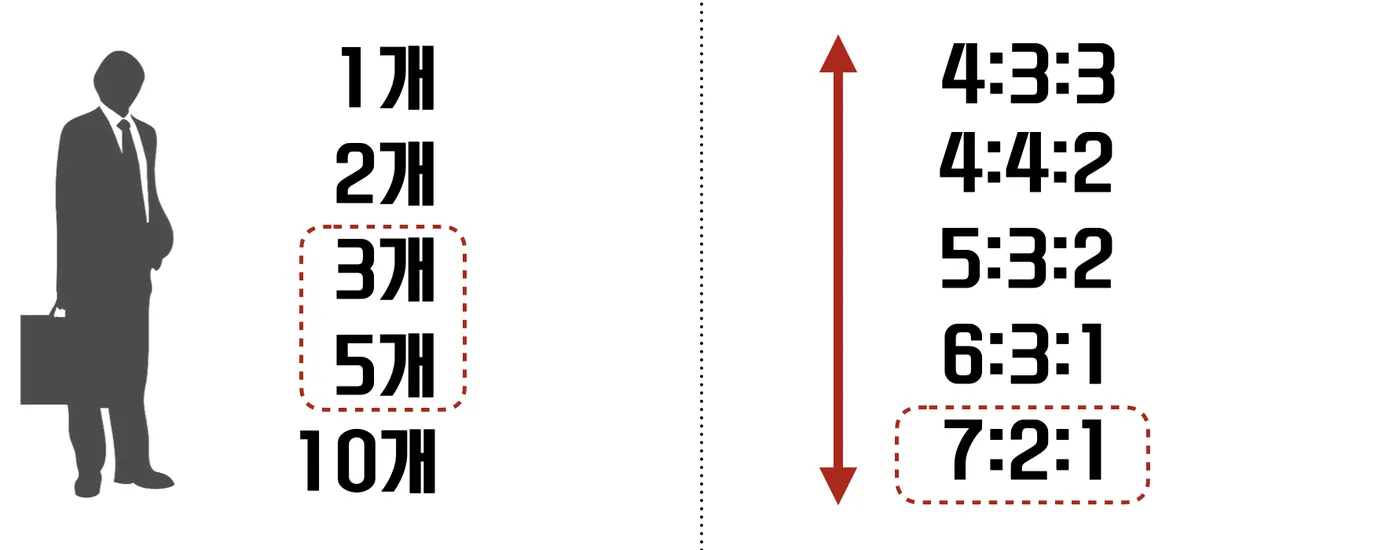
Over the past 12 years, I have asked this question hundreds of times to university students, public servants, and employees of state-owned enterprises, SMEs, mid-sized companies, large corporations, and foreign-owned companies. There are five choices: '1, 2, 3, 5, or 10.' How many do you think?
1 supplier: Typically, out of 30 trainees, 2–3 hands go up among university students and 1–2 among working professionals (3–10%). A single supplier leaves you exposed to many risks. If a fire or strike hit the glass supplier’s production line, we as the automaker would suffer even greater losses. (In March 2023, a fire at a Hankook Tire plant disrupted production at Hyundai and Kia. The number of models switching their OE (Original Equipment) tires to Kumho Tire and Nexen Tire is growing, which will also affect long-term market share.) You become dependent on that one exclusive supplier, more vulnerable when quality problems arise, and less competitive in cost reduction and new product development.
2: Typically, out of 30 trainees, 3–4 university students and 2–3 working professionals raise their hands. (6–13%) With two suppliers, there is competition, and customers think that intensifying it will get them a better price. However, with only two suppliers, it is easy to fall into the temptation of 'collusion.' If they collude on minimum order quantities and prices, it becomes very hard for the customer to respond.
10: Here I suddenly change the question from 3 or 5 to '10.' Out of 30 trainees, 2–3 university students and 1–2 working professionals raise their hands. (3–10%) When I then ask, "So, how would you feel if you were the manager in charge of 10 or so suppliers?", their faces tighten a little. You would have to arrive early every day and work late into the night, spending a great deal of time on supplier evaluation, purchase planning, price negotiation, and contract management. That takes a lot of effort and time. Does the payoff match it?
3 to 5: Typically, out of 30 trainees, 15–20 university students and 20–25 working professionals raise their hands. (50–80%) With three or more suppliers, the chance of collusion drops. It is also relatively easy to make them compete. In 2012, Nongshim, Ottogi, and Korea Yakult were fined KRW 108 (≈ US$1) billion, KRW 9.8 (≈ US$1) billion, and KRW 6.2 billion (≈ US$4,638,600) respectively for fixing ramen prices over nine years. Samyang Foods self-reported the cartel and was exempted from a KRW 12 billion (≈ US$8,978,000) fine. With many players, it is also easier to get one of them to defect. This is an example of the 'prisoner's dilemma,' which I cover in detail in another section.
You are the head of the purchasing team at SAIC Motors, a client in China, responsible for buying automotive glass. You have decided to source the glass from three suppliers.
How would you set the SOW ratios for three automotive glass suppliers? Raise your hand for the ideal ratio!
40% / 30% / 30%: Typically, about 3 of 30 trainees raise their hands (10%).
40% / 40% / 20%: Typically, about 5 out of 30 trainees raise their hands. (17%)
50% / 30% / 20%: Typically, about 20 of 30 trainees raise their hands (67%).
60% / 30% / 10%: Typically, about 2 of 30 trainees raise their hands (7%).
70% / 20% / 10%: Almost no one raises a hand. (0%)
Nearly 30% of people raise their hands for 40% / 30% / 30% and 40% / 40% / 20%. They seem to want an ideal where everyone works together and shares the profits, but with SOW ratios like these, it would be hard for a purchasing manager to manage suppliers efficiently. Suppliers, for their part, would have no need to compete hard, change, or innovate. Communism failed because it underestimated human nature. People need to be motivated through differentiated rewards, and communism removed the very foundation of motivation. Isn't this kind of SOW ratio similar? '共産主義'
Nearly 74% of people raise their hands for 50% / 30% / 20% and 60% / 30% / 10%. People seem to find a sense of stability and comfort in the 5:3:2 ratio. Every time I ask, close to 70% of people raise their hands. I believe the 5:3:2 and 6:3:1 ratios also have little dramatic impact. Dropping from 50% to 30% share at one customer won't kill you. Conversely, if you are at 30% share, there is no reason to compete fiercely, bloody your hands, and fight to reach 50%. It looks like a structure that breeds complacency.
Almost no one raised a hand for 70% / 20% / 10%. The moment I say 7:2:1 is the ideal ratio, the audience reacts differently. At mid-sized companies, the front rows are filled with less experienced staff and assistant managers, while senior managers, directors, and executives sit in the back. In front, you hear "Huh??"... and in back, "Ah~~!!" When I interview them about it, the less experienced staff and assistant managers say 70% was surprisingly high, while experienced managers and above say that, judging from their own experience, the number seems reasonable. A supplier with about 70% SOW supplies at very competitive prices, which builds a barrier to entry, yet it also lives with the fear of falling to 10–20%. Thanks to the second and third suppliers with 10% and 20%, a healthy competitive structure forms, and those suppliers get a clear goal: winning more of the customer's share.
In B2B sales, SOW (Share Of Wallet) is a key metric for building strategy and tactics. For customers where your products have a high SOW, you should offer additional services to raise the barrier to entry even further. For customers where your SOW is low, you should take share from competitors with aggressive sales strategies and tactics. So if you were the head of sales at K, the automotive glass maker in this section, and wanted to grow M/S in the China market, you would check the SOW ratios of all your major customers at least monthly, ideally weekly, and hang a 'digital dashboard' in the office. SOW is not fixed. Like a living organism, it keeps changing. If you suddenly see a particular competitor's share drop sharply at a particular customer, you need to move fast. It is evidence that the competitor's factory has caught fire, a strike has broken out, or a quality or delivery problem has erupted. This is the 'canary in the coal mine.' It is the canary's chirp that reveals a competitor's weakness and signals an opportunity for you. The time to move has come.
"Charge! Forward!!"

David Cairns/Daily Express/Getty Images
To be continued