In 1989, when I was in ninth grade, I went on a school trip, and ten or so of us spent the night in one run-down inn room. A friend suddenly talked me into a card game called 'poker'. I was a beginner, and that card-shark friend tricked me in all sorts of ways and, by morning, had won all KRW 5,000 (≈ US$4) of my trip allowance. Watching the sun rise over Seoraksan outside the window, I sank into despair. On the last day of the trip, I could think of nothing but the KRW 5,000 (≈ US$4) I had lost at poker. With KRW 5,000 (≈ US$4) I could have bought souvenirs, or the Academy Science tank model kit I loved... I was full of regret, and I resented the friend who had lured me in. Twenty years later, in 2009, I bought stocks for the first time in my life, sold after a few months, and made a profit of KRW 3 million (≈ US$2,240). I celebrated my first successful investment with dinner out with my wife. But the next day, the stock I had sold hit its daily limit-up, and if I had sold that day, I could have made KRW 13 million (≈ US$9,730). After that, I couldn't get anything done. Like the night I first played four-ball billiards, or the night I first played StarCraft at an internet cafe, stocks were all I could think about. At lunchtime I drove out and called my father.
Author : Dad, I made KRW 3 million (≈ US$2,240) on stocks, but if I had waited just one more day, I would have made KRW 13 million (≈ US$9,730).
Father : Well, KRW 3 million (≈ US$2,240) is a good result for a first investment.
Author : Right now, KRW 13 million (≈ US$9,730) is floating around in my head and just won't go away.
My father: That money was never yours.
Author : Yes...
My father's words, "That money was never yours," stuck with me. I had treated money that wasn't mine as if it were, and so I felt I had lost it. That was it! Instead of feeling good about my KRW 3 million (≈ US$2,240) gain, I felt as if I had lost KRW 10 (≈ US$1) million, because I could have had KRW 13 million (≈ US$9,730) if I had waited just one day. Even after that, I kept investing in stocks and lost roughly the price of a mid-size sedan in total. I swung between joy and despair over the blue and red of the charts, couldn't focus on my real job, and even averaged down. My brain treated gains as rightfully mine from the start, and at the slightest loss I blamed myself for days and couldn't settle down.
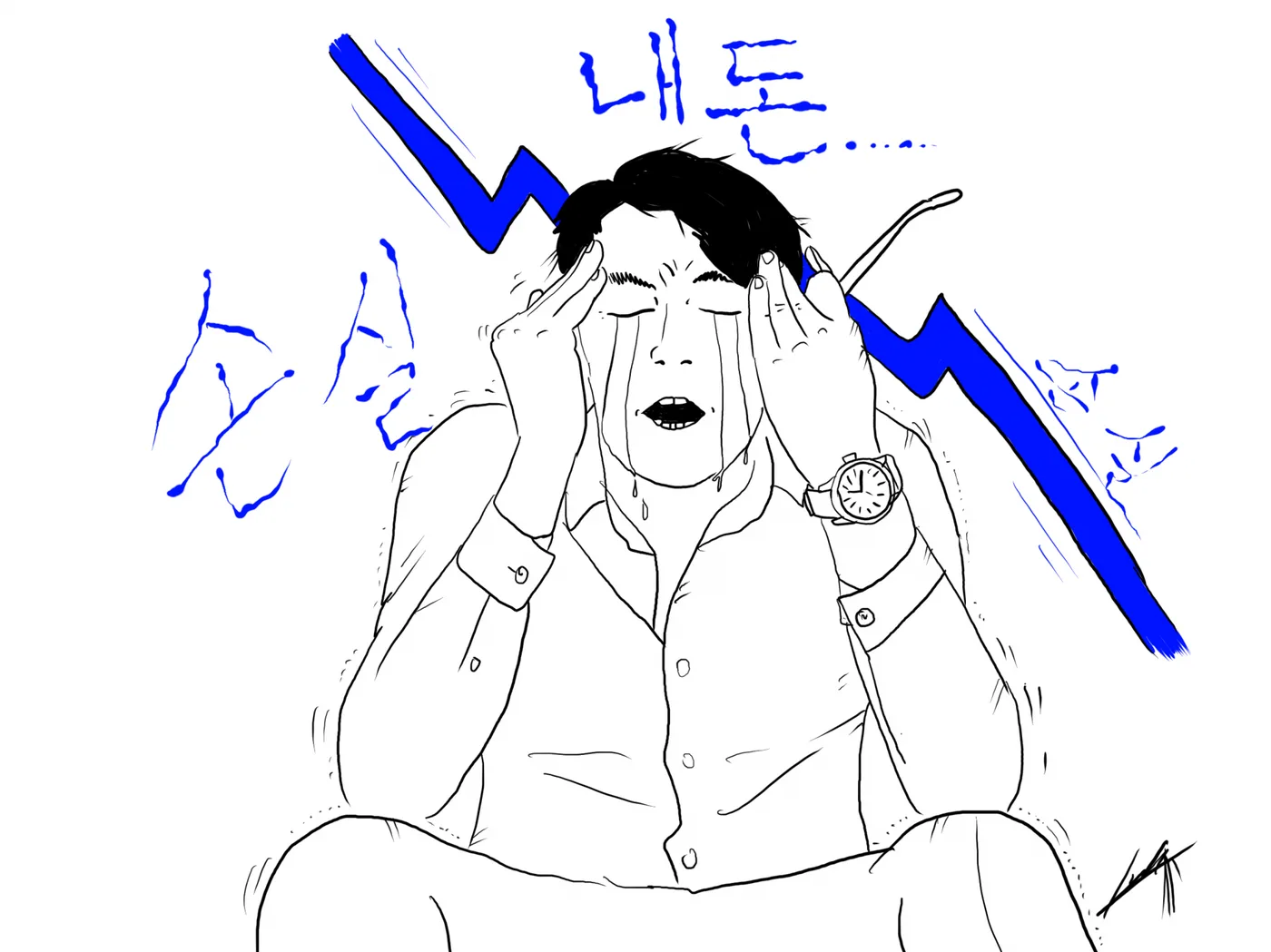
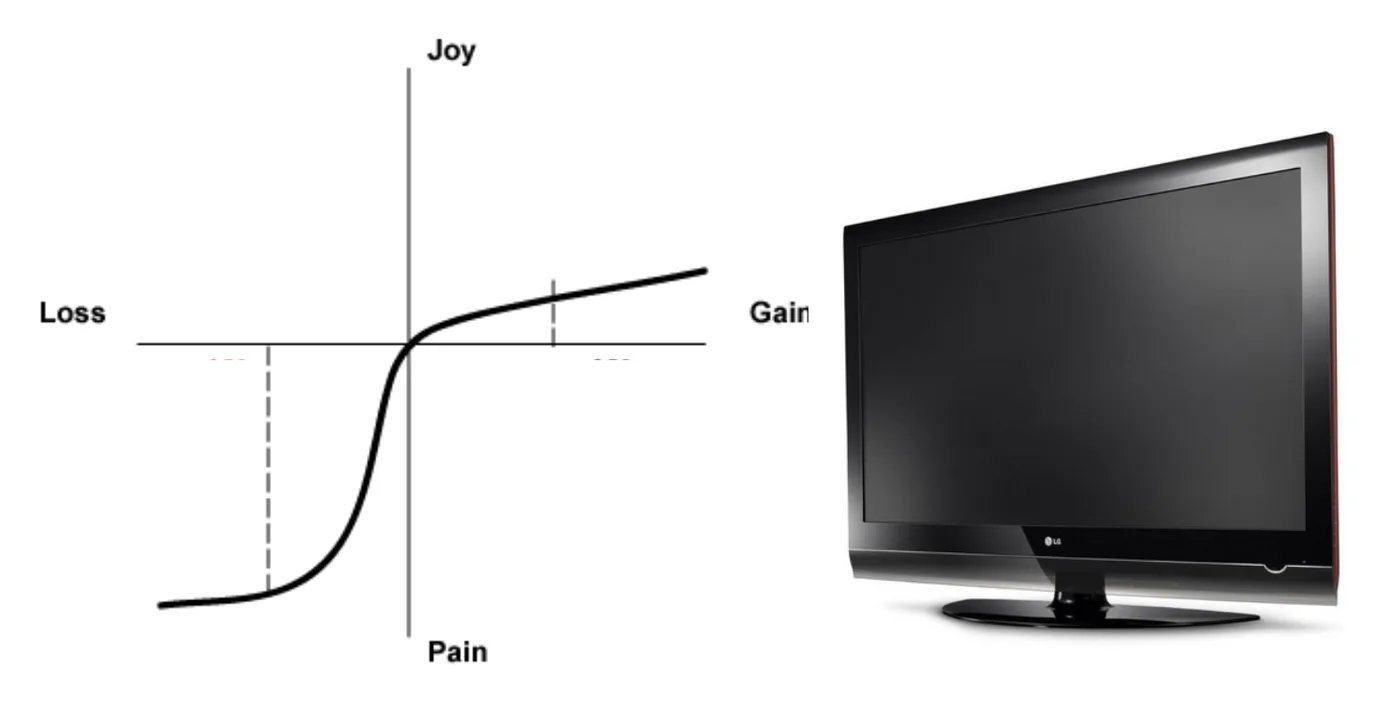
This is 'Loss Aversion'. It began in psychology and is now firmly established in behavioral economics as well. Professor Daniel Kahneman, the Israeli-born psychologist and economist who won the Nobel Prize in Economics, proved it through experiments. Humans instinctively feel a stronger urge to avoid losses than to make gains.
[ Case #1 ]
Let me give a first example. You are walking down the street, and someone hands you KRW 10,000 (≈ US$7). Would you take it? There are no conditions attached.
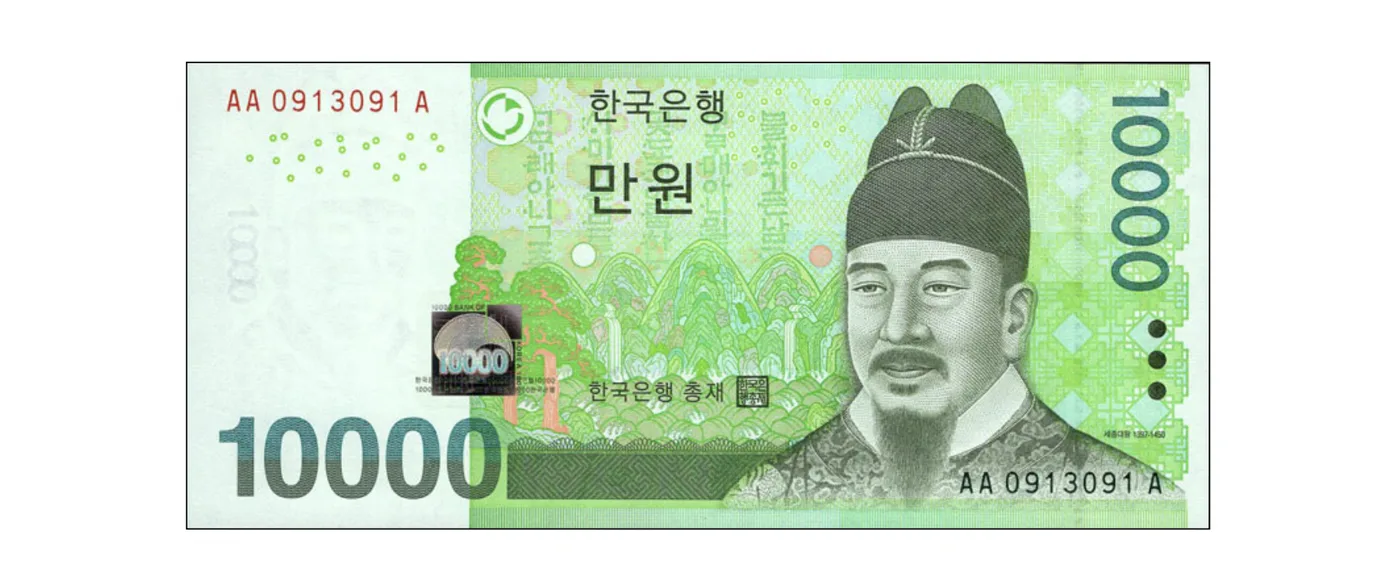
You'd take it, right? Then they invite you to play a game together. They say you don't have to. The rules of the game are...
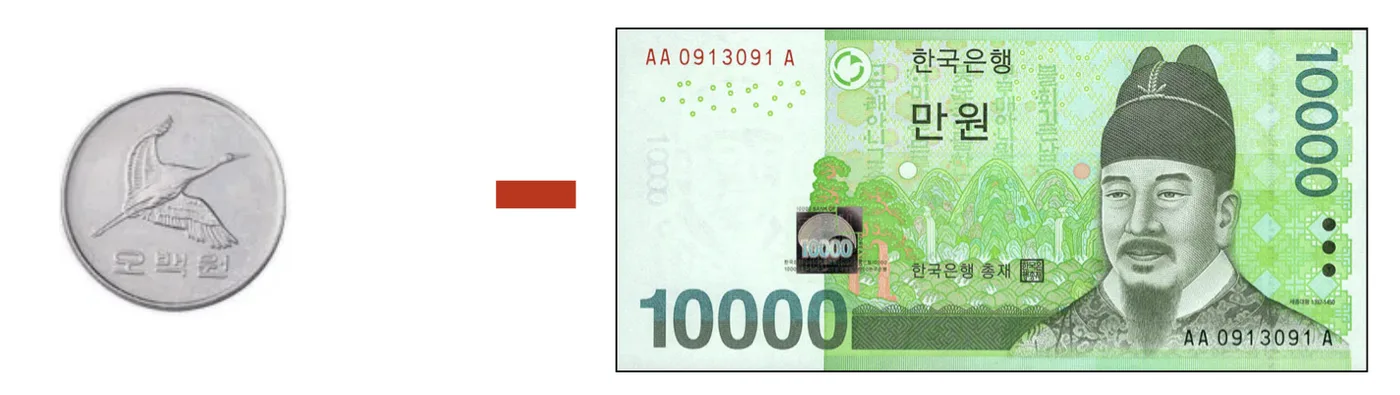
It's a coin-toss game. You flip a KRW 500 (≈ US$1) coin, and if it lands on heads, you have to give back the KRW 10,000 (≈ US$7) you received.
If it lands on tails, you receive KRW 20,000 (≈ US$15) more. Added to the KRW 10,000 (≈ US$7) you got at the start, that makes KRW 30,000 (≈ US$22) in total.
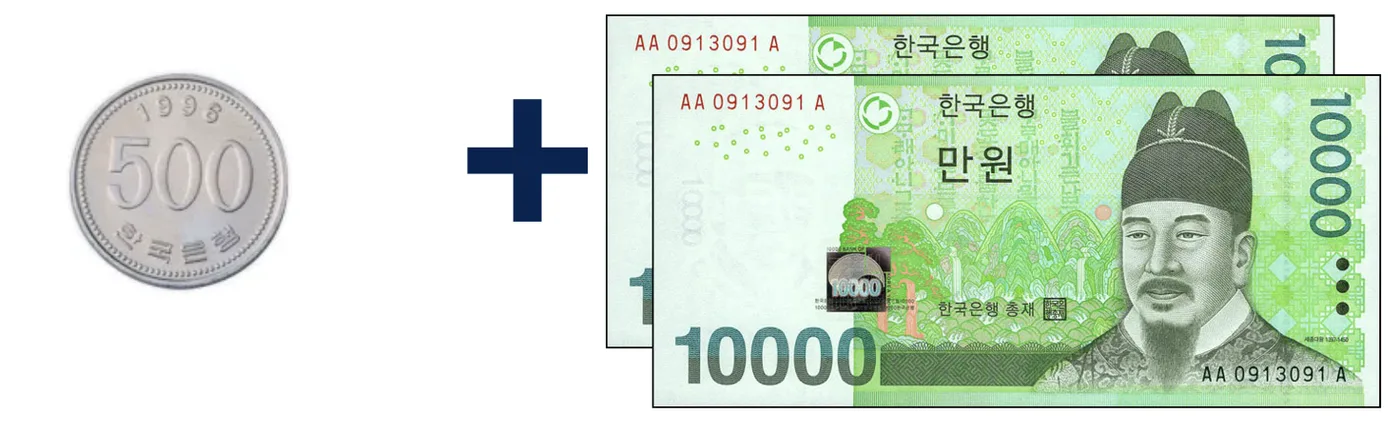
Would you like to start the game? When I test this in my lectures, fewer than 10% of people are willing to play. Why? The KRW 10,000 (≈ US$7) you were given before the game already felt like your own money the moment you received it. The fear of losing it on a 50% chance keeps people from playing. And all this over KRW 10,000 (≈ US$7) that, a moment ago, wasn’t even yours...
[ Case #2 ]
Let me give a second example.
I recently decided to splurge on a new TV. I paid KRW 2 million (≈ US$1,500) for this 65-inch LG TV.
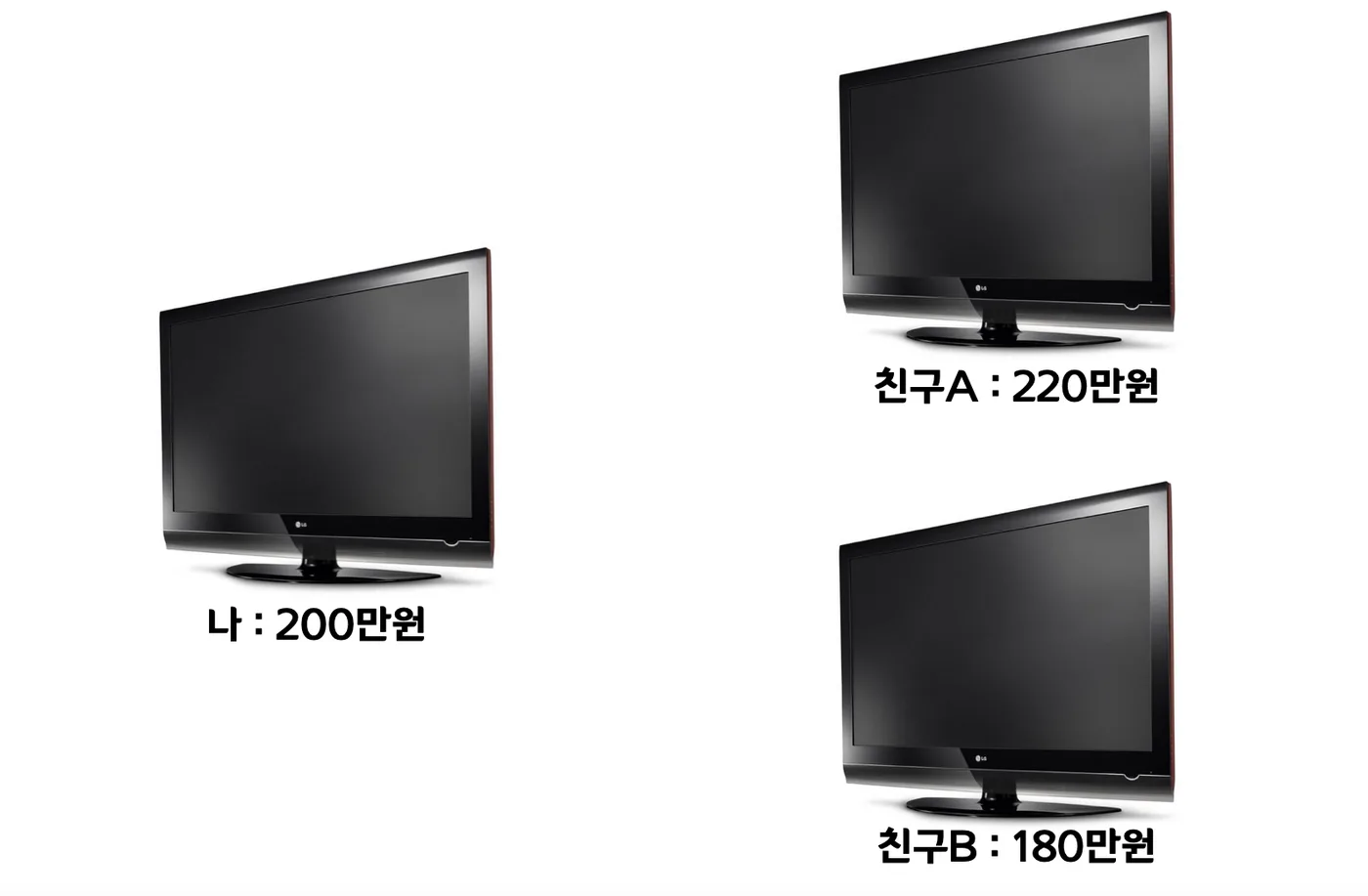
Two weeks later, you hear that friend A bought the exact same TV model at an electronics store for KRW 2.2 million (≈ US$1,650). How do you feel? A little sorry for them, perhaps, but pleased with yourself for buying smarter and cheaper. Three weeks later, you hear that friend B bought the same model from an overseas retailer for KRW 1.8 million (≈ US$1,350). How do you feel now? Bad. First you are angry at yourself for not knowing about that option. Then, after a while, you are angry at friend B for not telling you. Eventually you get angry again at the thought that KRW 200,000 (≈ US$150) could have bought something else.
[ Case #3 ]
Let me give a third example.
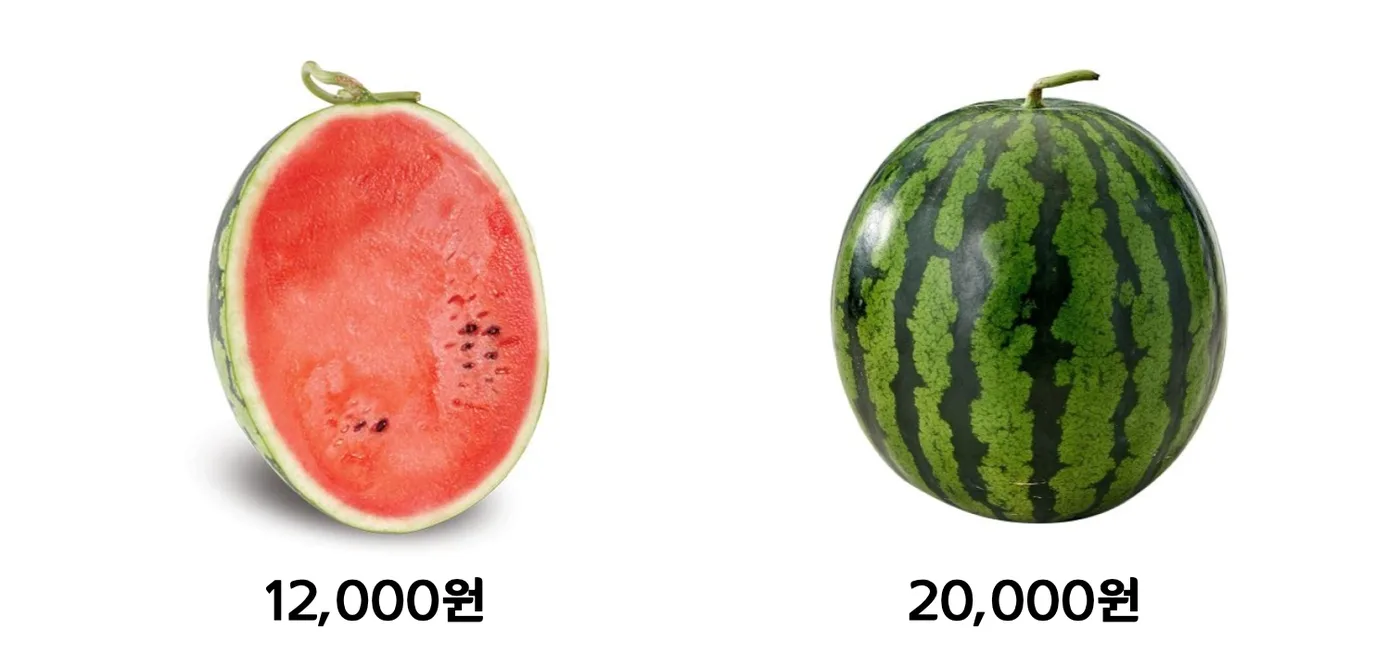
On your way home from work, you pass the fruit shop near your house. Half a watermelon wrapped in plastic costs KRW 12,000, (≈ US$9) and a whole watermelon costs KRW 20,000 (≈ US$15). Which would you buy? The whole watermelon is clearly the better deal. It would normally come to KRW 24,000, (≈ US$18) so at KRW 20,000 (≈ US$15) you save about 17%. If you are still hesitating, the shop owner can deliver the final push: "Only 20 available. If you don't buy now, you'll lose out." This is FOMO (Fear of Missing Out), the fear of letting the moment pass. 'Limited to 20 units,' 'Today only at this price,' and 'Almost sold out' all play on this psychology.
[ Case #4 ]
Let me give a fourth example.
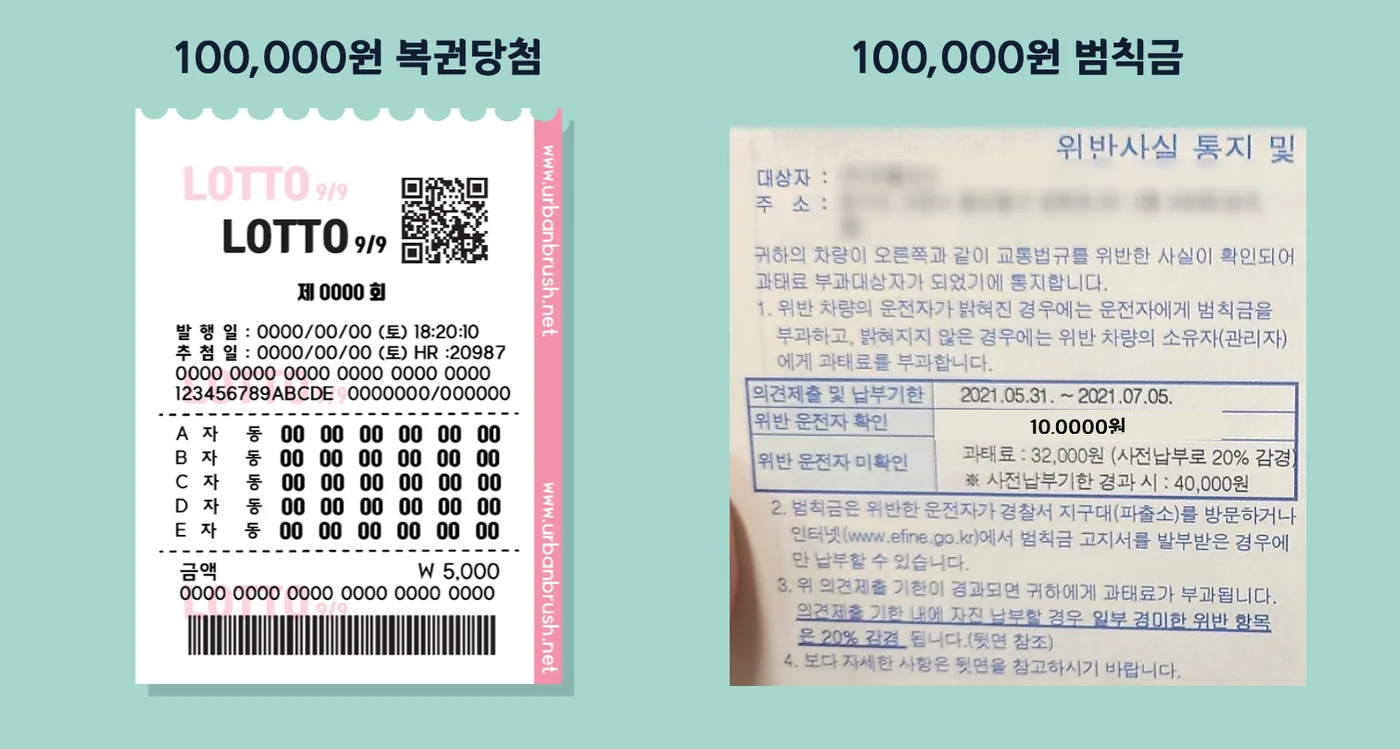
Say you go to work on a weekend, and on your way home you stop at a lottery shop by the bus stop and buy five auto-pick Lotto games for KRW 5,000 (≈ US$4). While eating dinner, you watch the draw and win KRW 100,000 (≈ US$75). You feel great. Then your spouse quietly hands you a traffic violation notice with a KRW 100,000 (≈ US$75) fine. How do you feel now? +KRW 100,000 (≈ US$75) from the lottery and −KRW 100,000 (≈ US$75) from the fine adds up to zero. In theory you should regain your composure right away, but the feeling is not zero. You feel much worse. You start checking where you were caught, blame yourself for driving that way, and think that KRW 100,000 (≈ US$75) could have paid for a nice family dinner out.
[ Case #5 ]
Let me give a fifth example.
You are a salesperson at a Hyundai Motor dealership. A customer walks in, looking to buy a car for their spouse. The model is the Sonata. The base model with no options costs KRW 25 (≈ US$1) million, and the fully loaded model costs KRW 30 million (≈ US$22,400). You need to quote a price. Would you start with the base price of KRW 25 million (≈ US$18,700) and add options one by one, quoting the price as you go (bottom-up)? Or would you start with the fully loaded price of KRW 30 million (≈ US$22,400) and remove options one by one, quoting the price as you go (top-down)?
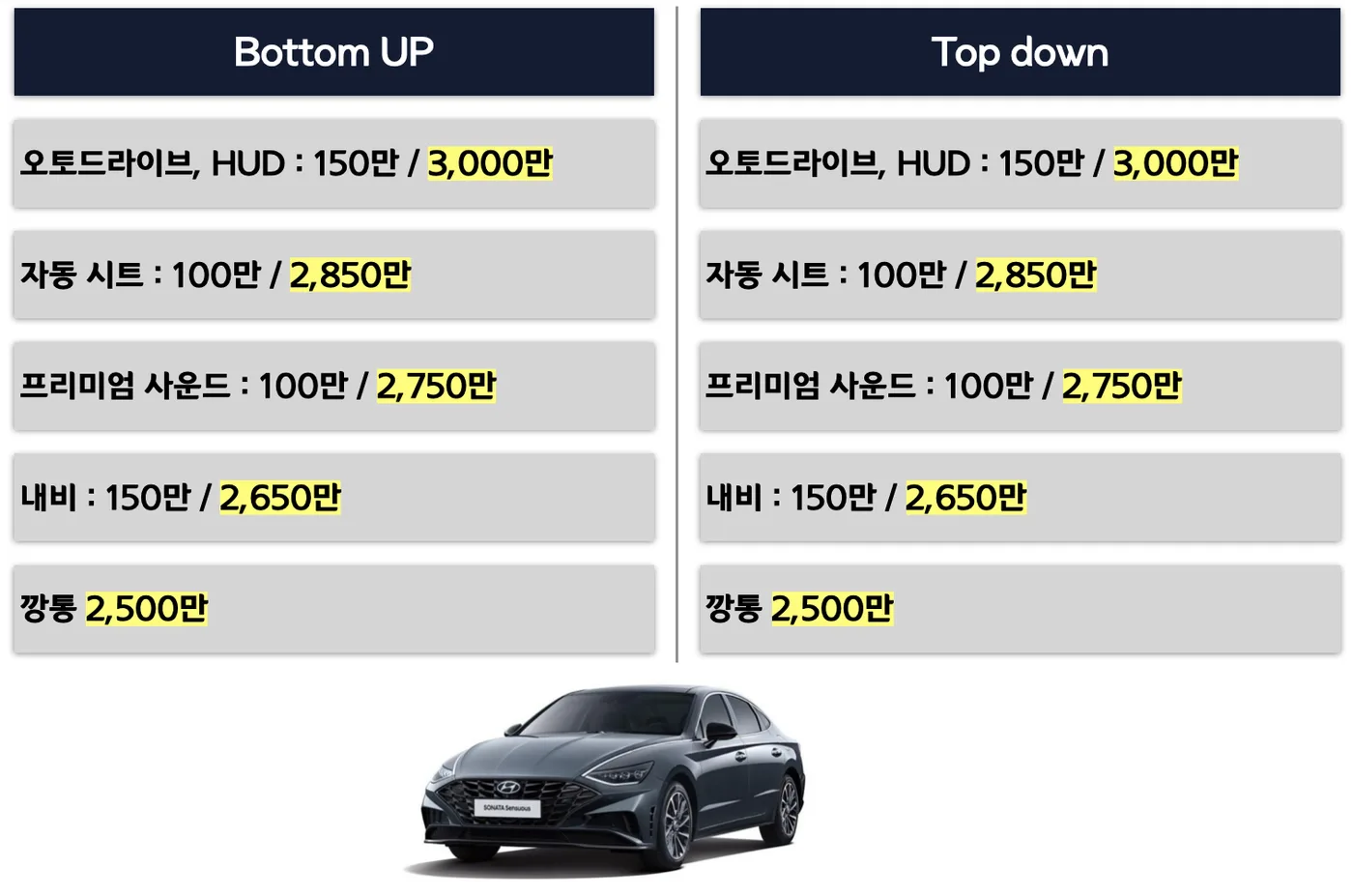
Have you ever bought a new car? I had always bought used cars or relied on rentals, until I bought my first new car, a Kia Carnival, in 2015. I started by looking at the price of the fully loaded model, and since I was buying new anyway, I kept adding options. Startled by what I was doing, I went back to check the base price and ended up adding only the bare minimum, such as automatic sliding doors.
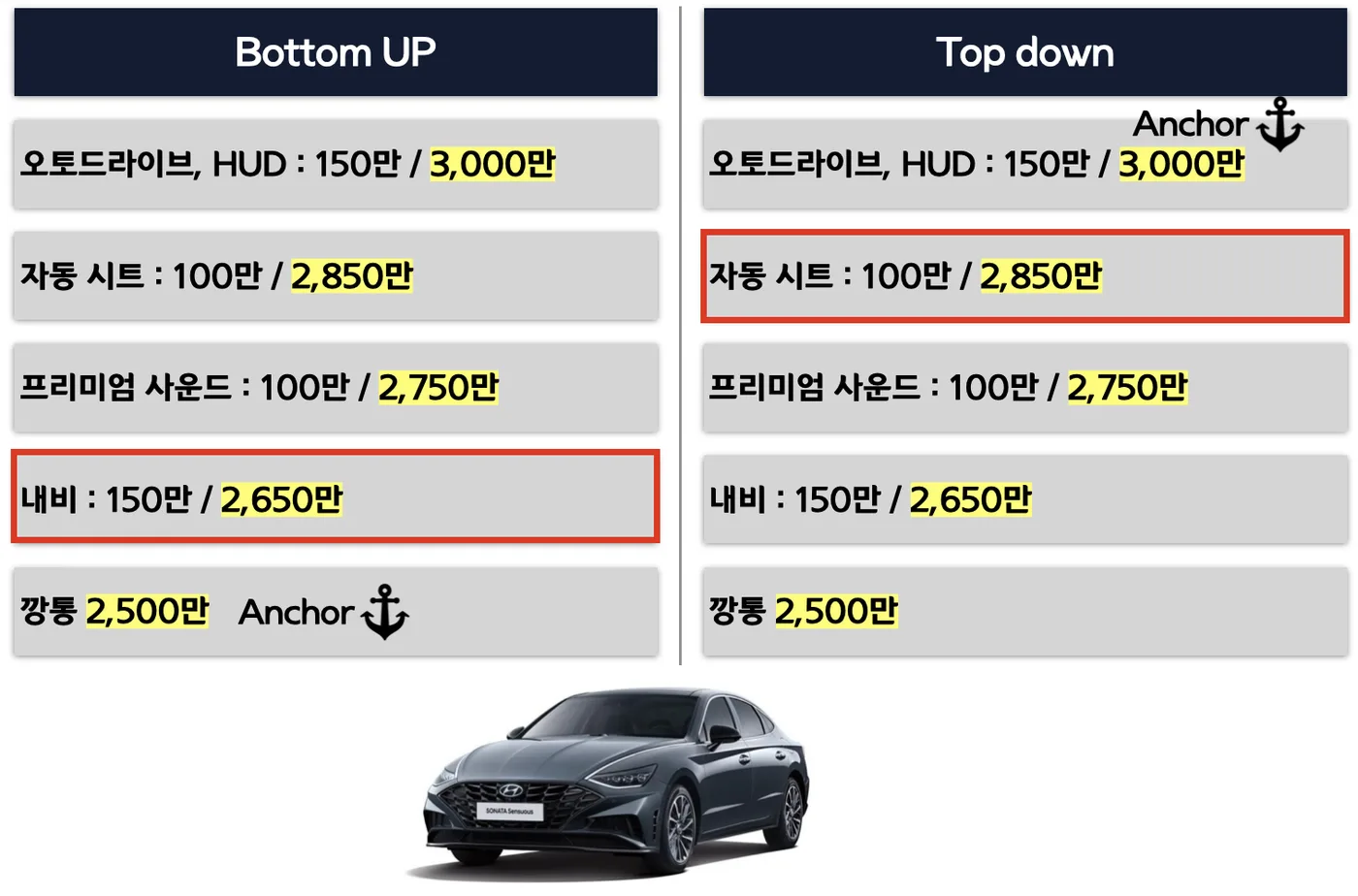
If you start with the base price of KRW 25 million (≈ US$18,700) and add options one by one, quoting the price as you go (the bottom-up approach), KRW 25 million (≈ US$18,700) becomes the 'anchor'. Like a ship's anchor, it lodges in the customer's mind. They will start wondering whether they really need a KRW 1.5 million (≈ US$1,120) navigation system, a KRW 1 million (≈ US$750) premium sound system, or KRW 1 million (≈ US$750) power seats. With this approach, the odds are higher that the contract closes close to KRW 25 million (≈ US$18,700). If instead you start with the fully loaded price of KRW 30 million (≈ US$22,400) and remove options one by one, quoting the price as you go (the top-down approach), KRW 30 million (≈ US$22,400) becomes the 'anchor'. Going through the quote and taking out the KRW 1.5 million (≈ US$1,120) auto drive and HUD, the KRW 1 million (≈ US$750) power seats and the KRW 1 million (≈ US$750) premium sound system will be painful. The customer may think, "Since I'm buying a new car anyway, shouldn't I get good options?" and spend even more. This is where you can use PAD marketing psychology. PAD stands for Pennies - A - Day. A fully loaded Sonata costs KRW 5 million (≈ US$3,740) more than the base model, but on a 36-month installment plan that adds only about KRW 140,000 (≈ US$105) a month. Divided by day, that is about KRW 4,700, (≈ US$4) roughly the price of a pack of cigarettes. You could say: 'Why not think of it as a chance to quit smoking, or at least cut back? You spend so much time in your car that your satisfaction will rise accordingly.' That is one way to approach it.
I have talked about 'Loss Aversion'.
To be continued