The key benchmark in B2B sales and marketing
Have you heard of a 'reference check'? Anyone who has changed jobs surely knows it. In a reference check, the hiring company's HR manager has a headhunter ask the candidate's former colleagues about the candidate's reputation. They look into whether achievements were exaggerated, whether there were any legal violations, whether there are negative opinions, and how the candidate's work ability is rated. In everyday English, a reference is a mention, a source, something you consult. In sales in particular, a 'reference' is the magic key to adoption in fields with high technology barriers and a strongly conservative mindset. Choosing a proven product or service already used by a leading player or competitor in that industry is naturally more predictable and safe.

When you start selling at a small company or startup, the first wall you hit is the lack of 'sales references'. "Who are your main clients?" If you cannot answer that question convincingly, winning that prospect’s business will probably be next to impossible. Put yourself in the customer’s shoes and it is easy to see why. However innovative a product looks, if no major client has used it for a long time, the customer would be the guinea pig, so it is hard for them to take a chance. On the other hand, if you can name top-tier clients in that industry as references, selling gets much easier. In B2B and B2G especially, nothing matters more than sales references. Yet building reference clients is even harder when you launch a new product or enter a new line of business.
Shall we try pitching a new client together? You put on a pressed suit, visit the client, exchange business cards with the contact, connect your laptop to the projector, and play a company introduction video of more than 10 minutes with a grand soundtrack. Then you open a polished sales PPT file produced by an outside agency and start explaining your company’s Mission, Vision, and Values with flashy diagrams. You mention the many achievements you have had across various fields, even though they have little to do with the other party’s business, and then list your proud products one by one, more than 10 of them. Trying not to notice the client, whose wandering eyes and pen-twirling hand show their boredom, you carry on with your workforce structure, branch offices, sales graphs, quality management system, intellectual property, and customer service system. Against the backdrop of the large “Thank you very much” on the last slide, you say, "Please let me know if you have any questions," and a question comes right away. "Who are your main clients?" If you answer that you have none yet, but will work hard if they give you a chance, the meeting will most likely end like this. "I see. We will review it and get back to you. Thank you for your time. Goodbye." An inexperienced salesperson will feel proud of having presented hard with a well-made PPT and wrapped up the meeting well, and will mistakenly think they have had a rewarding day. Will this client ever get in touch?
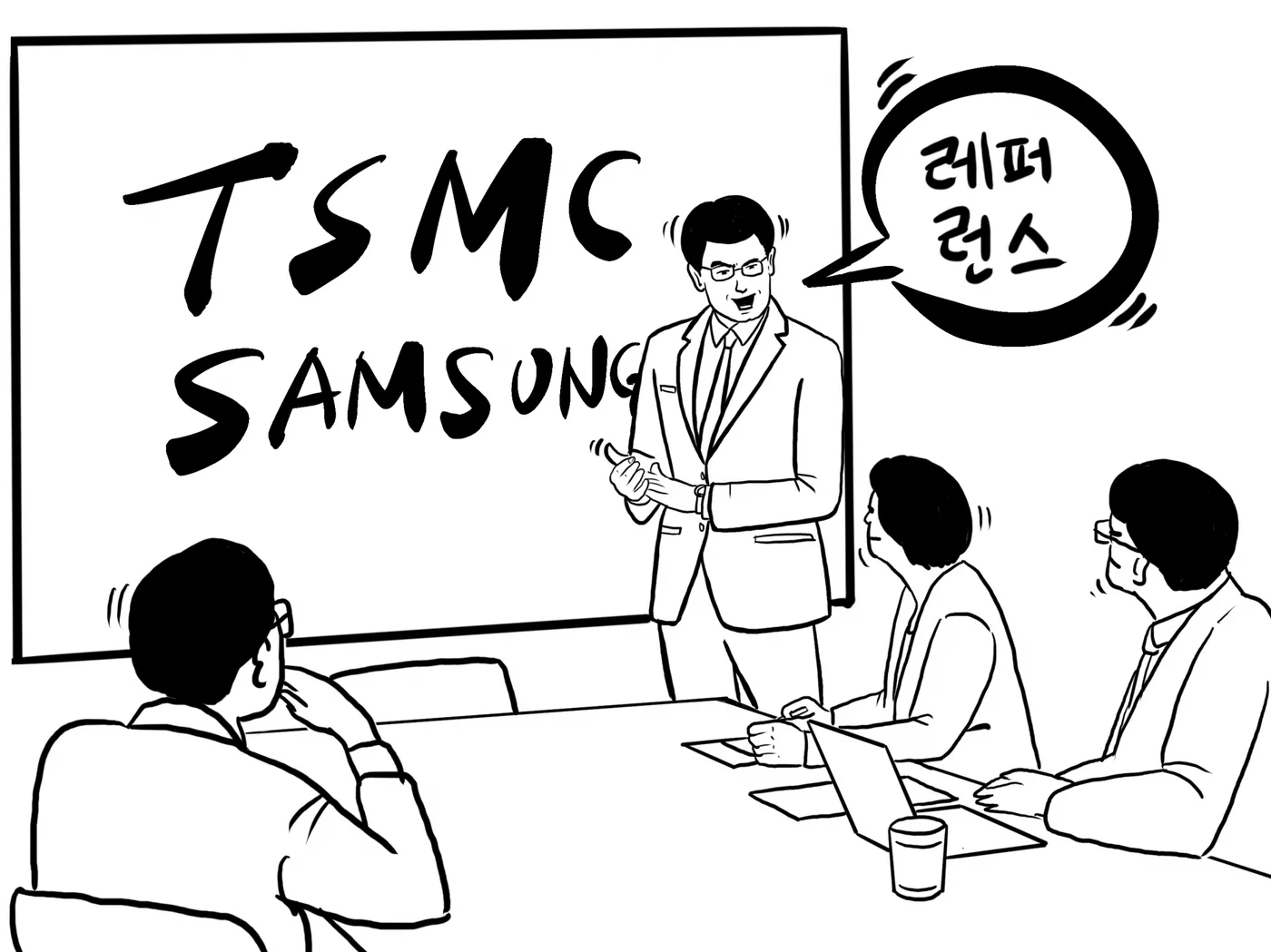
What about the opposite case? In 2007, when I had a meeting at the Shanghai plant of SMIC, a Chinese semiconductor foundry, I did not open the materials I had prepared in advance on the client’s pain points, our solutions, our company, and our products. Instead, I left a blank page and had two client names appear one by one with an entrance effect each time I pressed the presenter button. The two names were 'TSMC' and 'Samsung Electronics'. In English and Chinese, I said, "Our key customers for this product are Samsung Electronics in Korea and TSMC in Taiwan." The most senior of the 3-4 employees listening said, "That’s enough. There’s no point droning on about things we already know. It would only be a waste of time, so let’s go get lunch." Over a meal with a few drinks, sharing strong Chinese cigarettes, we discussed 'supply price', 'delivery date', 'issues', and more, and agreed that they would email me the test schedule. On the way to that stage, whenever I gave a typical company introduction, the reaction I often got from client team leaders and executives was "Fine, we’re busy, so let’s get straight to the point. Tell us your 'references' and your 'supply price'." Back then I had only memorized my prepared presentation, but watching the sales pitches of the senior colleagues beside me, I learned firsthand that the moment clients’ eyes light up most is when they hear information about your reference companies.
Let's list the leading Korean companies by industry, in the order they come to mind. For 'electronics,' there are 'Samsung Electronics,' 'LG Electronics,' and 'SK hynix.' For 'automotive,' 'Hyundai Motor,' 'Kia,' and 'Hyundai Mobis.' For 'finance,' 'Hana Bank,' 'Shinhan Bank,' 'KB Kookmin Bank,' and 'Woori Bank.' For 'general trading companies,' 'Samsung C&T,' 'Hyundai Corporation,' and 'LG International.' For 'chemicals and textiles,' 'Hyosung,' 'Kolon,' and 'Toray.' For 'tires,' 'Hankook Tire,' 'Kumho Tire,' and 'Nexen Tire.' For 'oil refining,' 'S-Oil' and 'Hyundai Oilbank.' For 'heavy industry,' 'Hyundai Heavy Industries,' 'Samsung Heavy Industries,' and 'Daewoo Shipbuilding & Marine Engineering.' For 'construction,' 'Hyundai E&C,' 'GS E&C,' and 'Daewoo E&C.' For 'steel,' 'POSCO' and 'Hyundai Steel.' For 'retail,' 'E-Mart,' 'Coupang,' and 'Lotte.' For 'confectionery,' 'Lotte,' 'Haitai,' and 'Crown.' Break industries and applications down further, and split them by region too, and you arrive at the top-tier ( first-rate) B2B and B2G clients in each category. When the mere mention of a name draws an "Ah!" and an approving nod from a prospect, you feel you have won most of the battle.
I have worked as a corporate instructor for more than 10 years and now have B2B and B2G client references across many industries. When I first entered corporate training, though, I struggled to win reference clients. Every day, like homework, I sat at my computer, copied the email addresses and phone numbers of training managers at major public institutions, universities, and companies from their websites, and pasted them one by one into a spreadsheet to build a prospect list. I took a lot of flak for sending emails and texts so often. Eventually, though, calls came in with responses like 'Let’s have a meeting', and asking for a chance in face-to-face meetings was my main job for the first two years. Nowadays, when a company requests a particular training program, I start by sharing references from training delivered to its industry competitors or top-tier companies and exchanging views, and I proactively offer a training solution as well.
In B2B and B2G sales, a reference is like the school or neighborhood tough guys who used to puff up their chests saying, "Know so-and-so? He's a good friend of mine." You get to puff up your chest the same way: "Know Company OO, or Agency XX? They've been our long-time client." It becomes a big, reliable backer.
To be continued