If you are new to B2B, it can be confusing to know which department at which client company to target, who to approach, and when, how, and what to propose and prepare. Let’s walk through how this purchasing process unfolds, step by step, from the customer’s point of view.
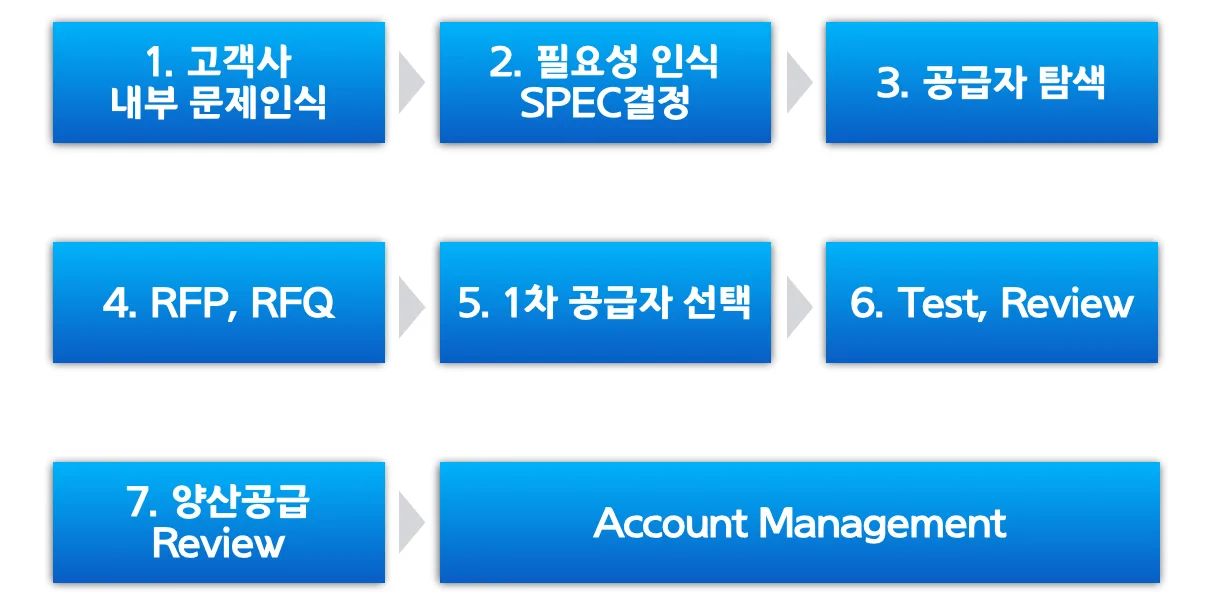
1. The client recognizes an internal problem
Let’s start with the “why” behind a B2B purchase. Suppose the machine a company uses has no major problems. Would the person in charge replace it just because of a preference for a nicer color or a new design? Of course not. The B2B purchasing process begins when the client organization recognizes a “Problem” internally. Take a “manufacturing machine” needed on a factory floor. The client can realize the problem on its own. The production floor may notice frequent breakdowns or poor ease of operation. The quality team may pick up information about an improved machine from an industry acquaintance, a trade magazine, or a related trade show. Or a sales rep from a machine manufacturer may call on the purchasing manager, and the meeting can reveal the problem with the existing machine. The high maintenance costs and low productivity of the current machine are a “Problem” that erodes the company’s competitiveness, and a “Pain” for the organization. Now there is a “reason” to replace it, isn’t there?
2. Recognizing the need and deciding the specs
Once someone inside the client organization recognizes a problem, they will raise it through meetings, reports, and other channels to someone in the DMU (Decision Making Unit) within the DMP (Decision Making Process). The responsible department then thoroughly evaluates the machine currently in use and first checks whether it needs replacing. They confirm the reasons for replacement by weighing maintenance costs, production efficiency, capacity, and the TRM (Technical Roadmap). They then set a budget based on performance indicators such as downtime, energy savings, and ESG impact, along with the price of candidate replacement machines, installation costs, training costs, infrastructure replacement costs, and switching costs. Once the organization recognizes the need and reaches consensus, it defines the product specifications (SPEC), taking into account compatibility with the existing production system, performance, maintenance methods, industry standards, and regulations.
3. Supplier search (Initiation)
Once the need is recognized and the specs are set, the buyer has to find suppliers who can make and deliver the product. Compared with 20-odd years ago, when I started my career, buyers behave differently at the supplier-search stage. In the late 1990s and early 2000s, we narrowed down candidates from ads and articles in industry trade magazines, business cards, brochures, and catalogs collected at trade shows, or industry directories obtained from senior colleagues, and then asked those colleagues for advice. Today, as we head into the mid-2020s, the search starts on Naver or Google. Buyers search in several languages, visit the supplier’s website, check its major clients, watch and analyze demo videos, and read customer reviews and user manuals. They may also look for online B2B directories specific to the industry, and if the search would take too much time and effort, they may ask a solution provider or an agent for consulting. If a supplier can pinpoint who starts this supplier search (the Initiator), it can find new ways to approach marketing and sales.
4. RFP, RFQ
RFP stands for Request For Proposal. When a company or institution needs a particular project, product, or service, it issues an RFP that says, "This is what we need, and this is how we want it built." It includes the project name, timeline, estimated budget, overview, background, expected benefits, and requirements. It is most common in the IT industry. A supplier reads it and replies, "Understood. Here is how we will build it." That reply is the 'proposal.' RFQ stands for Request For Quotation. It is widely used in manufacturing, because the deliverable is a concrete physical product rather than an IT system, solution, or program, so quotes that spell out materials and design are relatively easy to compare. It includes the requesting company or institution, background information, detailed specifications, quantities, quality standards, submission format, deadline, and contact details. The core of an RFQ is 'price': detailed pricing, delivery terms, and payment terms.
5. Choosing the primary supplier
Say a request went out to 7 suppliers and 5 replied. The client reviews those proposals and quotes, checks each supplier’s references (track record and experience in the industry), looks into creditworthiness and reputation, then verifies financial stability, quality management systems, ISO standards, and ESG assessment results. If more is needed, they may follow up by email, fax, or phone, or send a formal RFI (Request For Information) to get detailed capabilities and other information. The criteria and priorities for choosing a primary supplier differ from client to client. Typical ones include quality, track record, price, reliability, reputation, financial stability, expertise, technical scalability, capacity, accessibility, responsiveness, customization, delivery time, inventory management, after-sales service, and innovation. Priorities and considerations shift with each client’s circumstances. That is why, as a supplier, you need to research the client’s internal situation before sending a proposal or quote. Only then can you offer a proposal or quote that stands out against competitors.
6. Test, Review
Once the primary supplier candidates are chosen, the client decides how, when, and in what order to run the pilot test, in what quantities, and which KPIs (Key Performance Indicators) to use to evaluate results such as quality, lifespan, reliability, performance, and spec compliance. Then it picks 2 of the 5 suppliers that replied and orders test products. For materials or parts, it will order a set quantity free of charge or at a steep discount. For IT solutions or programs, it may trial a version with limited functions for a set period. When the product arrives, the client inspects it against its own standards and starts the pilot test. After the pilot, it may run 1st, 2nd, and 3rd tests under changed conditions, and during this process it picks just one supplier and scales up the volume for a mass-production test. By this point, you can consider yourself past the 80% mark toward supplying new products to the targeted client. During testing, the supplier’s sales rep should also check, where possible, the on-site conditions and the contact details of the people running the test. Many variables come into play here. Even a slight change in test conditions can produce a different result, right?
7. Mass-production supply and review
After the mass-production test, the client reviews the final results (Performance Review). If there are no problems, it signs a supply contract with the supplier. Items to confirm at this stage include: contract information, contract date and term, supplier information, contracting party information, product information, delivery date, shipping schedule, shipping method, shipping address, inventory management, price, payment terms, taxes, customs duties, other costs, quality standards, inspection methods, service contact or vendor, defect handling criteria, intellectual property, confidentiality, order changes, dispute resolution, termination and cancellation, legal matters, signatures, and other reference materials. Once mass-production supply is approved, the supplier assigns an Account Manager (AM) to the client. The AM regularly checks production, shipping, and inventory status, logs the history in the CRM (Customer Relationship Management) system, and keeps the client’s purchasing cycle and performance data up to date. The AM reviews customer feedback closely and keeps delivering solutions to the client’s pain points and problems.
To be continued