1) If a client wants the same price discount as a competitor, should you give it?
In B2B business, a value proposition is a message that conveys the distinctive value your products and services offer your clients. Conveying it well is no easy task. The core goal of a B2B value proposition is to help clients clearly understand, and be persuaded, why they should choose your products and services. Often it is a solution to a problem the client is facing right now. Yet many B2B salespeople and marketers, and even R&D and production staff, struggle with how to present their value when they meet customers. Many clients also ask us for training on the details: the tools, methods and theory. Let’s go through them one by one.
1) If a client wants the same price discount as a competitor, should you give it?
We covered this first, using the relationships among Samsung Display, LG Display and Apple, in 'Does the Price Always Have to Be Lower? (Pricing Strategy Tied to the Total Value of B2B Products)'. Click the link above for details. In short, prices can be compared on the same basis only if your product and a competitor’s are identical in every respect. Even equipment, materials or parts that look the same will differ in how much they improve a client’s productivity, because of many detailed factors. Lifespan, quality and sales impact will differ too. Let’s walk through this value proposition step by step.
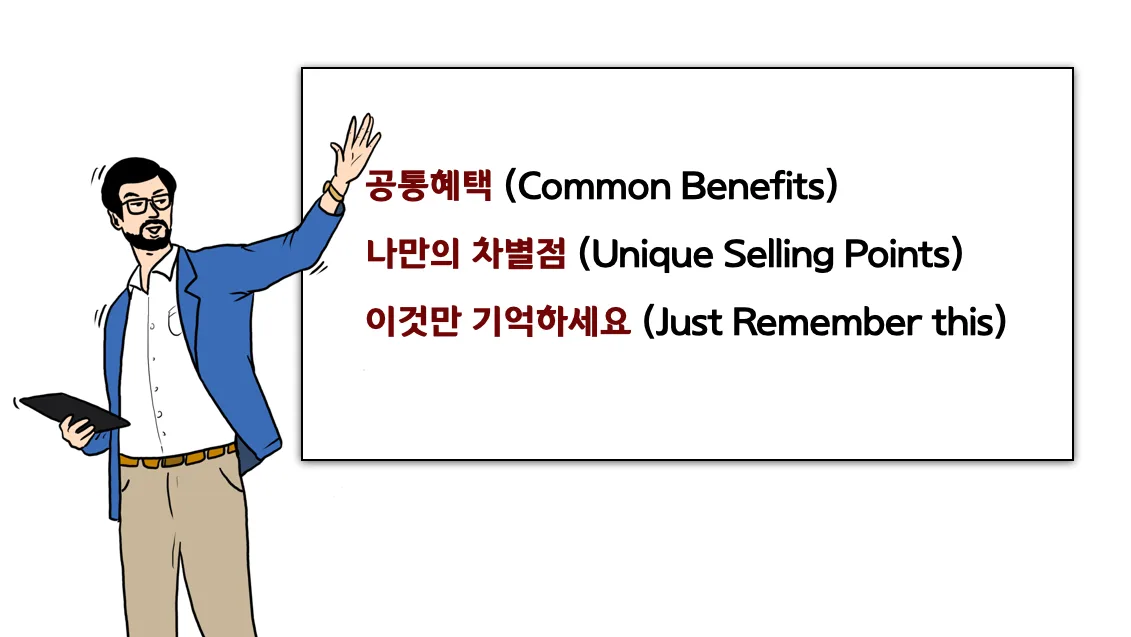
① Common Benefits
Take the 'transparent display', which lets users see the background through the screen. Suppose you are a B2B sales representative at LG Display. Common benefits means explaining the product category, transparent displays, regardless of manufacturer. This is the stage of persuading clients who currently use ordinary opaque displays. At this stage there is no need to compare the strengths and weaknesses of each maker, such as LG, Samsung or BOE. For example, a transparent display can project information a driver needs onto the glass, let retail stores overlay product information on the display glass, deliver an innovative user experience and raise brand awareness. You need a concrete answer to the client’s question, "Why should we buy this kind of product?" Explain the common benefits customers can expect from such a product, and be sure you know the product category well.
② Unique Selling Points
After explaining the common benefits, you now move on to what sets your own product apart. This is the stage of persuading the client to choose your product over another maker’s. Here you do need to spell out the strengths and weaknesses of each maker, such as LG, Samsung and BOE. 'LG’s product uses wireless transmission technology, so it needs no cables and can be placed anywhere, enhancing the look of a space and dramatically improving the user experience. Its viewing modes switch freely between transparent and opaque, and optimized lens design plus newly developed emission and image-quality algorithms improve peak brightness and color.' That kind of explanation can set you apart. You need a concrete answer to the client’s question, "Why should we buy your product instead of a competitor’s?" Explain what makes you stand out from competitors, and have the expertise and experience to study your products and competitors’ offers in detail in advance, compare them and present yours favorably.
③ Just remember this
When you meet B2B client contacts, you often see a similar pattern. You pass the client’s guard desk and security, show ID, get a visitor badge, and wait a long time in the reception room until a busy-looking contact comes down, apologizing. Quite often you start showing the materials and data you prepared, anxiously, because there is nothing special in them. Then the contact says something like this: "Yes, understood. I have to get back upstairs. What should I tell our executive director?" This is the key point. It leads to the 'Just remember this' stage: the differentiating point your customer needs most and finds most satisfying. At this stage, a salesperson’s instinct and experience play a big role. Your unique selling points will hold several kinds of value. Which one to present first depends on what you learned about the client beforehand and the needs you sense during the conversation. Propose the value that beats the competitors under consideration, and this stage also demands expertise and experience.
To be continued