② Customer Types on the 'Loyalty Ladder'
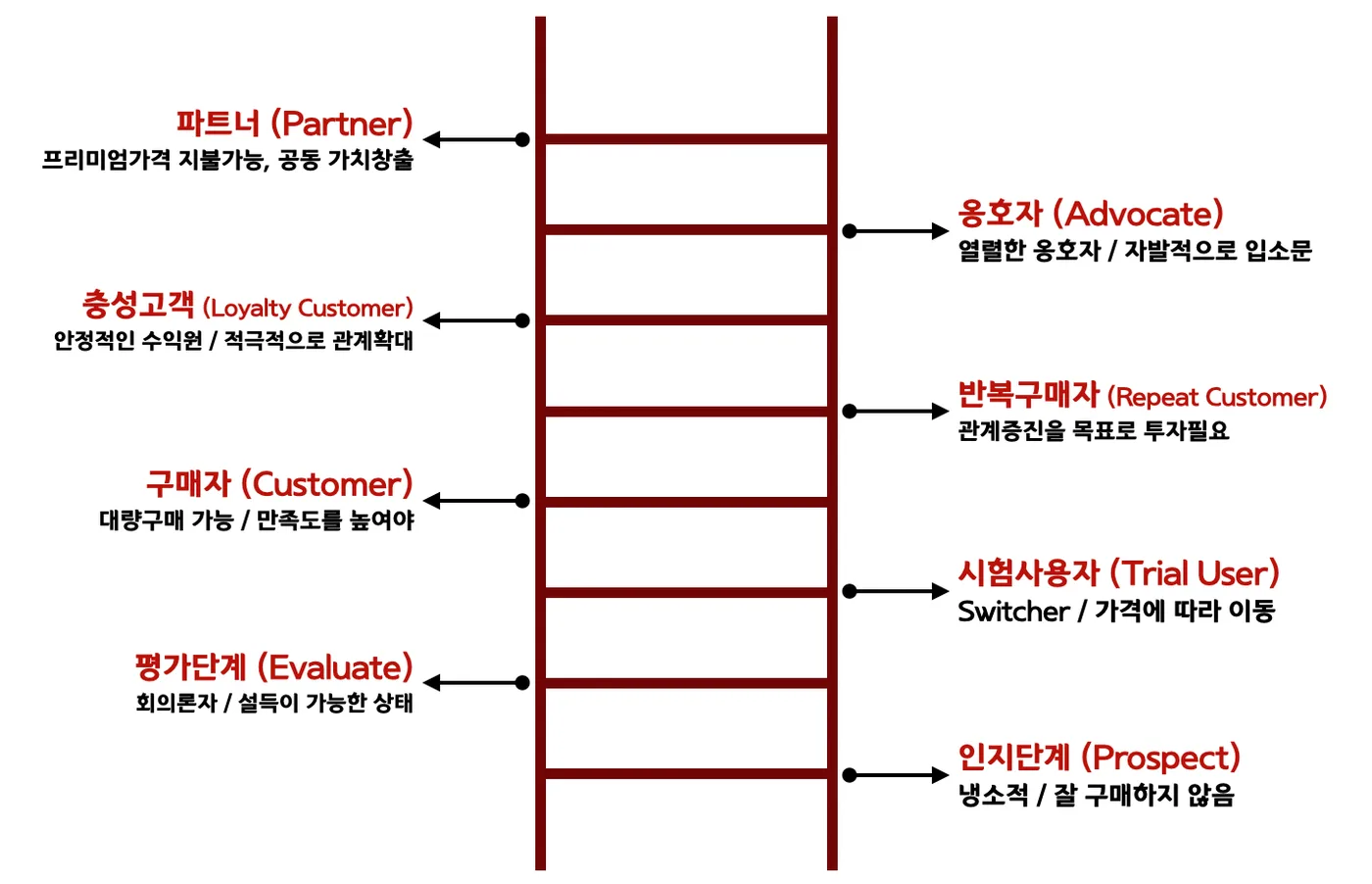
This figure shows the 'Loyalty Ladder,' which maps the stages of customer loyalty in a B2B environment. The stages run in order of deepening relationship and loyalty. Let’s walk through them, starting from the bottom.
• Prospect: The first stage, when a potential customer starts to become aware of the company or product. Customers at this stage haven’t decided to buy yet, but they know about the product or service. They are quite skeptical, though, and don’t convert easily.
• Evaluate: Prospective customers assess the product or service and consider whether it fits their needs. Comparative analysis and further information gathering take place at this stage. They may be somewhat skeptical, but they can still be persuaded.
• Trial User : A user who tries and evaluates a product or service in real use before buying. They test features, effectiveness, and usability firsthand to decide whether it fits their needs and requirements. They are likely to test other options at the same time and often behave like switchers, moving easily on price.
• Customer: The stage where a customer buys your product or service for the first time. The first purchase happens here, and a real transactional relationship begins. If the product meets their needs and delivers real benefits, they may even become large-volume buyers. This is the time to raise customer satisfaction further.
• Repeat Customer: The stage where a customer satisfied with the product or service keeps buying. Customers at this stage are building trust in the vendor’s brand and starting to show some loyalty. To strengthen the relationship, the vendor needs to keep investing money, time, people, and effort.
• Loyalty Customer: A customer who buys the product or service consistently and has strong loyalty to the brand. These customers use the brand regularly and may even share feedback on new products or services. They bring the vendor a stable revenue stream, so the vendor should actively expand the relationship.
• Advocate: A customer who recommends the brand or product to others based on positive experiences. They promote the product voluntarily and help build trust in the brand. When a top-tier customer in the market reaches the 'Advocate' stage, other prospects in that market take notice, and they are more likely to contact the vendor.
• Partner: Clients at this stage go beyond simple transactions and have built a close business partnership with the company. They pursue mutual success and maintain a deep working relationship, often joining in co-marketing or product development. They can pay premium prices and work to create shared value.
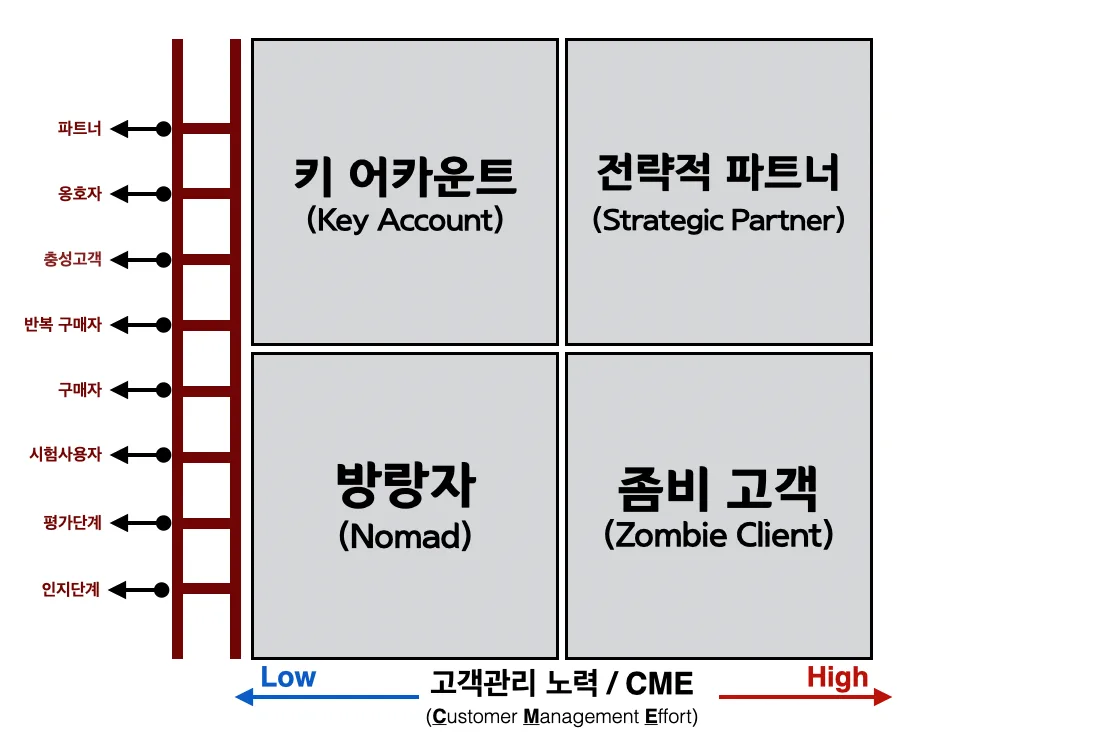
This figure shows the four client types in B2B business, classified by the Loyalty Ladder described earlier and Customer Management Effort (CME). 'Customer Management Effort (CME)' is the sum of the time, resources, people, effort, and attention a company invests to maintain and strengthen client relationships, including customer service, customized solutions, responsiveness to client needs, relationship-building, and efforts to improve the customer experience. Here is each of the four quadrants.
• Key Account
Clients in this quadrant are highly loyal even without much attention to account management. They bring the company stable revenue and often sustain long-term relationships. Large clients who have used one company’s products exclusively for years and keep reordering without extra marketing effort belong here.
These clients rely heavily on the vendor’s products or services, which makes them key customers who bring in stable revenue. To keep their loyalty steady, deliver special value through customized services and processes. Strengthen customer satisfaction to deepen the relationship over time, and help them play an important role in your business growth. In addition, 'Key Account' clients generate relatively more revenue than other clients, and the extra profit from the services or products you provide them helps drive the vendor’s development and growth. It is therefore critical to deliver a high level of satisfaction to these clients while maintaining and developing the relationship.
• Strategic Partner
Clients in this category take a lot of effort, but they are highly loyal and reward that effort. They play a pivotal role in the business, interact frequently, and maintain a cooperative relationship. Companies that run joint projects or take part in joint technology development fall into this group.
Like 'Key Accounts,' Strategic Partners are very important clients for the company, but serving them takes more proactive management. They depend heavily on the vendor, and as a result provide the company with stable, predictable revenue. Strategic Partners often want to be supplied through a 'turnkey solution,' a complete package that includes everything the customer needs. Such a package can include services and technical support beyond the product itself, with the supplier responsible for every stage from design through implementation and operation, and the customer receiving a solution that works the moment they 'turn the key,' with no extra effort. These clients also value partnerships that create value and recognize that their success is directly tied to the company’s success. Through collaboration with them, the vendor can drive innovation and growth, which also helps sustain premium pricing. It is important to offer these clients the latest innovations and advanced technology, because they are open to the company’s new proposals and may even advise on such innovations.
• Nomad
Nomad clients have low loyalty, and the Customer Management Effort (CME) the vendor needs to invest is also low. They often buy from multiple suppliers and place relatively high importance on 'supply price' and 'convenience.' Think of small distributors that frequently switch to whoever offers more favorable contract terms.
These customers usually don’t depend much on your product or service. They buy items that are easy to replace in a fiercely competitive market, so they switch often. This type of customer looks for new benefits and advantages, and can easily move to a competitor if the vendor’s value isn’t differentiated. Vendors should look for ways to hold their attention by offering new benefits or added value, and build loyalty over time. You can offer tailored promotions or personalized service to turn them into long-term customers. Also, because 'Wanderer' customers may not fully understand what a company offers, it is important to teach them the features and benefits. That education also helps drive upgrades and open up new markets. In short, for 'Wanderer' customers you need a strategy that pairs competitive pricing with the vendor’s unique value and gives them the information and support they need, so you can build a deeper relationship and grow their loyalty.
• Zombie Client
Zombie customers demand a lot of effort from the vendor but show low loyalty. This type of customer is relatively unprofitable. They’re customers who don’t make you money. They raise issues often and ask for extra services, yet add little to sales or profit.
Relationships with these clients are likely to be difficult, because you invest a great deal of time and resources in them but often see no matching revenue or profit. A company can handle Zombie Clients in a few ways. First, re-evaluate the benefits you provide them and reduce your customer management effort or make it more efficient. Second, use the Loyalty Ladder to look for ways to move these clients toward becoming more valuable 'Key Accounts' or 'Strategic Partners.' Finally, analyze closely what value these clients actually bring to the business and what improvements could sustain the relationship. If the prospects are still slim, end the relationship and focus on other clients. It takes a firm decision.
To be continued