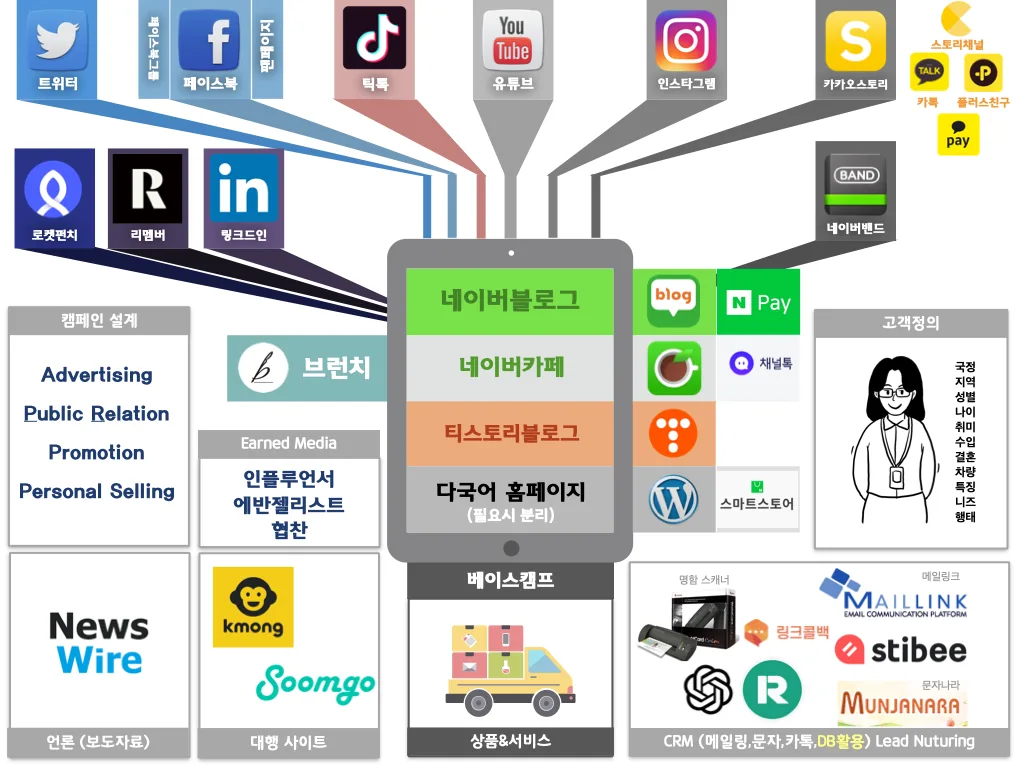
I will walk through the slides I prepared on the 'B2B Digital Marketing Framework' one by one.
① Products and services to sell
When planning B2B digital marketing, start with a deep understanding of the products and services you want to promote. First, clarify the problem your product or service solves and the value it delivers to customers. Along the way, pin down its features, benefits, and what makes it unique, and begin by building a value proposition that sets it apart from competitors. Otherwise, you will build it and then leave it to gather dust.
② Defining Personas
Shall we start by setting up personas? Begin by understanding the characteristics of your target client companies and target individuals as deeply as you can. To do that, first gather customer information through market research and data collection. This includes key business attributes of your customer contacts, such as job function, role, industry, company size, and purchasing decision process, along with their concerns, pain points, challenges, and purchase motivations. After analyzing the collected data, create a detailed profile for each customer type, in order of priority. Each profile contains specifics, starting with a (fictional) name and extending to age, occupation, industry, job function, income, preferences, and behavior patterns, as well as the situations the customer faces in daily life and their preferred communication channels and content types. Next, check how well the draft persona matches real customers, and keep revising it based on feedback. Finally, share the persona with all relevant teams inside the vendor’s organization, such as marketing, sales, and product development, so each team can use it to build strategies and tactics that reach customers more effectively. This process lets you develop marketing messages and content tailored to each customer segment, maximizing engagement and improving marketing results.
③ Website
In B2B, your website is like a digital business card, so first impressions matter. Design comes first: your logo, color palette, and fonts are the first things visitors see. Your value proposition should be short, clear, and easy to grasp. Within seconds of landing, visitors should understand what problem you solve and what solution you offer. Intuitive navigation that helps visitors find what they need is the bare minimum. Pages must load fast, and responsive design is essential for a seamless customer experience (CX) on every device: desktop, laptop, smartphone, tablet, even in-car displays. Surely no company still runs an outdated site that stays locked in its PC layout on a smartphone, forcing visitors to pinch and zoom to read each line?
It is also critically important to keep providing content that is useful, relevant, and even entertaining, so that visitors become interested in the vendor’s products and services. It can take the form of informational articles, case studies, white papers, and more. Don’t overlook search engine optimization (SEO). Proper keywords, strong metadata, and SEO-friendly URL structures improve the site’s search rankings and bring more customers to it. Attract many leads, raise the conversion rate, and grow your pool of prospects as much as possible. Set up analytics tools such as Google Analytics, which let you analyze visitor behavior and improve your marketing strategy based on it. Analyze the results, fix any problems, and run again, repeating the cycle to keep improving. One more thing you cannot skip is customer support. Offer live chat, a frequently asked questions (FAQ) section, and clear, easy-to-find contact information, so visitors can get help immediately when they need it.
Combined, these elements give a vendor a strong foundation, a 'base camp', for conveying its expertise through its website, building customer trust, and forming long-term business relationships. A website should not be a static source of information that is built and then left alone. It should work as a real-time channel for communicating with customers. The goal is for customers to find the information they want easily at any time, develop trust in the vendor, and ultimately use its products or services. The website should also show the vendor’s B2B brand story and company culture, so visitors sense value that goes beyond a single product or service. ESG values are the prime example. By sharing core values and a vision that include social responsibility, sustainability, and innovation, you can leave the impression of a modern, admirable, and responsible business partner. On the technical side, a website needs steady maintenance. Check regularly for technical problems and make sure content is up to date. This helps maintain the site’s credibility and also has a positive effect on SEO rankings. In short, a B2B website is the center of a vendor’s digital strategy and its base camp, and every element must deliver a customer experience (CX) optimized for the decision-makers at your target accounts.
④ Blog
A blog is also a core element of strategic content marketing. It is very useful for delivering dynamic, in-depth, up-to-date information about the company itself, employee news, products, services, and technology. A blog helps you build relationships with potential customers, improve SEO performance, and encourage social media sharing. When planning blog content, focus on the needs, pain points, and interests of the target persona at your target client companies. To do this, cover fresh, varied topics that customers find valuable right away, such as industry trends, problem-solving methods, case studies, user guides, and product updates. This content helps solve customers’ problems while showing how your products or services can support them.
Blog content should be written with search engine optimization in mind. Use relevant keywords effectively and apply SEO techniques such as meta descriptions, title tags, and internal links so your posts rank high in search results. This increases blog traffic and exposes your brand to potential customers. Your blog should also be well connected to your social media channels. Include social share buttons so content is easy to share, and promote blog posts regularly on your company social accounts to reach a wider pool of prospects. Using AI to write blog content can be an innovative approach to your digital marketing strategy. AI makes content creation more efficient, lets you produce large volumes of content quickly, and makes it possible to deliver more personalized content to your target customers. Example prompts are shown below. Try them out with ChatGPT.
#Content details
This content is a blog post.
#Variables
[Reader] = Employees of an automaker looking for automation equipment
[Keyword] = Automation Equipment
[Interest] = Mobile robots, wearable robots
#Command
[C = Write an outline for a blog aimed at [reader], reflecting [reader]’s [interest] in [keyword].
[C2] = Please write the final blog post following the outline.
#Execution
$ run [C1] [C2]
⑤ Community (e.g., Naver Cafe)
Communities such as Naver Cafe can help you build deep relationships with target customers, raise brand awareness, and reach potential customers. Over more than a decade, I have seen this approach work several times for supplying specialized, high-priced products or services to a small number of customers. The key is to communicate directly with your target customers and learn their characteristics, needs, and preferences thoroughly. Examples include high-end hobby gear, luxury items, or premium technology products. These community platforms enable direct communication with customers and let you provide tailored content based on their needs and interests.
To use communities, a vendor can join an existing community focused on a relevant industry or topic, or build one of its own. This connects the vendor directly with customers who care about the field. Within the community, you can build trust and demonstrate expertise by sharing useful information such as industry trends, product updates, user guides, and case studies. Hosting Q&A sessions, webinars, online and in-person seminars, events, and outdoor activities is also a good way to encourage participation. These activities increase interaction with customers, and answering their questions directly helps solve their problems. You can also collect customer feedback and fold it into product development and service improvements, creating a fully customer-centric approach.
⑥ CTA (Call to Action)
Used well, calls to action (CTAs) on your website or blog, such as buttons for chat, phone calls, and sharing, encourage visitor engagement, generate more leads, and improve customer service. They improve the user experience and can also guide visitor behavior. When using CTAs, start by understanding what visitors are trying to accomplish on your website or blog. For example, visitors who want to ask about a product respond best to CTAs such as 'Contact Us Now' or 'Book a Consultation', while visitors who want more information should see CTAs such as 'Learn More' or 'View Details'. A chat CTA lets you respond to customer inquiries in real time. You can answer visitors’ questions immediately and deliver a high level of customer service. Place the chat button where it is easy to see, and make it clear that help is available at any time. A phone CTA lets visitors reach someone at your company with a single click. For mobile users in particular, a phone button offers a direct, personal way to get a consultation. Place phone buttons not only on the contact page but also in key spots such as the homepage and product pages. A share CTA lets visitors easily share content through social media or email. This increases the visibility of your content and helps build brand awareness. Place share buttons on blog posts and important landing pages so visitors can share valuable content with their own networks. When designing CTAs, use clear, concise messages, and make sure the button design and colors stand out while still matching the overall look of your website. Also analyze and test CTA performance regularly to find the most effective placement and message.
⑦ Content Platforms
Content platforms like 'Brunch' let a vendor showcase its expertise and build deep relationships with target customers. By publishing high-quality articles on these platforms, a vendor can share its industry knowledge and insights, which builds customer trust. Content should cover topics your target customers find valuable, such as industry trends, case studies, new technologies, market analysis, and user manuals. When using these platforms, the vendor’s voice and message must come across consistently and clearly. The content should also deliver real value, so that readers are naturally guided to destinations such as the brand website or blog. Promote content published on Brunch through social media channels such as LinkedIn and Facebook to reach a wider audience. Finally, being active on a platform like Brunch means more than simply publishing content. By interacting with readers, collecting feedback, and building relationships, you can increase loyalty to the vendor. Over time, this supports your long-term business goals.
⑧ Video platforms
Video content can convey information in many ways, drive engagement, and create an emotional connection. To use these platforms well, first define your goals and target customers clearly. This lets you decide the type, style, and tone of your videos, and build a strategy around the content types your target customers prefer. Educational content such as product demos, user guides, case studies, and industry insights gives B2B customers useful information and lets them experience a vendor’s products or services online, indirectly, before they ever get in touch. Content such as brand storytelling, employee interviews, and behind-the-scenes stories can also strengthen the emotional connection between the vendor and its customer contacts. Your distribution strategy on YouTube and TikTok matters too. YouTube suits long-form content with detailed explanations and in-depth analysis. TikTok and YouTube Shorts, on the other hand, are effective for short, punchy messages, and creative, trendy content can capture the attention of younger audiences. Also consider SEO for your videos. Using the right keywords, writing clear titles and descriptions, and adding tags make your videos easier to find and help you reach a wider audience.
You can also use AI to produce videos. The first step is to write a script with an AI such as ChatGPT. Enter basic information about a specific topic or scenario, and let the AI generate a specific, engaging script from it. Once the script is done, add a voice to it with AI dubbing technology such as 'Clova Dubbing' or '11labs'. Here you can choose from a variety of voice options to match the content and mood of the script. After dubbing, use an AI-based image and video generation tool such as 'Midjourney' to visualize the script, and then use a graphic design tool such as Canva to add design elements and edits to the generated images and videos. In this step you can adjust backgrounds and colors, add text and background music, and do other design work to make the video more appealing to both eye and ear. Canva is a good fit because most editing work is quick and easy, and it offers many kinds of editing assets. The last step is to add subtitles to the video with a subtitle tool such as Vrew. It automatically converts the audio of the dubbed video into text, helping viewers follow along more easily. Writing the script and dubbing it with AI, generating images and video, designing in Canva, and finishing the subtitles in Vrew is an efficient way to produce high-quality content while cutting time and cost dramatically. You do not need to pay experts a fortune for every video; a team member can create basic videos on their own.
⑨ Weighting each social media platform differently by nationality, age, and gender is a key consideration for the success of a digital marketing strategy. Consumer behavior, preferences, and social media habits can vary greatly across these demographic variables. Popular platforms differ by region, and certain age groups tend to prefer certain platforms. For example, younger generations prefer visual, highly interactive platforms such as TikTok and Instagram, while users across a wider age range tend to be active on platforms such as Facebook and LinkedIn. Preferences for specific content types and platforms can also differ by gender, which gives you important input for adjusting your marketing messages and content strategy. So when building a B2B digital marketing strategy, analyze the demographics of your target customers closely and choose the most suitable social media channels based on that analysis. Create tailored content that reflects each platform’s characteristics and your target customers’ usage habits, so you drive higher engagement and conversion. Even within the same industry and the same client company, the preferred platform differs depending on the rank and job function of the person in the buying center.
⑩ Facebook
With its flexibility and broad user base, Facebook offers a platform for running many kinds of marketing strategies. Start by creating and optimizing your company’s Facebook fan page. That means including a logo, cover image, and detailed business information that clearly convey your expertise and identity. The page should be updated regularly, and high-quality content should encourage interaction with followers. Update it with industry news, product updates, shared blog posts, case studies, videos, and infographics. This content should reflect the interests and needs of your target customers while also offering educational and practical value. Facebook ads are also a very effective way to reach target customers. With detailed targeting options, you can define a precise persona based on industry, job role, interests, region, and more. If you have email address data, you can easily expand to lookalike audiences and show your ads to them. This maximizes ad efficiency and improves the ROI of your marketing budget. Creating a Facebook Group or joining relevant groups can also build a community, much like a Naver Cafe.
⑪ Instagram
Instagram lets a vendor deliver its message through visual storytelling and build an emotional connection with target customers (for example, younger female managers). It offers many formats, including images, video, Stories, and live broadcasts, so vendors can show a fresher, more creative side of their brand. To start, optimize the brand profile for Instagram. It is also important to use high-quality images and video to showcase the brand’s products, services, company culture, and events. Stories and Highlights make it easy to share day-to-day company life, behind-the-scenes moments, customer testimonials, and how-to-use guides in a friendlier way. This encourages real-time interaction with target customers and helps build trust in the brand. Hashtags increase the visibility of your content and help you reach relevant customers. Using industry hashtags, brand-specific hashtags, and event hashtags appropriately can encourage target customers to engage and help you build a community. Influencer marketing can also extend a vendor’s message and add credibility.
⑫ Twitter (X)
Twitter is a platform for sharing information quickly and joining conversations, and it can be applied to B2B marketing strategy in many ways. On Twitter, it is important to post valuable content regularly, such as industry news, trends, case studies, and shared blog posts. This helps the brand be seen as an important source of information in its industry and encourages followers to engage. Strategic communication with hashtags matters too. Relevant industry hashtags help your posts reach a wider audience and promote specific campaigns or events effectively. Twitter is also well suited to real-time conversation and engagement. Through Q&A sessions, Twitter chats, and real-time feedback collection, you can communicate directly with target customers and quickly gather their opinions and feedback.
⑬ KakaoStory
KakaoStory is a social media platform in Korea that is especially popular with older users. Its defining feature is its integration with KakaoTalk. Among middle-aged and senior users in particular, KakaoStory is seen as an easy, familiar platform that grows naturally out of KakaoTalk group chats. When using KakaoStory for business, the first step is to create storytelling that is unique to your brand. That means developing content that gives customers real value, such as product or service features, customer cases, and industry insights. Content that is educational and informative while also showing a human side is ideal. Companies on the Kakao platform can also talk directly with customers through a KakaoTalk Channel. This lets you quickly share news such as new product launches, special promotions, and events. You can also collect customer feedback and provide customer service through the channel, which raises customer satisfaction.
KakaoTalk chat support lets you respond to customer inquiries in real time, improving the customer experience. It can reduce complaints and leave a positive impression of your brand. KakaoStory is useful for brand storytelling and everyday communication. Companies can strengthen their bond with customers by posting product how-tos, customer reviews, and day-to-day brand news on KakaoStory. This personal approach helps build customer loyalty. The Kakao ad platform also lets you promote your brand and products effectively to target customers. KakaoTalk had 42.33 million monthly active users as of November 2023. Kakao’s range of ad solutions lets you drive customer engagement and increase sales through precise targeting. And if you use location-based services such as KakaoMap to show customers where your physical stores are and what they offer, you can bring customers in-store too. This is especially useful for regional marketing strategies.
⑭ Naver Band
Using Naver Band is a community-based approach that helps you build deep relationships with users who share a particular industry or interest. Naver Band is a platform where users form small groups and share information, and companies can use it to talk directly with target customers and build brand awareness. Start by creating or joining a Band that fits your industry or topic. When B2B companies use Naver Band, they can pursue many goals, such as building partnerships, networking, sharing knowledge and training, and delivering product and service updates. A B2B company can use Band to communicate with partners, suppliers, and prospects in its industry, strengthen those relationships, and look for opportunities to collaborate. You can also use the platform to share in-depth information, usage guides, and the latest updates about your products or services, which improves customer understanding and builds trust. B2B companies can also form a group of experts from a specific industry on Naver Band and use it as a space to share knowledge and insights in that field.
⑮ LinkedIn
LinkedIn is a global platform used for professional networking. In Korea, too, professionals across industries such as IT, finance, manufacturing, and education use LinkedIn to network, look for job openings, and share industry news. Active LinkedIn users in Korea tend to include many people from major corporations such as Samsung Electronics, as well as professionals comfortable working in English. This is likely because LinkedIn is a global platform: users often communicate in English, and it is used mainly by professionals interested in global companies or international expansion. LinkedIn users are generally people who care about career development and management. They share their work experience, educational background, and skill sets, while also exchanging knowledge with other professionals and looking for opportunities to collaborate.
Using LinkedIn in B2B digital marketing is a highly effective strategy for professional networking, building brand awareness, and generating leads. LinkedIn is a platform where professionals gather, making it an ideal place to build business relationships and promote your brand within your industry. You can connect and build relationships with experts, prospects, and partners in relevant industries, and expand your brand’s influence by joining groups and growing your network. Along the way, you can share your views as an expert and join industry discussions to highlight the brand’s expertise. LinkedIn also offers advertising options that are easy to target. These let you run precise campaigns aimed at specific industries, job titles, and company sizes, which can contribute greatly to lead generation and brand awareness. The paid LinkedIn Sales Navigator, with its advanced search and granular filtering options, makes it easy to find the prospects most relevant to the vendor’s business. With it, a company can target by industry, company size, job title, region, and more. Sales Navigator’s 'InMail' feature lets you message LinkedIn users you are not directly connected with, which is especially useful for building new business relationships or reaching prospects directly. Messages sent through InMail reportedly tend to have higher open rates than regular LinkedIn messages.
⑯ Rocket Punch
Rocketpunch is a platform where startups and tech professionals introduce their businesses, share job postings, and network, bringing together a wide range of companies and experts. A vendor can give platform users detailed information about itself, including its vision, products, services, culture, and success stories. Rocketpunch is also useful for recruitment marketing. Posting your openings can attract top talent in your industry, which is a key driver of company growth. Through the hiring process, a company can promote its brand to prospective employees and leave a positive impression by sharing its culture and vision.
You can also network and explore collaboration opportunities through Rocket Punch. Connecting with other companies, startups, and experts opens up opportunities for business collaboration, partnership development, knowledge sharing, and industry insights. This helps expand your company’s network and strengthen its position in the market. Rocket Punch can also serve as a platform for sharing business-related events, workshops, and seminars. Companies can use it to promote their own events and to meet experts and potential customers in their field directly.
⑰ Remember
Remember began as a platform for digitizing and managing business cards and for professional networking. Using Remember in B2B digital marketing mainly means focusing on business networking and building expert communities. It is a platform for managing business contacts and networking among professionals, where users share their career information and connect with industry peers. It appears to be evolving into something similar to LinkedIn. A company can share information about its business model, products, services, and culture to highlight its expertise and credibility within the Remember community. This is a chance to introduce the company to potential business partners, customers, and investors.
Networking is another important way to use Remember. Companies can connect with professionals active in a particular industry or field, explore business collaboration opportunities, and get the latest industry trends and insights. It is also useful for finding partnership and collaboration opportunities between companies, and it can be an effective tool for recruitment marketing. Companies can post job openings and share information to attract top talent in the industry. This lets them find the right people while promoting their brand to potential employees. Remember also offers an advertising platform that uses precise targeting based on registered business card information to reach new customers effectively. It reaches high-income professionals and executives, including key business decision-makers and managers, which makes it effective for targeting premium products and services.
⑱ Turning Business Cards into a Database
In B2B digital marketing, building a database from business cards for lead management means organizing and putting business contact information to work, and it is the most basic first step into digital marketing. With a database in place, a company can efficiently collect, store, and analyze prospect information, and build personalized marketing strategies on top of it. The first step is scanning and digitizing the cards: scan each card, convert it to digital form, and extract the information you need. Since the 1990s, the market has offered a variety of card scanners and software, most of which use OCR (optical character recognition) to convert the information on a card into text data. Once the card information is digitized, it needs to be stored and managed in a database. That database can hold not only contact details but also additional information such as interactions with the lead, interests, and likelihood to buy.
This information can be integrated into a CRM (customer relationship management) system, so a company can track and manage its interactions with each lead. Based on the data stored in the database, companies can run segmented marketing campaigns. By sending emails, newsletters, and promotions tailored to each lead’s characteristics and interests, you can put a personalized marketing strategy into practice. This increases lead engagement and helps improve conversion rates. I have used business card scanners since the mid-2000s, and I have often seen database errors caused by the variety of card designs, changing scanning conditions, and the limits of OCR technology itself, leaving us unable to contact prospects. What sets Remember apart from existing OCR-based card-scanning services is that people enter the card information by hand, which greatly improves data accuracy and reliability. Manual entry minimizes the errors and misread characters OCR can produce, which makes a big difference for cards with overlapping text or unusual fonts. That is why I now use Remember whenever I turn business cards into a database.
⑲ Mailchimp, Mailink, Stibee, Munjanara, etc.
Email and SMS marketing tools such as Mailchimp, Mailink, Stibee, and Munjanara help you communicate effectively with your target customers. Each service has its own features and characteristics, and understanding how to use them, along with their strengths and weaknesses, is key to executing your marketing strategy.
Mailchimp is an email marketing service with a user-friendly interface, a wide range of email templates, and automation features. It lets companies easily design and run email campaigns and monitor performance with detailed analytics. Its strengths include ease of use, efficient segmentation, and targeting; its drawbacks are a fairly high subscription cost and an English-only interface. Mailink is an email marketing service aimed mainly at the Korean market, with a Korean-language interface and support. It is tailored to businesses and audiences in Korea and works well for localized email campaigns, but it can be limiting for companies that need global targeting. Quite a few people also dislike Mailink’s design and usability. Stibee is praised for its UI and UX, which let you design as easily as writing a blog post, and it offers an integrated solution for managing campaigns across email, social media, SMS, and other channels. This suits companies that want to strengthen cross-channel marketing, though having to manage several channels at once can be a hassle. Munjanara specializes in SMS and LMS marketing, offering fast message delivery and high reach. Munjanara can store important dates such as birthdays and anniversaries in a database and automatically send personalized messages as those dates approach. Text messages are a direct communication channel with high open rates, but message length limits and relatively high costs are drawbacks to consider. These services can be used in many ways within a B2B digital marketing strategy. It is important to understand each one’s characteristics, strengths, and weaknesses, and choose based on your business goals and target customers.
⑳ Kmong, Soomgo
Using freelancer and expert matching platforms such as Kmong and Soomgo is an efficient way for companies to find and work with the right specialists when they need professional services. These platforms bring experts and freelancers from many fields together in one place, making it easy for companies to find tailored services for a specific project or task. Through them, companies can get professional services in design, marketing, IT development, consulting, and more. This is especially useful when in-house resources are limited or a project calls for specialized knowledge. A company first defines its needs and project requirements clearly, then searches the platform for experts in the relevant field and evaluates their portfolios, past project experience, and client reviews to shortlist suitable candidates. It then requests a quote from the selected experts and negotiates terms and budget, which settles the project scope, timeline, and cost. Once the contract is signed, the project moves into execution, where the company needs to monitor progress and communicate with the expert to make adjustments when necessary. After the project is complete, the company evaluates the deliverables and gives the expert feedback. This becomes valuable reference information for future projects. By using services like Kmong and Soomgo, companies can obtain the professional services they need quickly and efficiently, which can play an important role in business growth and development.
㉑ Working with influencers and brand advocates
Working with influencers and evangelists is very effective for raising brand awareness, building trust in your products or services, and forming deeper relationships with target customers. An influencer is an individual who can influence the public through their own social media channels. An evangelist is someone who deeply believes in a particular product or brand and actively promotes it. Choose carefully: look for influencers and evangelists who have trust and authority in the field, are highly relevant to your target customers, and fit well with your company. In the selection process, consider the influencer’s area of expertise, the quality and size of their following, and the success of past campaigns. Before partnering with them, you need to be clear about what you want to achieve and what message you want to deliver. This sets the direction of the campaign and lays the groundwork for consistent messaging. The creative, interactive content you deliver through influencers and evangelists should capture the attention of target customers and encourage them to engage. You can use many formats for this, including videos, blog posts, webinars, and interviews. To measure the results of influencer and evangelist marketing, you can use a range of metrics such as website traffic, social media engagement, and lead volume. B2B digital marketing through influencers and evangelists plays an important role in building trust with your target audience and forming long-term relationships. With this approach, a company can deliver its message more widely and more deeply.
㉒ Newswire
A newswire service distributes a company’s press releases to a wide range of media outlets and online platforms, helping raise brand awareness and product visibility. It is an effective way to get important news, such as company updates, product announcements, and partnership agreements, to a broad audience quickly. To use the service, first write a clear, concise, and persuasive press release. If a release contains errors or needs updating, the newswire can also help you correct it. A press release should state the key message plainly and highlight the unique value proposition of the product or service. It is also important to add credibility with relevant statistics, data, and customer testimonials. When choosing a newswire service, pick one that fits your target audience and industry. There are many newswire services, and each specializes in particular regions, industries, or media networks. Choose the one that reaches your target audience as effectively as possible. After distribution, it is also important to monitor media coverage and audience response. This lets you assess the impact of the release and strengthen your relationships with media outlets. You can then promote the coverage you earn again through other marketing channels such as social media, your company website, and email newsletters. Distributing press releases through a newswire helps build brand credibility and underscores your expertise within your industry.
㉓ Keyword ads and display ads
Keyword ads and display ads let you reach your target customers more precisely and effectively. Each format has its own characteristics and strengths. Keyword ads appear alongside search results for specific keywords on a search engine. They are shown when users search with strong interest in a particular topic or product, so they let you target prospects who are ready to buy. When using keyword ads, thoroughly research and analyze your target customers’ search behavior and related keywords, then choose the keywords that are most relevant and convert best. Ad copy and landing pages should also closely match the chosen keywords and be built to satisfy the user’s search intent.
Display ads appear across digital channels such as websites, social media platforms, and online media, and are designed to naturally draw the attention of specific target customers. They are effective at raising brand awareness and increasing interest in a product or service. To use them well, track your target customers’ digital footprints and understand their media consumption patterns, then choose the right platforms and placements for your ads. Display ads need creative, eye-catching design and a clear, concise message, and should include a strong call to action (CTA) that prompts users to take a specific step.
In my view, the ultimate goal of B2B digital marketing is to capture as many leads as possible, raise conversion rates, and turn customers into repeat buyers who order more often and stay loyal. To achieve this, a company must first build an effective lead generation strategy. It starts with identifying your target customers precisely and understanding their needs, pain points, and problems. Then you reach potential customers through a variety of digital marketing channels, including high-quality content marketing, search engine optimization (SEO), social media marketing, and email marketing. The content and messages you provide along the way should be designed to capture the attention of target customers, deliver value, and convert them into leads. Once you have leads, keep them interested and encourage purchase decisions through personalized communication and tailored marketing strategies. A CRM system and automation tools let you track lead behavior and responses, and carry out strategic follow-ups based on them. To build repeat customers, it is important to maintain the relationship and keep delivering value after the deal. Through customer support, regular feedback requests, and loyalty programs, you raise customer satisfaction and build long-term business relationships. This increases the volume and frequency of customers’ orders and strengthens their loyalty to your brand. In the end, B2B digital marketing goes beyond simply generating leads. It is the whole process of converting those leads into customers and turning those customers into loyal repeat buyers.
To be continued