② Classifying and linking benefits by DMU
Let’s build a flowchart showing the interaction between vendor and client. It lets us see the matching strategy for each decision-making unit (DMU) and decision-making process (DMP). The flowchart on the left shows the vendor’s perspective and the one on the right shows the client’s. For each stage, we will check which activities should target which people on the other side. Let’s start with the vendor’s side at the bottom left.
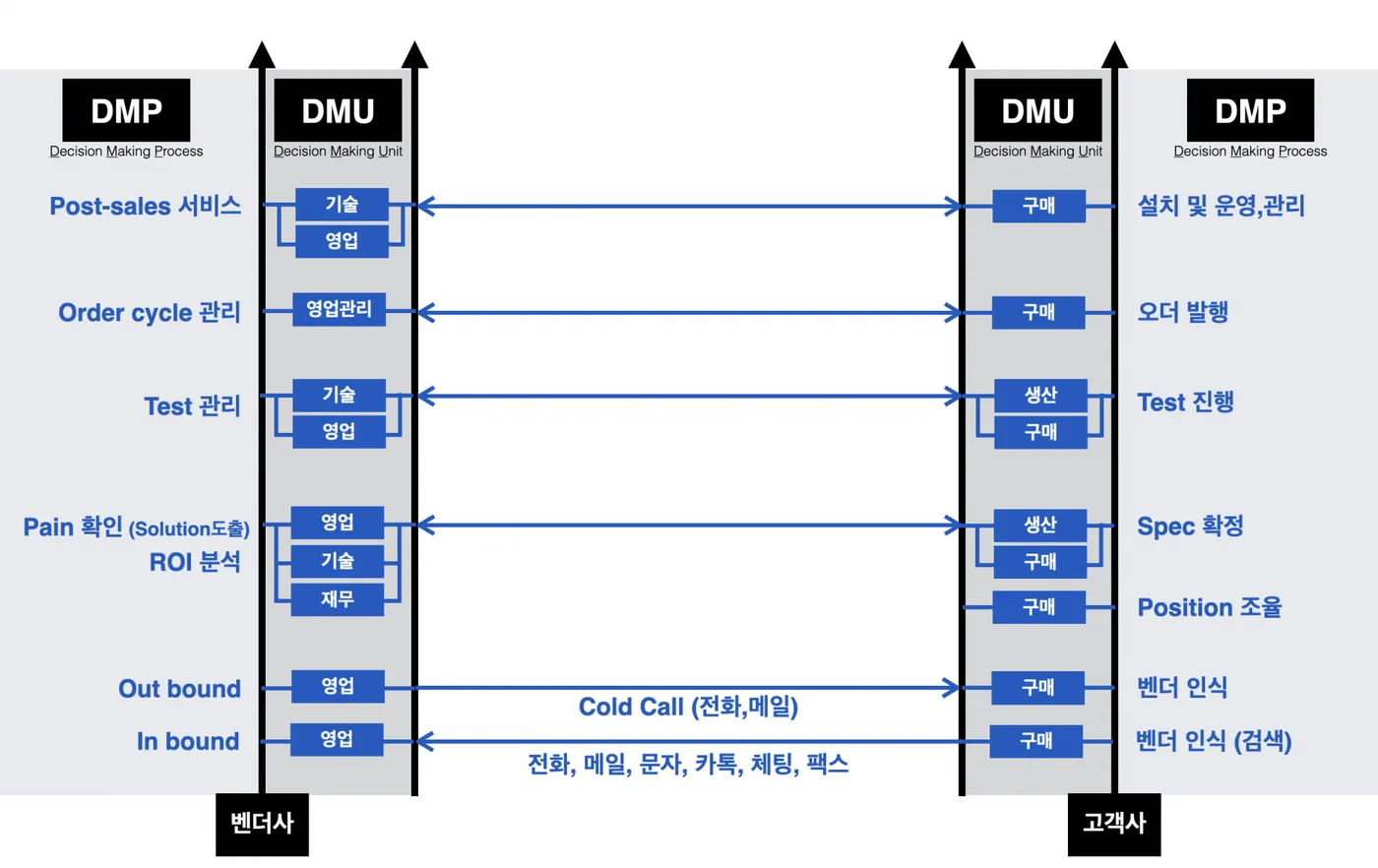
(a) Vendor awareness (inbound, outbound)
In this stage, the vendor wins new customers and strengthens relationships with existing ones through active sales efforts. The customer is contacted through various vendor channels and responds. Inbound sales is when a contact at the customer company reaches out on their own in response to the vendor's marketing. The vendor attracts customer interest online through content marketing, SEO, and social media marketing, and gets the customer to make contact. By drawing customers in and making them want to learn more about a product or service, the vendor creates sales opportunities. Customers can make contact by phone, email, text message, KakaoTalk, chat, fax, or website form. Outbound sales is when the vendor proactively approaches prospects directly. It uses phone calls, email, in-person visits, and trade shows to attract interest and propose business. Direct sales activity drives sales. Through these methods, the customer's purchasing team becomes aware of the vendor.
(b) Value proposition
In this stage, the vendor pins down the customer's problems and offers a solution, and the customer evaluates what value that solution brings to the business. The customer's purchasing team becomes the counterpart of the vendor's sales team. Internally, it talks with the users, finalizes the required specs, and issues an RFP (Request For Proposal). The vendor's sales or marketing team then takes the lead, consults the technical, production, and finance teams, and prepares the best-fit solution, proposal, and quote. In early meetings, often only the vendor's sales rep and the customer's purchasing rep attend. As meetings accumulate, a vendor 'technical sales' or 'R&D' representative and a customer-side user, such as someone from 'production,' may join. Depending on the key topics in those meetings, the vendor can adjust which kinds of value it emphasizes and how it positions itself.
㉰ Test Management
In this stage, tests are planned and run to confirm that the product or service meets the customer's requirements. For pilot tests of items such as equipment, parts, materials, and tools, the vendor's R&D or technical staff and the customer's production staff will be heavily involved. For IT solution providers, this typically means running a system integration test for the customer. The customer receives the test results from the vendor, or analyzes them directly, to evaluate the product or service's performance. Electronics vendors run extensive quality tests before delivering a new product to the customer. These tests catch and fix product defects in advance, so the customer sees high satisfaction when bringing the product to market.
㉱ Order Cycle Management
The vendor must systematically manage every step of the order cycle, including ordering, delivery, and inventory management, and meet the customer's needs precisely through an efficient order system. Order cycle management covers inventory management, order processing speed, and on-time delivery. The vendor optimizes inventory levels to shorten order processing time, while the customer monitors the order cycle and factors its evaluation of the vendor's efficiency into repurchase decisions. Suppose an auto parts vendor optimizes the order, production, and delivery cycle so the customer's production line runs without interruption. Thanks to that efficient cycle, the customer minimizes inventory costs and can respond to the market faster. If the vendor goes further, managing the whole process from order to delivery on a digital platform and supplying parts to the automaker's production line just in time, the value is so hard to replace that new suppliers will find it very difficult to enter.
㉲ Post-Sales Service
Even after the sale, the vendor must keep customers satisfied and encourage repeat purchases through ongoing technical support and account management. These services are essential to customer satisfaction and long-term relationships. At this stage, the vendor handles technical support, maintenance, and collecting customer feedback. The client evaluates the quality of the service it receives and requests additional support if needed. One example is a software company that provides regular updates and training for new users after the sale. After buying a product or service, the client monitors its performance and evaluates the quality of the vendor’s technical support and management services. For instance, a consulting company that sells project management software to a client keeps providing updates and maintenance afterward, and holds regular user training sessions for the client’s employees to increase software adoption. This helps the client improve project management efficiency, and the vendor maintains a long-term relationship. An electronics manufacturer runs a 24/7, 365-day customer support center for its products. When clients resolve technical problems quickly through this support, their productivity improves and competitors have a harder time winning them over.
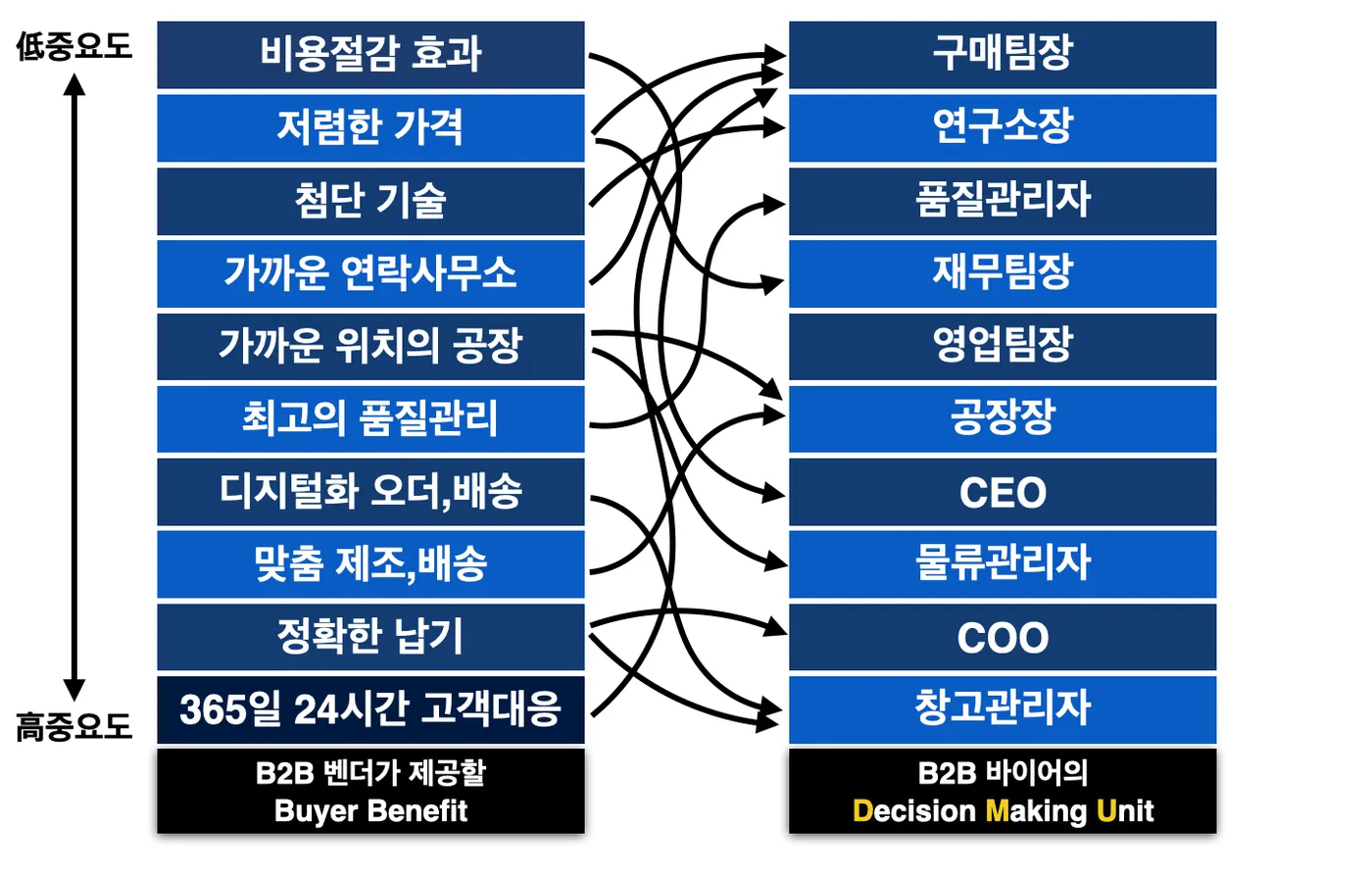
This slide visualizes a strategic approach: linking the benefits a B2B vendor offers to the people or departments that make decisions inside the customer company, known as decision-making units (DMUs). Buyer benefits, ranked by importance, are matched to the interests and needs of specific DMUs at the customer. The vertical axis on the left shows 'benefit importance,' and the vertical axis on the right shows 'type of decision maker.' Using these two axes, the matrix in the middle shows how to match vendor benefits to the right DMU. Each DMU has different roles and responsibilities within the company, and will pay attention depending on whether a benefit fits its needs. You could also turn this into a B2B sales simulation game. Try it as a quiz by blanking out both the left and right sides.
• Cost savings (Cost saving effect)
The 'cost saving effect' will interest the CFO (Chief Financial Officer) or the COO (Chief Operating Officer). The CFO focuses on overall cost management and the company’s financial health, while the COO wants to cut costs while improving operational efficiency. The purchasing manager and purchasing staff can also influence cost-saving decisions. At smaller clients, the CEO may be interested too.
• Affordable Price
Interest in 'affordable price' will naturally concentrate in the purchasing department. The finance team and the CFO (Chief Financial Officer) will care a great deal too. Purchasing is the function that buys goods and services for the company, so maximizing value for cost is its key performance measure. The CFO manages the company's overall costs and works to improve financial performance, so the cost savings a low price delivers matter a great deal to them.
• Advanced technology
Interest in 'cutting-edge technology' will mainly come from the CTO (Chief Technology Officer), the CIO (Chief Information Officer), or the heads of technical departments and research labs. Because they focus on strengthening the company’s technological competitiveness and driving innovation, they will care most about the value and potential impact of adopting the latest technology. A CEO with a technology background may be very interested in this as well.
• Nearest liaison office
A vendor's nearby liaison office will draw the most interest from DMU members who value operational efficiency and local service. These are especially the head of SCM (supply chain management), the COO (Chief Operating Officer), and purchasing and production team members. They put fast communication and quick problem resolution above all else.
• Factory located nearby
A 'nearby factory' appeals mainly to DMU members closely tied to production management, supply chain management (SCM), and logistics. These members may be the COO (Chief Operating Officer), the head of SCM, or the head of production. They care about production continuity, delivery speed, and minimizing inventory costs. The customer may not even need to hold safety stock in its own warehouse.
• Best quality control
The vendor’s 'best quality control' benefit appeals to every DMU member who prioritizes quality, but it will matter most to the head of Quality Assurance (QA), the CTO (Chief Technology Officer), and the COO (Chief Operating Officer). They are responsible for quality standards and regulatory compliance, and final product quality directly affects whether the company meets customer expectations and protects its reputation.
• Digitalized Order and Delivery
The DMU members most interested in 'the vendor’s digitalized order and delivery system' are likely the CIO (Chief Information Officer), the COO (Chief Operating Officer), and the head of SCM (Supply Chain Management). They aim to improve their company’s technology infrastructure and operational efficiency, and they care about making ordering and delivery more transparent and efficient through a digital system. System compatibility can be a key deciding factor.
• Customized manufacturing and delivery
Interest in the 'customized manufacturing and delivery' service will come mainly from the head of product development, the COO (Chief Operating Officer), and the head of SCM (Supply Chain Management). For these DMU members, manufacturing products to their company's specific requirements and an efficient delivery process matter most. They want to know how customized products and services can raise customer satisfaction and competitiveness.
• On-time delivery (Exact delivery date)
The client DMU members most interested in 'the vendor’s on-time delivery' are the head of SCM (Supply Chain Management), the COO (Chief Operating Officer), and project managers. They are directly responsible for supply chain efficiency, product launch schedules, and keeping commitments to customers, and on-time delivery from suppliers affects all of these.
• 24/7, 365-day customer support (Customer service 24 hours a day, 365 days a year)
IT managers, plant managers, production managers, and the CTO (Chief Technology Officer) will show the most interest in a vendor's 24/7, 365-day customer support. They play a key role in resolving problems quickly and keeping systems running reliably. In businesses where IT infrastructure or technical support is essential, this capability is directly tied to customer satisfaction.
To be continued