3) VWE (Value Word Equation) / Example 1
Making a 'tangible' value proposition that resonates with B2B customers is a critical step in B2B sales and marketing. To present a value proposition to clients, B2B vendors and suppliers need a VWE (Value Word Equation). A VWE is 'a way of converting the performance, lifespan, functionality, and productivity gains of our offering into money, using simple words or mathematical formulas, in comparison with the competitor’s value proposition.' I’ve also explained this simply in the article 'Let’s Sell Industrial Laptops!' Now let’s go a little deeper, using the two examples below.
[Example 1]
Let’s start with an assumption: Company A’s equipment, made in Korea, costs KRW 100 million (≈ US$74,800) per unit, while a competitor’s Chinese-made equipment costs KRW 70 million (≈ US$52,400) per unit. The time unit is one year.
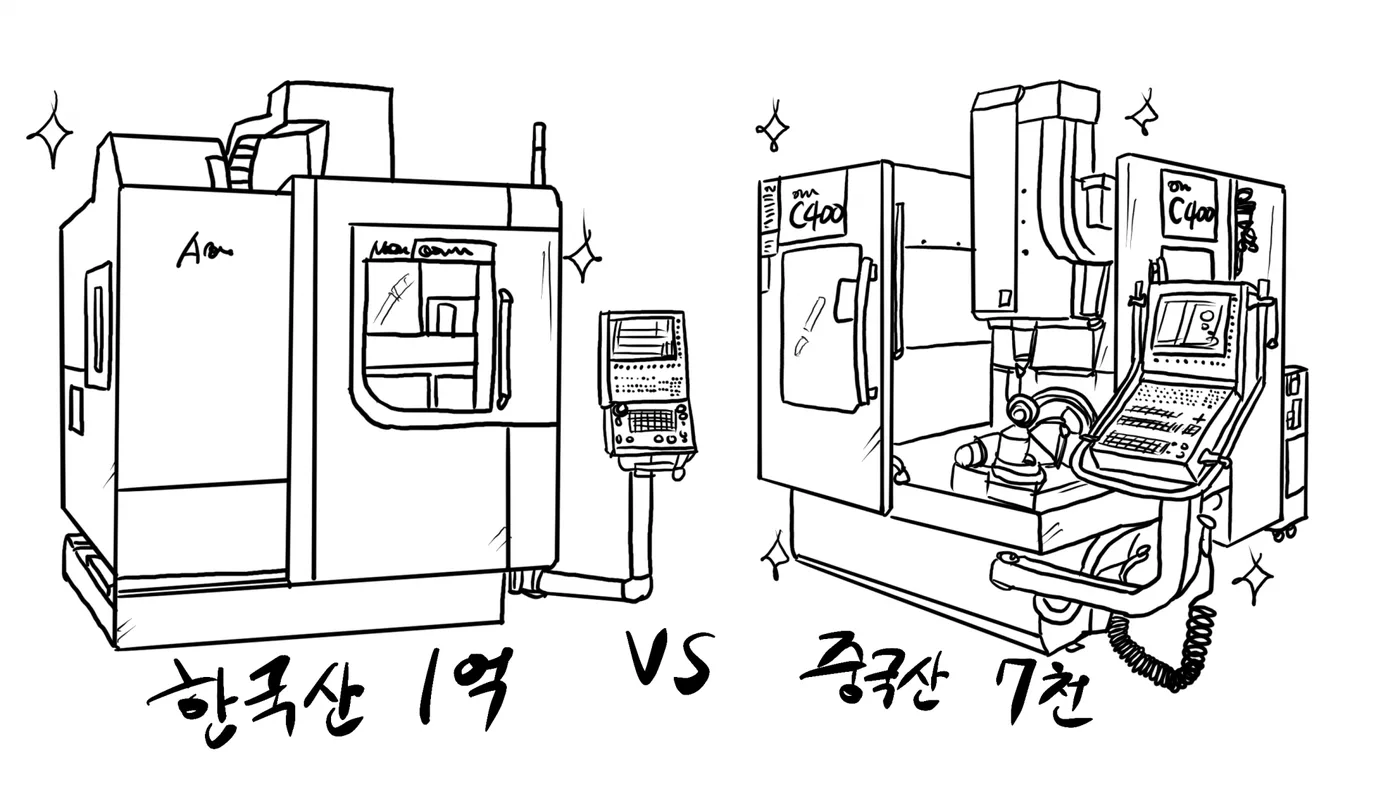
• Our price (KRW 100 million (≈ US$74,800)) vs. competitor’s price (KRW 70 million (≈ US$52,400))
As shown above, supply prices alone don’t allow an accurate comparison. A fair comparison requires applying the Competitive Savings Impact (CSI) to our price. The formula then becomes:
• Our price (KRW 100 million (≈ US$74,800)) - (CSI x years) vs competitor price (KRW 70 million (≈ US$52,400))
Compare the competitor’s supply price with our supply price minus the annual savings versus that competitor, multiplied by the number of years. How do we work out this CSI (Competitive Savings Impact)? Use the formula below.
• CSI = TCSRI−CSRIC
Here, TCSRI stands for Total Cost Savings and Revenue Increase, the 'total cost savings and revenue increase formula.' Subtract CSRIC (Cost Savings and Revenue Increase from using Competitor's) from this amount. If the result is positive, our offering delivers more benefit; if negative, the competitor’s offering delivers more. For CSRIC, enter the amount the competitor claims, or an amount estimated by the customer or by us. To find the TCSRI of our equipment, use the formula below.
• TCSRI = ECS+MCS+LCS+IPR
Here, ECS is Energy Cost Savings, MCS is Maintenance Cost Savings, LCS is Labor Cost Savings, and IPR is Increased Productivity Revenue, meaning the additional revenue from higher productivity. For ECS, estimate the annual energy savings per unit of equipment. For MCS, factor in quality, failure rates, and ease of maintenance. For LCS, calculate based on the degree of automation. For IPR, calculate the additional revenue gained from improved productivity. I’ve made it sound simple, but these calculations are tricky, and quantifying the results in numbers and amounts is not easy. Depending on the situation, other factors may be added.
If the VWE calculation comes out as
• Our price (KRW 100 million (≈ US$74,800)) minus (KRW 10 million (≈ US$7,480) x years) vs. competitor’s price (KRW 70 million (≈ US$52,400))
above, then buying 10 units means an upfront cost of KRW 1 billion (≈ US$748,200) vs KRW 700 million (≈ US$523,700). But with KRW 100 million (≈ US$74,800) in annual savings versus the competitor, over 5 years of use: { Our price (KRW 1 billion (≈ US$748,200)) - (KRW 100 million (≈ US$74,800) x 5 years) vs competitor price (KRW 700 million (≈ US$523,700)) }
The conclusion: a saving of KRW 200 million (≈ US$149,600) compared with the competitor. The key message to deliver is 'KRW 200 million (≈ US$149,600) saved'.
To be continued