B2B sales and marketing to corporate customers, and B2G sales and marketing to government customers, often see fortunes swing dramatically with changes in the political and economic environment. In the October 2023 Polish general election, the nationalist ruling party failed to win a majority, and power passed to an opposition coalition. An opposition lawmaker mentioned as the next defense minister said that "contracts signed by the previous government after the election will be re-analyzed and evaluated," putting Korea’s major defense companies on edge, including Hanwha Aerospace, Hyundai Rotem, and KAI (Korea Aerospace Industries), which won large defense contracts with Poland. As this case shows, B2B vendors are exposed to several major outside factors. Let’s look at them together.
1) Environment
① Economic Outlook
Major events of the past five years have had a large impact on interest rates, raw material prices, exchange rates, and other economic factors. They include the global COVID-19 pandemic in 2019, Russia's invasion of Ukraine in 2022, and the Israel-Hamas war in 2023. In 2020, COVID shut down the global economy, but remote work and education continued online, and major governments released huge amounts of cash as subsidies to respond to the pandemic. Consumers had more cash in their pockets, but disruptions in production and logistics created an imbalance between supply and demand. With demand exceeding supply and inflation already intensifying, the Russia-Ukraine war pushed raw material prices sharply higher and poured fuel on the fire of inflation. When this happens, people spend more and save less, real income falls, and the economy can slow. As savings shrink and interest rates rise, companies have no choice but to cut new investment and other costs, and to restructure. To rein in inflation, central banks raise their benchmark rates, which hurts the real estate and stock markets.
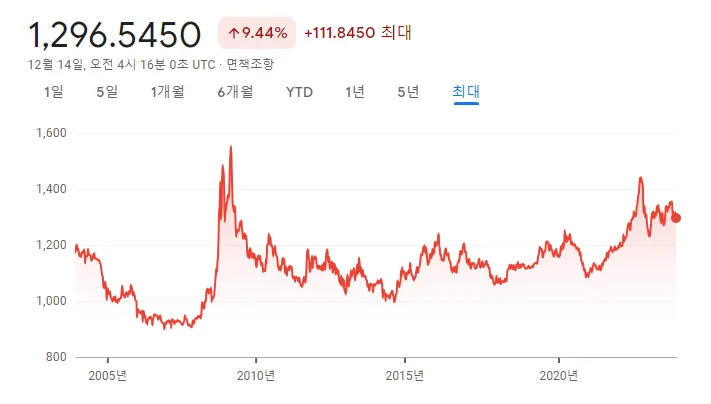
Exchange rates are another major factor that strongly affects corporate customers. The won-dollar exchange rate over my roughly 20-year career tells the story of the economy. In 2006 and 2007 the rate was in the 900s won per dollar; during the 2008-2009 global financial crisis it was in the 1,300-1,400 range. Heading into 2024, it is in the 1,300s. Industries such as steel and paper, which import large volumes of raw materials, can see profitability deteriorate sharply as material costs rise. So how does a high won-dollar rate (a weak won) affect exports? The dollar price stays the same but earns more in won (USD 100: KRW 900,000 (≈ US$675) → KRW 1,300,000 (≈ US$975)), so a company could lower its dollar price to boost sales volume. Companies that source most of their raw materials domestically would benefit, but Korea is a resource-poor country, and if a company relies heavily on imported raw materials (as most do), higher procurement costs will cancel out the sales gain from lower dollar prices. A high exchange rate also raises goods prices in the domestic market, so consumers cut spending and sales fall. That leads to job cuts and cost reductions, creating a vicious cycle.
② Client’s Market Position
As of December 2023, one film is closing in on 10 million viewers. It is “12.12: The Day” (Seoul Spring), based on the “12.12 incident,” the coup staged in Seoul on December 12, 1979 by a new military faction centered on the Hanahoe group. Kukje Group, which started in 1949 as a rubber-shoe maker called Kukje Rubber and was famous for the Prospecs brand that was hugely popular in the 1980s, refused to cooperate in raising funds for the Ilhae Foundation run by President Chun Doo-hwan of the Fifth Republic. Hyundai Group, then ranked No. 1, paid KRW 1.5 billion (≈ US$1,122,300) in cash (about KRW 6 billion (≈ US$4,489,000) in today’s terms), Samsung Group at No. 2 also paid KRW 1.5 billion (≈ US$1,122,300) (about KRW 6 billion (≈ US$4,489,000) today), and Lucky-Goldstar Group (now LG Group) at No. 3 paid KRW 1.2 billion (≈ US$897,800) (about KRW 4.8 billion (≈ US$3,591,200) today). Kukje Group, by contrast, offered a KRW 500 million (≈ US$374,100) promissory note (about KRW 2 billion (≈ US$1,496,300) today), and was dismantled in 1985 for its lack of cooperation. The partner companies that supplied Kukje Group with raw materials, parts, personnel, and services must have suffered greatly as well.
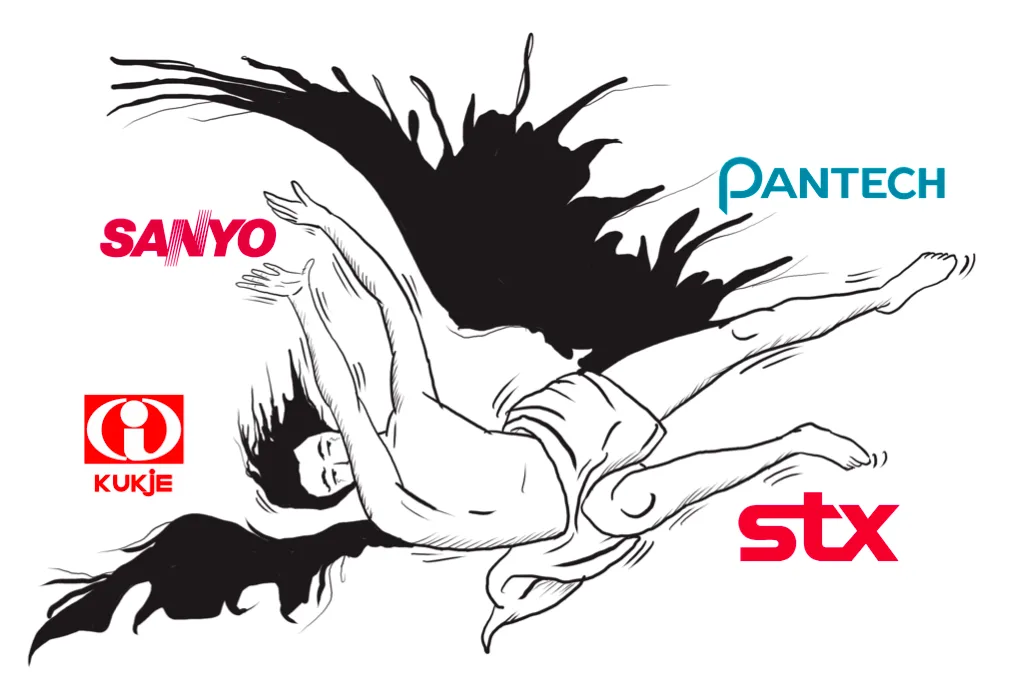
Do you know the mobile phone maker Pantech? It was founded in the early 1990s by a salesperson from Maxon Electronics, the maker of the cordless phone my own family used in the late 1980s, and it grew into a wireless equipment manufacturer. In the late 1990s it formed an alliance with Motorola and received investment, and in the 2000s it acquired Hyundai Curitel and SK Teletech. It was best known for its Sky series. At one point it supplied phones and smartphones to the major handset makers and carriers and owned a well-known brand of its own, yet the company went bankrupt in 2017. In 2001, Kang Duk-soo, then CFO of Ssangyong Heavy Industries, founded STX Group, and within ten years built it into Korea's 13th-largest conglomerate. He expanded along the B2B value chain. After personally acquiring Ssangyong Heavy Industries, a marine engine maker, and renaming it STX, he acquired Daedong Shipbuilding, a customer, then Pan Ocean, a bulk carrier specialist and a customer of that shipbuilder. The peak of the expansion was the enormous STX shipyard built in Dalian, China. In boom years the group grew rapidly: higher cargo volumes lifted shipping profits, ship orders went to the group's own shipyards, and engine orders went to its own heavy industry arm. After the financial crisis, however, it entered court receivership in the 2010s, and its affiliates were split off and sold one by one. Sanyo Electric was founded in 1947, when it split off from Matsushita, a company tied to Japan's wartime regime, and received factories and patents. It began to grow by supplying bicycle dynamo lamps in large volumes to the U.S. military government. In the early 1950s it caught consumers' attention with radios made of lightweight plastic, built affordable home appliances, developed into a full-line appliance maker, and kept winning in overseas markets, starting with the U.S. It was especially friendly to Korean companies, and it formed a joint venture with Samsung Electronics, Samsung-Sanyo Electric, to introduce TVs, refrigerators, washing machines, and other electronics to the Korean market. Its technology was strong too: in the mid-1970s it developed and mass-produced the world's first lithium-ion battery and amorphous silicon solar cells, in the 1980s it supplied batteries to Duracell of the U.S., and in the late 1990s it made nickel-metal hydride batteries for hybrid cars, leading its field. But it made a serious mistake by spreading its investment across home appliances, semiconductors, and batteries just as competition intensified, and it lost its competitive edge. The financial crisis then hit, and its affiliates were split off and sold one by one.
If you run a B2B business concentrated on one or two customers without diversifying your accounts, the moment that customer's market position weakens, your business can face an existential crisis. To prevent this, you must keep watching your customers' internal situations and industry trends, and keep building business with other customers. You also need to diversify beyond direct supply into other distribution channels, and open new markets by changing application fields, to hedge risk.
To be continued