Key criteria for B2B sales and marketing
In 1998, the author, then a university student back from military service, sold copper and silver rings, bracelets, and other accessories imported from Tibet and Nepal on early online marketplaces such as Waawaa (Waawaa.com) and Auction (Auction.co.kr), as well as on a personal homepage. I was surprised that so many people bought from posts with product photos taken on an early-era digital camera from the late 1990s and edited rather clumsily. Customers placed orders through guestbook posts on my personal homepage, paid in advance, and I mailed the items in envelopes. For a university student, it was a handy business that brought in several hundred thousand won a month. While juggling school and the business, problems started to appear one after another. Some rings left green marks on customers’ fingers, and some orders that had been paid for in advance were never shipped because I did not manage them properly. I could not handle these problems well, and customer complaints poured in. In this kind of B2C business, the impact of a defective product or sloppy operations is relatively limited, but what about B2B businesses that deal in materials, parts, equipment, and tools?
In May 2011, a supply problem hit the piston ring, a ring-shaped part that seals pressure and gas between an engine cylinder and its piston, transfers heat well, and keeps lubricant from leaking. The cause was trouble at 'Yoosung Enterprise', which supplied engine parts such as camshafts, cylinder liners, and piston rings to Korean automakers with an 80% market share. Yoosung’s union, locked in a dispute with management over work schedules and the pay structure, had gone on strike. A piston ring costs only KRW 1,000 (≈ US$1)–2,000 apiece, yet the stoppage grew into a massive production disruption that could halt the lines of many automakers in Korea and abroad. Yoosung’s daily revenue at the time was about KRW 500 (≈ US$1) million, but damages for the halted deliveries could have reached KRW 20 (≈ US$1)–30 billion per day. Behind the incident lay a tangle of factors: the relationship between Hyundai Motor and Yoosung, government labor policy, and the union’s struggle. Even so, to the author it was the moment the ripple effect became visible: in B2B manufacturing, where value chains are intricately linked, the quality or supply of a small, seemingly trivial part can have enormous consequences.
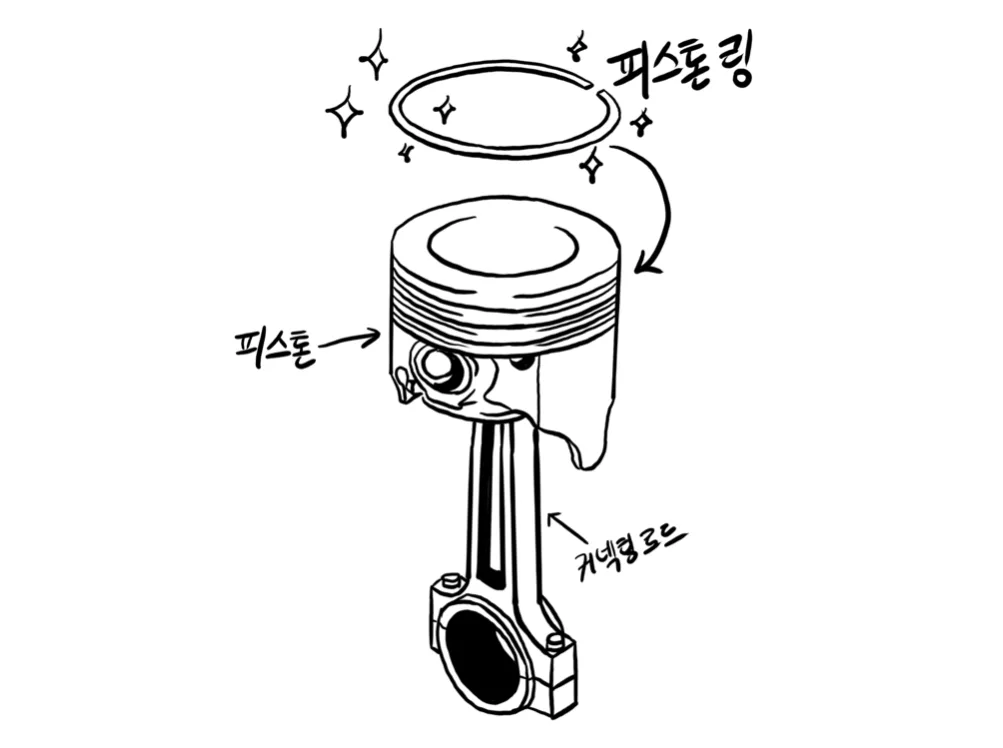
Let’s use our imagination and play out a scenario: 'a quality problem with AA Corp’s piston rings.' In May 20XX, AA Corp supplies piston rings to HH Motor at KRW 1,000 (≈ US$1) each. Of HH Motor’s daily output of 6,000 vehicles, AA Corp has an 80% supply share, so daily revenue is KRW 86.4 million (≈ US$64,600) for 4,800 vehicles. Over 30 days, it has delivered 2,592,000 piston rings worth KRW 2.592 billion (≈ US$1,939,200). One month later, a call comes in from HH Motor’s manager.
HH Motor: (In an agitated voice) We are seeing a growing number of problems with engines built with AA Corp’s piston rings. Customer complaints are flooding in, and the cost of recalls and repairs is substantial. Our analysis found that the problems come from breakage of the piston rings you made. Repairs for the 144,000 units produced in one month alone will cost KRW 14.4 (≈ US$1) billion, so we ask that you compensate us in full in cash and, of course, quickly deliver quality-improved replacements for the roughly KRW 2.6 billion (≈ US$1,945,200) worth of piston rings supplied during that period.
(Author : When a quality problem like this occurs, clients most often file a strong claim, and they frequently inflate the estimated damages to gain the upper hand in later negotiations. How should you respond? Is it right to say 'I am sorry.' and leave it at that? When a defect occurs in B2B manufacturing, there are many possible causes: equipment problems, operator carelessness, program malfunctions, power supply issues, material problems, tooling problems, and more. Large foreign-owned suppliers defend themselves well because they have decades of accumulated data and references. That is why small and mid-sized Korean suppliers are so often singled out as the cause. At this point in the case, we do not yet know what the cause of the problem is.)
AA Corp: We regret that this problem has occurred. We will analyze the root cause of the defect and get back to you. We would appreciate it if you could provide the status of the problems with your engines, along with samples of our piston rings that are suspected to be the cause. Our research lab will run its own analysis, but we would also like to jointly commission a third-party testing organization.
(Author : Over the past 10+ years, in training sessions and workshops with many manufacturers, I have discussed quality incidents with managers at small and mid-sized companies. Many said that more than 50% of the quality problems blamed on their own company were actually caused by something else. So even when a client raises a quality issue, the basic approach is not to simply accept it from the start, but to commission a credible third-party organization to find the fundamental problem, the root cause. And it goes without saying that the supplier should quickly secure samples of the problem and begin its own analysis, right? )
[ 2 weeks later ]
HH Motor : The analysis results are in. The material properties of the piston rings that failed differ from those of your piston rings delivered in other periods. As a result, they crack and break easily, causing gas and lubricant to leak and impurities to form inside the cylinders. As I mentioned earlier, repairs for the 144,000 vehicles produced in one month alone cost KRW 14.4 (≈ US$1) billion, so we ask that you pay the full amount in cash.
AA Corp: Our investigation reached similar findings. The problem was a change in heat treatment method in the batches produced during that period, which increased brittleness and caused cracking. We sincerely apologize and will send you a report on the corrective measures within a few days.
(Author : When a quality problem occurs and is confirmed to be your company’s fault, apologize quickly and sincerely, investigate in detail to find the root cause, and act fast. At the same time, draw up countermeasures, carry out corrective action and testing, and standardize the process with the cause of the defect eliminated. The first document to send the customer is the quality 'Improvement Plan', of course.)
HH Motor : Understood. And how will you compensate us for the KRW 14.4 billion (≈ US$10,773,600)?
AA Corp: Our annual revenue is around KRW 50 (≈ US$1) billion, so KRW 14.4 billion (≈ US$10,773,600) is about 30% of it. As you know, our profit margin is only 2-3%. Compensation of that size would put our company in serious financial danger. We ask for your leniency. Over the long term, we will manage quality so that problems like this do not recur, and we will work to become a vendor that actively supports you. Please show leniency and reduce the compensation as much as you can.
(Author : The best case is that the quality problem is not your company’s fault. But if it turns out to be, you must negotiate to reduce the compensation. Most often the argument runs: 'If we accept the compensation you demand as is, we will go under. Please show leniency and reduce it.')
HH Motor : We understand the situation. Given our relationship of more than a decade, we discussed this internally and will substantially reduce the compensation to around KRW 5 billion (≈ US$3,740,800). Please pay the full KRW 5 billion (≈ US$3,740,800) in cash.
(Author : Is it better to pay the compensation in cash, or in kind?)
AA Corp: I am sorry to say that our cash flow does not allow us to pay KRW 5 billion (≈ US$3,740,800) in compensation in cash. If you can accommodate us, may we instead provide KRW 5 billion (≈ US$3,740,800) worth of the 'camshafts' that we are already delivering to HH Motor without any problems? We would be grateful for your understanding.
(Author : Cash? Or goods? This is a critical stage of the negotiation. The answer is, of course, goods! The manufacturing cost, which reflects material costs and manufacturing expenses, is lower than the amount based on the selling price. And as production volume grows, the unit manufacturing cost can fall. You might even take market share from competitors. )
HH Motor : Understood. Please deliver an additional KRW 5 billion (≈ US$3,740,800) worth of 'camshaft' products as compensation. When will you deliver them?
(Author : That answers 'when', the delivery date. But something matters even more: 'in how many installments?' Whether it is a single delivery or split deliveries makes a big difference.)
AA Corp: I apologize for raising this again, but delivering 'camshafts' worth KRW 5 billion (≈ US$3,740,800) in a single batch would add inventory-management costs for HH Motor. On top of the camshafts we currently deliver at KRW 1 billion (≈ US$748,200) per month, could we add about KRW 250 million (≈ US$187,000) per month in additional volume and deliver the KRW 5 billion (≈ US$3,740,800) in 20 installments?
HH Motor : Twenty installments would take too long. Please split it into 10 installments with an additional KRW 500 million (≈ US$374,100) per month in volume, and reduce your existing monthly camshaft deliveries from KRW 1 billion (≈ US$748,200) to about KRW 700 million (≈ US$523,700).
AA Corp: Could we keep the existing monthly volume of KRW 1 billion (≈ US$748,200) and deliver KRW 700 million (≈ US$523,700) worth of product per month free of charge over 7 deliveries?
HH Motor : Fine, let’s do that. How do you plan to improve the quality of the piston rings?
AA Corp: After internal testing, we plan to deliver the improved product quickly. We will also keep testing products with improved quality over the current ones, to help HH Motor cut costs and improve quality.
[ Basis of calculation ]
* 1 ring per piston: KRW 1,000 (≈ US$1)
* Rings required per piston, per cylinder: 3 (KRW 3,000 (≈ US$2))
* 6 pistons per car engine: KRW 18,000 (≈ US$13)
* HH Motor daily output of 6,000 vehicles (80% share / 4,800 vehicles): KRW 86.4 million (≈ US$64,600)
* HH Motor 30-day output of 180,000 vehicles (80% share / 144,000 vehicles): KRW 2.592 billion (≈ US$1,939,200)
* HH Motor 30-day output of 180,000 vehicles (80% share / 144,000 vehicles) (KRW 100,000 (≈ US$75) loss per vehicle): KRW 14.4 billion (≈ US$10,773,600)
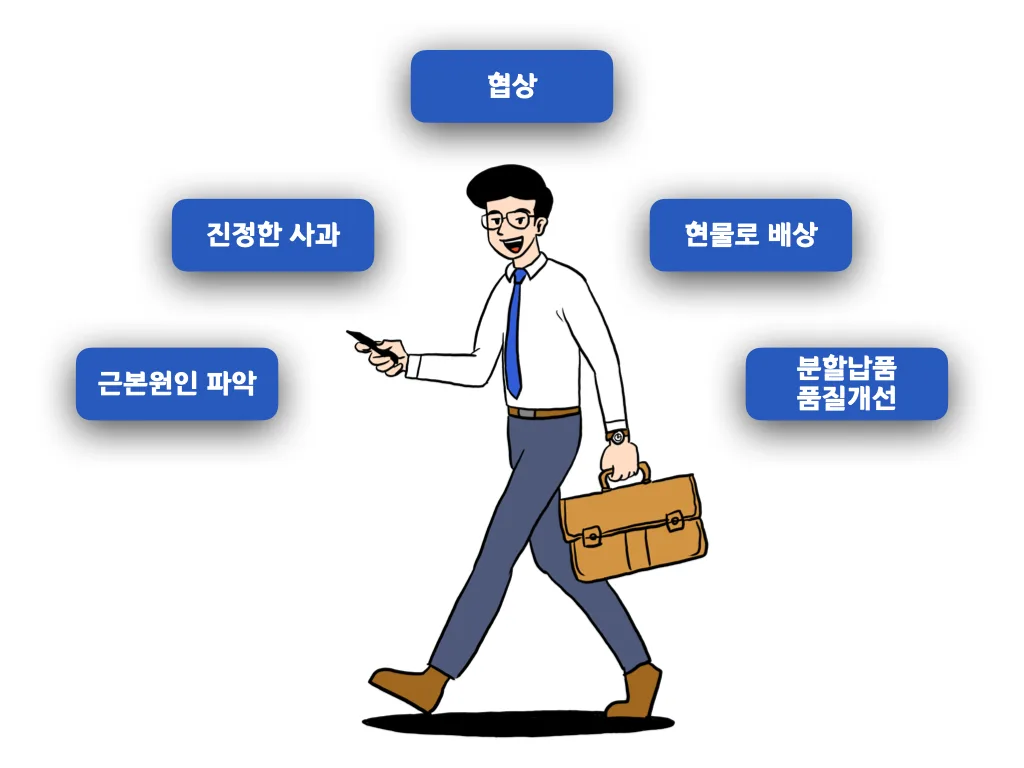
Readers from the automotive industry may find this piece unrealistic, so please keep in mind that it comes from the author’s imagination. Here is a summary of how to respond when a quality defect occurs. When a defect hits a B2B client, you will face claims far larger than anything in B2C: returns, replacement costs, recalls, and damages. The first thing a supplier must do is identify the root cause. If the supplier, the client, and a third-party body find that the defect originated with the supplier, the supplier must offer a sincere apology and a quality improvement plan, and then do everything it can to reduce the compensation in the negotiations that follow. Once the amount is settled, deliver goods in kind rather than paying cash, and spread the deliveries over as many installments and as long a period as possible. The client will not be able to cut ties with the supplier overnight. At the same time, the supplier should move quickly to improve the quality of the affected product and turn the crisis into a blessing in disguise (轉禍爲福).
To be continued