The Key Criterion in B2B Marketing: Quality? Ethics!
<Hand-drawn illustration>
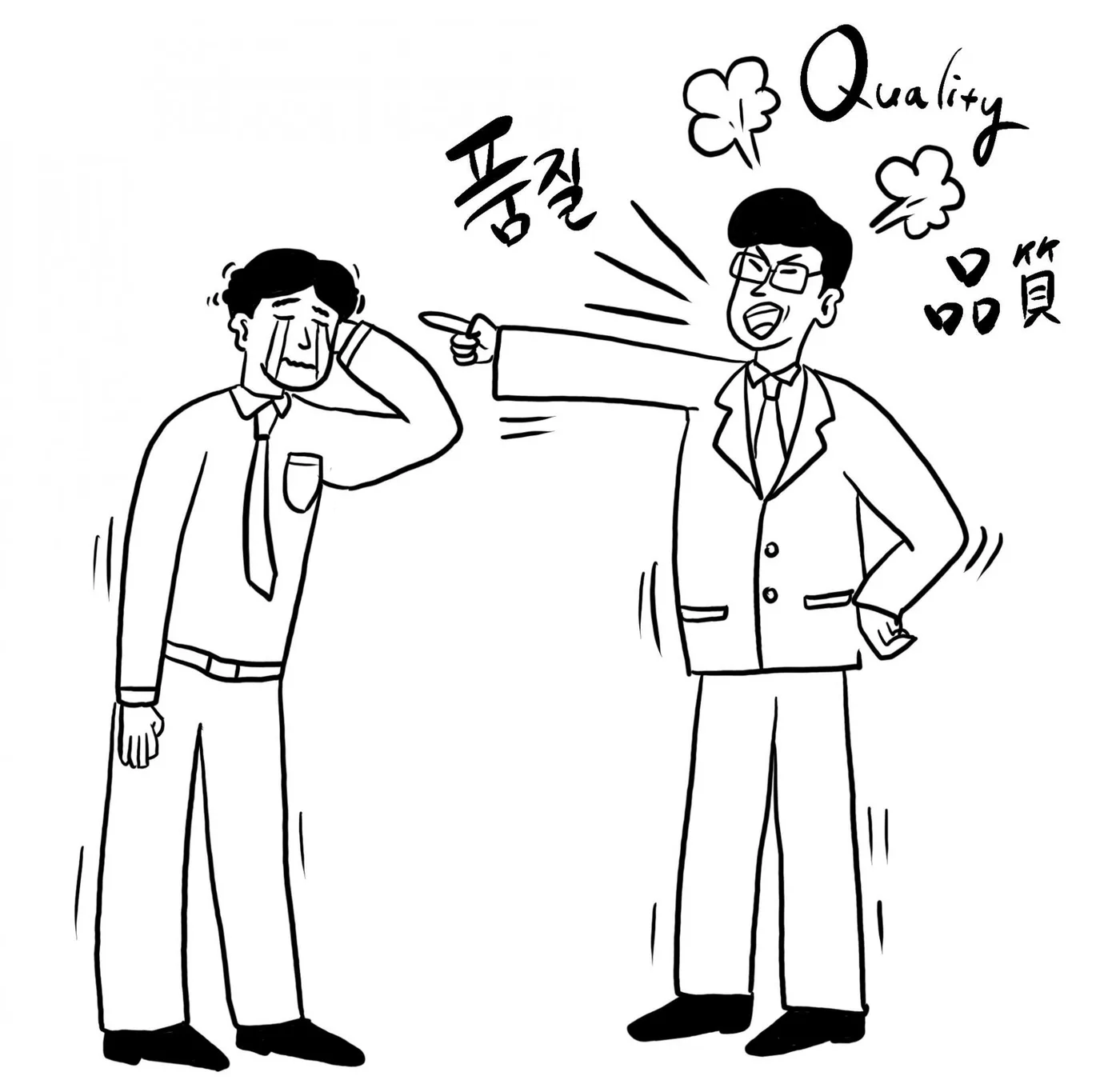
Quality matters a great deal in B2C businesses that supply products and services to consumers, but in B2B its importance is even greater. In B2B, a problem with a supplier’s product or service, whether parts, materials, equipment, tools, operating software, or consulting, can halt production, delay delivery, or force rework at enormous extra cost. And if a quality problem goes unnoticed and the final product reaches the next customer in the value chain, the accumulated value of every earlier step is at stake. Returns, replacement costs, legal disputes, and damage claims then create a fallout that B2C cannot compare with. Let’s look at some representative cases of B2B quality failures.
① Samsung Galaxy Note7 Fires

Samsung Galaxy Note7 (Source: Samsung Electronics website)
Samsung Electronics’ Galaxy Note7, released on 19 Aug 2016, should have been the Note6 in the usual numbering. Samsung skipped ahead to “Galaxy Note7” to match the Galaxy S7. The phone had curved glass, an edge design, a high-performance application processor, large RAM and expandable storage, and the market expected a lot from it. Six days after launch, reports of explosions and fires began to pile up. By September, similar incidents had been reported overseas, including in the US, Taiwan and Australia. The US Federal Aviation Administration even moved to ban the Note7 from aircraft. Samsung started a first recall on 2 Sep 2016 and reissued quality-improved units on 1 Oct, but the same explosions recurred, forcing a second recall. On 11 Oct, Samsung announced it was discontinuing the Note7 and would replace every unit with a quality-improved new product. The incident cost Samsung KRW 2.5 trillion (≈ US$1,870,417,500) in lost sales. Many theories circulated about the cause. The most plausible blamed the batteries: cells made by DONGGUAN ITM ELECTRONICS of China and imported by Samsung SDI, and cells made and supplied by China’s ATL, an affiliate of Japan’s TDK Group, both failed, so the cause was described as complex. According to the Korean Agency for Technology and Standards, the most likely cause of the fires was a design flaw at the battery corners combined with poor quality control, which compressed the negative electrode plates and damaged the separators. Suppose Samsung’s own design had been sound, and the fatal root cause was a battery maker that changed the design without approval or failed at its own quality control, triggering the biggest quality issue in Samsung Group history. That battery maker would have owed compensation not for the value of the batteries it supplied, but for enormous losses: the revenue from finished smartphones, lost sales opportunities and damage to the Samsung brand. After the Note7 battery fires, Samsung began a fundamental overhaul. It put safety first in parts procurement, supplier management and its own production processes, created a dedicated quality control organization, and turned the crisis into an opportunity. When a quality issue arises, the best response seems to be an honest, transparent and fast one.
② The Sony Battery Recall
Sony headquarters (Source: Sony website)
The Sony Walkman my father brought me from a business trip to Japan in the 1990s was cutting-edge electronics at its best. Instead of ordinary cylindrical disposable batteries, this thin cassette player took a flat, gum-shaped rechargeable battery, and it even played voice guidance when you pressed a button. Sony developed the world’s first lithium-ion battery in 1990 and moved into mass production in 1991. Then, starting in early 2006, laptops powered by Sony-made batteries began overheating and catching fire, one after another. Do you remember the PMP (Portable Multimedia Player), a popular device in the mid-2000s? It combined a hard drive, a lithium-ion battery and a small LCD screen so you could watch videos on the go. I used a PMP called the “iStation” on overseas business trips, until one day its battery swelled up, overheated and killed the device. Battery problems like this were especially common in the mid-2000s. Sony supplied batteries to laptop makers around the world: 4.1 million to Dell, 1.8 million to Apple, 830,000 to Toshiba, 300,000 to Hitachi and 300,000 to Fujitsu. When those batteries proved faulty, a massive recall was unavoidable. So how should compensation work for a quality problem in battery components delivered B2B? At first, Sony offered to cover only about US$230 million for battery replacement, shipping and replacement labor. But the laptop makers had been hit by the problem just before Christmas, the peak sales season, and had lost market share to rivals that did not use Sony batteries. They demanded compensation for indirect costs as well, including customers lost to dissatisfaction and damage to brand value, and the figure rose to as much as US$850 million. Sony also had to recall more than 8 million of its own “VAIO” laptops fitted with those batteries, so on top of the visible losses it suffered enormous opportunity losses. Its credit rating fell, and the entire Sony Group faced a serious crisis.
③ Takata’s “deadly airbags”
<Hand-drawn illustration>
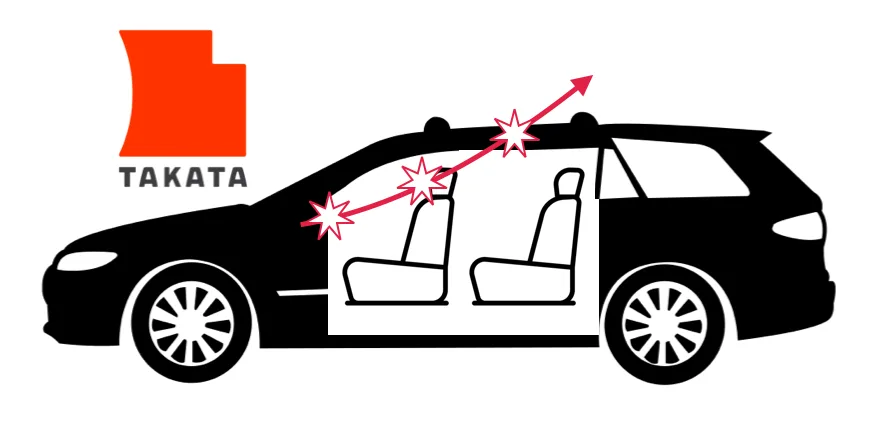
In 2010, my father, my mother, and my wife were riding together in a Kia Opirus in downtown Seoul when a drunk driver hit the car from the side. My wife still remembers vividly the moment the car speeding in from the left struck us. The front and side airbags deployed instantly and cushioned the impact as my parents’ heads hit the window in the front seats, so they were not seriously hurt. The airbag was reportedly invented in 1951 by John Hetrick, a US Navy torpedo engineer, who came up with the idea after shielding his young daughter and the dashboard with his own body during a car accident. The Japanese airbag maker Takata was founded in Saga Prefecture, Japan, in 1933 and grew by supplying parachutes to the Japanese military during World War II. It then used the seat belt technology that Volvo of Sweden invented in 1959 and gave away for free to shift its business toward auto parts, and it also devoted itself to airbag development. In 1989, Takata seized on the US government’s airbag mandate to expand its business significantly. An airbag works by packing a propellant, compressed into pill-shaped tablets, inside a metal canister; in a crash it expands instantly to inflate the bag. The early propellant was sodium azide, a toxic compound of sodium and nitrogen, which could cause chemical burns or respiratory damage to passengers when the airbag deployed. So in 1998, Takata developed a next-generation, non-azide compound harmless to humans called tetrazole. But tetrazole was expensive to produce and cut into Takata’s profits, so the company went looking for a cheaper propellant to improve its margins, and that was ammonium nitrate. This is the same substance that caused the huge explosion in the port of Beirut, Lebanon, in August 2020, producing a mushroom cloud like an atomic bomb’s. Using an explosive material as the propellant cut propellant costs by 90%. Starting in 2004, cars fitted with Takata airbags began to suffer a string of airbag explosions. In 2014, the US National Highway Traffic Safety Administration recalled all vehicles fitted with Takata airbags. Worldwide, 16 people died from this quality defect, and the recall exceeded 100 million vehicles. Takata, an airbag maker that chose profit over safety, was ultimately driven into bankruptcy by fines, damages, and recall costs. It is a textbook case of a company focusing only on its own profit instead of customer safety.
④ The Ford Pinto Case
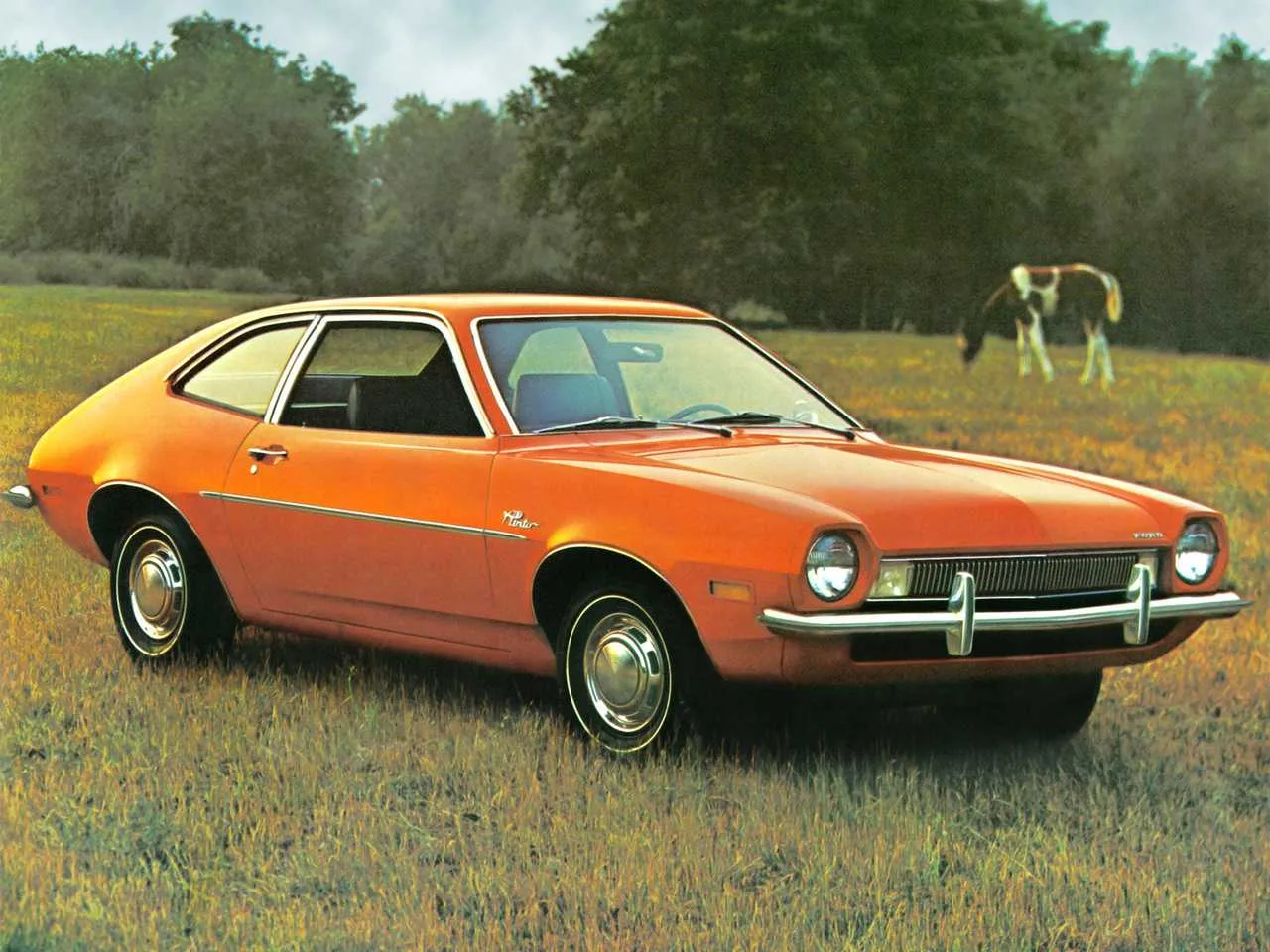
Ford Pinto (Source: https://car.info)
As of October 2023, oil prices are soaring due to the clash between Israel and Hamas. On October 7, 2023, Hamas launched a large-scale attack timed to Yom Kippur, Israel’s holiest day, just as in the 1973 Fourth Arab-Israeli War. In 1973, the Arab oil-producing countries cut oil production and raised prices, while restricting exports to countries that had supported Israel. The result was the 1973 Oil Crisis. The crisis hit American automakers hard, as they had built large cars with little concern for engine size because oil was cheap. Japanese makers, which built small cars that were sturdy, economical, and eco-friendly, such as the Honda Civic, gained an unprecedented opportunity. The case I want to discuss here, the Ford Pinto, was a model launched just before the oil crisis. In the 1950s, Germany’s Volkswagen Beetle entered the U.S. and began to target a niche market. By the 1970s, Volkswagen was selling more than 500,000 vehicles a year through more than 1,000 dealerships and aggressively growing its share of the U.S. car market. American automakers began to feel the pressure. When GM launched a small car, the Vega, Ford moved to launch a competitive small car as fast as possible and disrupt that market. The aim was to effectively defend the highly profitable large-car market, because customers who buy a small car as their first car are likely to choose the same brand when they buy a larger one. Ford moved quickly, with a target of launching within two years, a weight limit of 900 kg, and a price under $2,000. It focused on an eye-catching design rather than safe engineering. The result was impressive. The Pinto, launched in 1970, had more interior space than its rival, the Volkswagen Beetle, and even better fuel economy. But problems began to emerge in the popular Pinto. In 1978, a Pinto that was rear-ended caught fire, causing deaths and injuries. In the lawsuit the victims’ families filed against Ford, a defect in the fuel tank came to light. The fuel tank sat at the rear of the car, and no design had been made to protect it from impact. As a result, the tank ignited easily in a collision and caused serious harm. It was like Mitsubishi’s Zero fighter (A6M) of World War II, which was designed around light weight and maneuverability rather than safety. The Zero had no armor plating to protect the pilot in the cockpit, and it saved cost by skipping the synthetic fiber and rubber lining inside the fuel tanks that reduces vulnerability to fire and explosion. It had low production costs, excellent turning ability and climb rate, and long range. But it lost its edge late in the war and was used only as a kamikaze suicide aircraft. In contrast, the Merkava tank developed in Israel maximizes crew safety by placing the fuel tank and engine at the front and adding spaced armor inside. Quite the opposite of the Ford Pinto’s design, isn’t it? According to a report Ford wrote internally, a single part to prevent fuel tank explosions cost $11. Installing it on the 12.5 million vehicles Ford had sold would have cost $137.5 million in total. Without the part, the expected costs were $200,000 in legal costs per death and $70,000 per injury, for an estimated 180 deaths and 180 injuries, totaling $48.6 million. That was only 35% of the total cost of installing the part. So Ford did not install the fuel tank explosion-prevention device. As a result, Ford had to pay $2.5 million in compensation and $3.5 million in fines, plus an additional $125 million in punitive damages. Sales and brand image hit rock bottom, and Ford wrote a dark chapter in its history by handing the market to the sturdy, economical, eco-friendly Japanese small cars described above.
⑤ The fall of Mitsubishi Motors
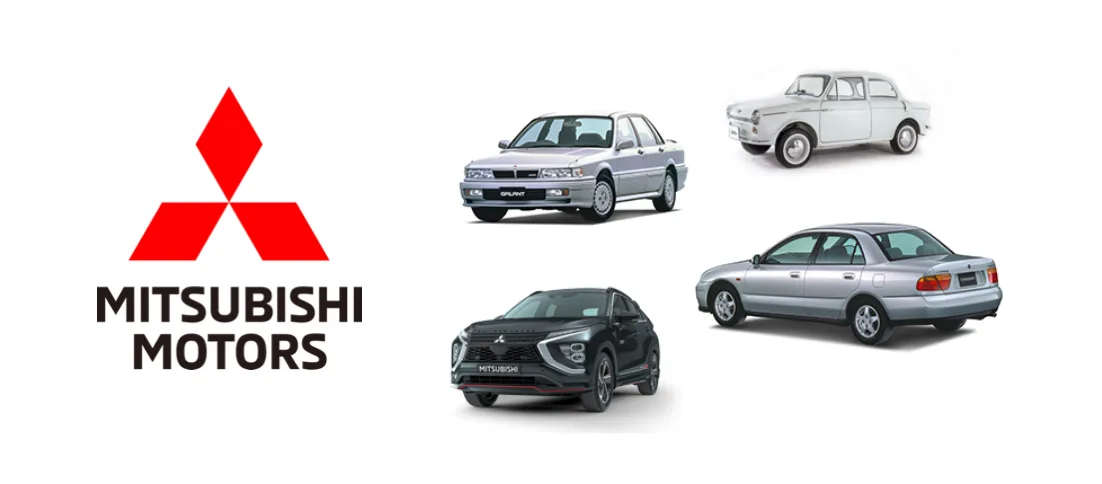
Mitsubishi, one of Japan’s three major corporate groups, was founded in 1870. It is a war-criminal company: during the colonial era it produced weapons and equipment for the Japanese military and treated Koreans forced into labor inhumanely. In the 1970s, Hyundai Motor produced Mitsubishi Motors’ engines and bodies under license, added a design by Italian designer Giorgetto Giugiaro, and launched the Pony. When I backpacked through Japan in the 1990s, I was delighted to see Hyundai’s Grandeur, Galloper, and Santamo on Japanese streets, but puzzled that they carried the Mitsubishi badge. The Grandeur was a model jointly developed by Mitsubishi and Hyundai, and the others were models Mitsubishi had developed, which Hyundai simply rebadged and brought to Korea. Until the early 1990s, Hyundai kept fitting Mitsubishi engines while it worked on its own. Then in 2000, a brave Mitsubishi employee blew the whistle on quality problems to the Ministry of Transport. For more than 30 years, the company had concealed quality defects. In particular, it had hidden 26 critical defects in vehicles produced from 1992 to 1997, including the engine, brakes, clutch, airbags, and axles. In 2002, a horrifying accident shocked everyone. The front wheel came off a large Mitsubishi trailer, the Great, while it was driving, and struck a family walking on the sidewalk. The mother died at the scene and her two children were seriously injured. Front wheels had come off 18 times between 1998 and this incident, but Mitsubishi shifted the blame to workers on site who had not tightened the bolts properly. The investigation found that the company had already known about these defects in 1996 and even held an internal countermeasure meeting, but covered them up without taking any action. Around the same time, Ford had a tire problem of its own. Firestone tires fitted on Ford vehicles from early 1996 burst at high speed and caused rollover accidents, resulting in 770 accidents and 88 deaths through 2006. Because of this quality problem, Ford had to spend $540 million and Firestone $1.617 billion on recalls and compensation, and the two companies’ partnership of nearly 100 years fell apart. Back to Mitsubishi. Mitsubishi Motors, which had hidden its quality problems, suffered serious damage to its reputation for integrity. Sales fell by more than 50%, losses mounted, partnerships were dissolved, and restructuring followed. After years of ups and downs, it was acquired by the Renault-Nissan Alliance in May 2016. Hyundai Motor Group, a start-up in the 1970s, ranked third in global sales in 2022, about 50 years later. The fallen Mitsubishi, even combined with Renault and Nissan sales, still trails Hyundai Motor Group, its former student.
⑥ The Genesis noise issue and the Hankook Tire case
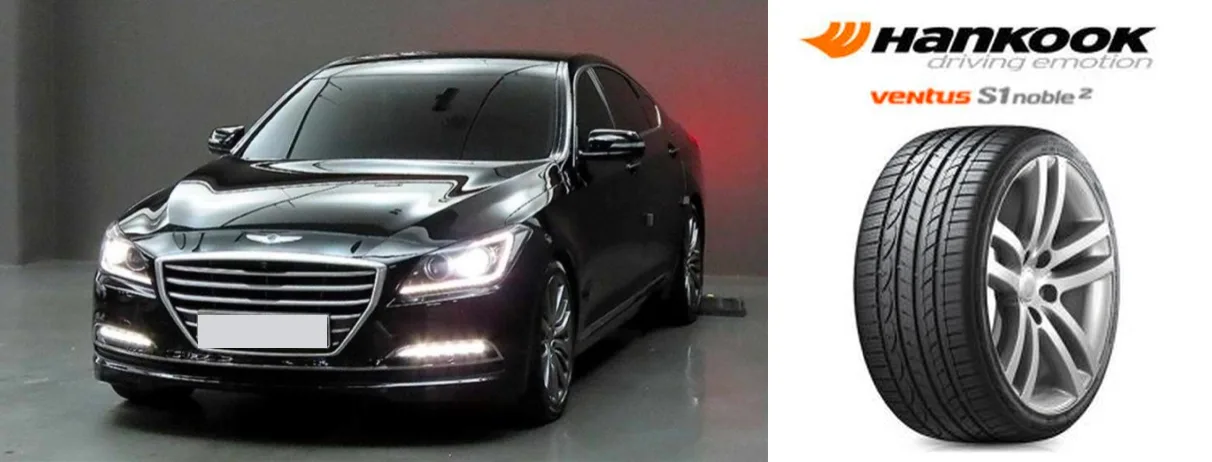
The second-generation Genesis that Hyundai Motor released in 2013 was designed by Peter Schreyer, formerly of Volkswagen. It had a bold, sleek look, a comfortable interior with intuitive controls, and nearly twice as much ultra-high-strength steel as competing cars. The group had invested heavily in its performance and safety. But drivers kept filing claims about serious “noise” and “vibration,” and the company launched an internal investigation. Car noise comes from several sources: “vibration noise” from the engine and transmission, “wind noise” from airflow rubbing against the body, “road noise” from friction between the road and the tires, and “rattle” from moving parts. In the second-generation Genesis, the source was road noise from the “tires.” The original equipment (OE) tires that Hyundai Motor bought for new cars at the time came from Hankook Tire. The root cause was uneven wear: contrary to the tire’s design intent, the inner and outer sides wore differently, and this produced constant friction noise. Because of this defect, the supplier of new-car tires for the Genesis was switched from Hankook Tire to Michelin and Continental. Hankook’s “Ventus S1 Noble2” tires that had already been fitted were replaced free of charge. Hankook Tire took heavy losses: the cost of the free replacements, fewer B2B opportunities, and a drop in brand value even in the replacement (RE) market, where individual buyers purchase tires directly.
⑦ The Daejin Bed Radon Case
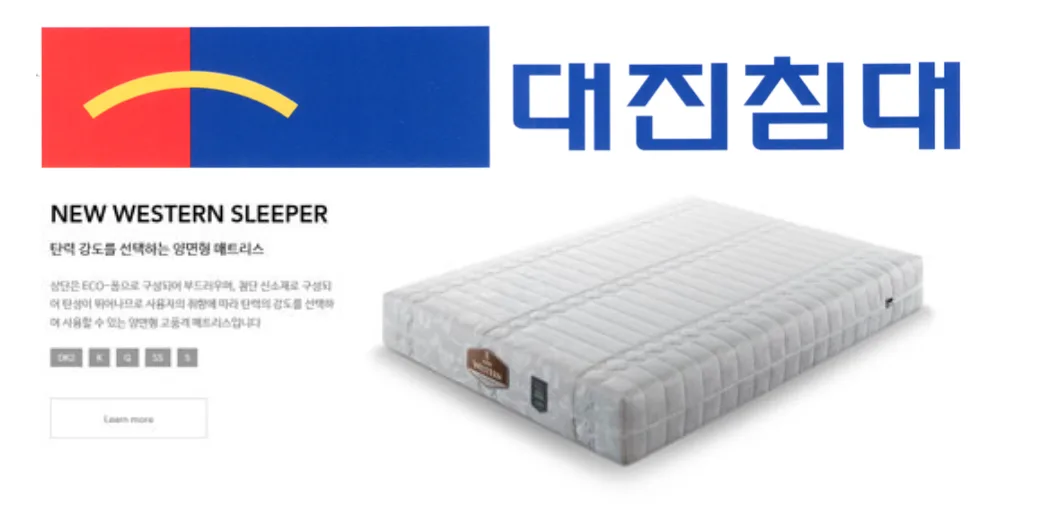
Do you remember the early-1990s bed ad line, “A bed is not furniture. A bed is science.”? It was an ad for Ace Bed, Korea’s No. 1 bed brand by market share. Thanks to that hit campaign, Ace Bed kept growing steadily. Korea’s bed market has an unusual structure. In 2001, Ace Bed founder Chairman Ahn Yu-soo handed management of Ace Bed to his eldest son and Simmons Bed to his second son, and in 2002 he acquired the license for Serta, America’s No. 1 mattress brand, from Daejin Bed. After keeping Serta out of Korea for 18 years, he founded Serta Korea in 2020 and now runs it. Together, Ace Bed, Simmons Bed, and Serta hold over 50% of the Korean bed market, a near monopoly. One company stood up to Chairman Ahn’s bed empire: Daejin Bed. I still remember its 1990s TV ad in which an elephant walked over its “Z Power Spring, comfortable without a sound.” Daejin Bed was founded in 1959 by Shin Seong-ju under the name Daejin Spring. It secured technology through a partnership with Sealy, the American bed maker founded in 1881, and even obtained the license for Serta, the No. 1 brand in the US, to compete with Ace Bed. After losing the Serta license to Chairman Ahn in 2002, it suffered falling sales and even withdrew from department store counters. In 2005 it decided to add a negative-ion effect to its mattresses, a feature said to stimulate cell metabolism, purify the blood, strengthen immunity, aid recovery from fatigue, and even sterilize and beautify. Daejin Bed bought monazite, a rare-earth mineral that emits negative ions, as a powder from an importer, ground it finely, and coated the inside surface of its mattresses with it. In 2011 one consumer bought this negative-ion bed and set it up in a child’s room. In 2018, seven years later, the consumer happened to check the bed with a radon detector and was shocked to find 2,000 Bq (becquerels), more than 10 times the 200 Bq recommended level for new apartment buildings in Korea. The tip went to SBS, and when it aired on SBS 8 News on May 3, 2018, the controversy spread explosively. Monazite is a phosphate mineral containing cerium-group rare-earth elements, and it also contains the radioactive elements thorium and uranium. When these decay, they release radon, a radioactive gas. More than 90,000 of Daejin’s radon beds were produced and sold from 2005 to 2018. Daejin Bed said it would recall them, but it closed its Cheonan factory, which had handled mattress production and replacement. Daejin Bed, with a history of nearly 60 years, took a fatal blow from this incident and became a company in name only. The 480 tons of radon beds collected at the time are still piled up in front of Daejin Bed’s headquarters in Cheonan, five years later, as of 2023.
⑧ Kobe Steel Data Falsification Scandal
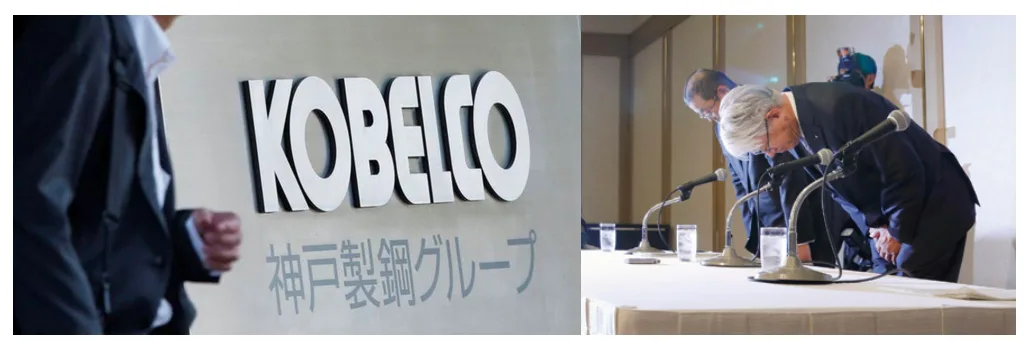
Kobe Steel, founded in 1905, is the third-largest steelmaker in Japan. In August 2017, it was discovered that the metal materials it had delivered to customers fell short of quality standards, and an internal audit began. In September, Kobe Steel played the problem down, saying it was limited to some aluminum and copper products, and its B2B clients dismissed it as minor and let it pass. But Japan's Ministry of Economy, Trade and Industry, the government regulator, saw it as a question of trust in Japanese manufacturing and ordered a further investigation, and what it uncovered was nothing short of shocking. On October 8, the chairman did not even appear at the announcement, citing a business trip, and shifted the blame to frontline employees, saying they had falsified quality inspection records for over ten years. Having drawn public anger by failing to respond sincerely at the start, Kobe Steel held a press conference three days later, on October 11, where the chairman apologized. The quality falsification extended beyond Japan to plants in Thailand, China, Malaysia and elsewhere, and to a wide range of products including aluminum, copper and specialty steel. The number of customers who received substandard products jumped from 200 companies at the first announcement to more than 520. Metal materials such as the aluminum and copper made by Kobe Steel pass through many links of the value chain and are used in final products such as trains, aircraft and automobiles, so once all the added value is combined, the impact on industry as a whole was expected to be enormous. When I saw this news at the time, my jaw dropped. The gist of the improvement report Kobe Steel released on November 10 was: 'Misconduct continued at many sites. Because each business unit was evaluated mainly on profitability, quality control was neglected, and frontline staff committed misconduct. We will do better going forward.' With output about one-sixth that of Nippon Steel, the industry leader, Kobe Steel was less competitive on economies of scale and paid more for raw materials. It then pressured its business units on yield, productivity and delivery deadlines, which led to the misconduct of fabricating quality data. Another major cause was 'monozukuri' (ものづくり), Japan's distinctive manufacturing culture that prizes craftsmanship, which gave frontline sites excessive authority and let bad practices pass as custom. The cause I found hardest to understand was a practice called special acceptance (tokusai, 特採). Even when a product fails inspection on the production line, if a customer in urgent need of delivery says they will use it anyway, the product is specially accepted, finished and delivered. After this incident, Kobe Steel's share price plunged 50%, and some plants had their national certification revoked. If a safety problem occurs in a train, aircraft or vehicle that the final customer (end user) in the value chain made with that metal, and Kobe Steel's product is identified as the root cause, the company could eventually face an enormous bill in recalls, damages, lost opportunities and brand value decline.
⑨ The Sinking of the Container Ship MOL Comfort
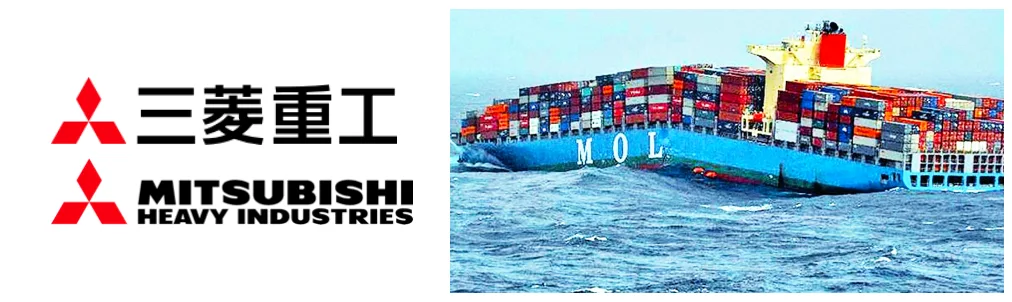
When I was working in the field, I shipped small orders and urgent samples through international couriers such as DHL, TNT, UPS, and FedEx, and sent bulky, heavy cargo to customers by container. I used the two standard container sizes everyone knows: the 40-foot (12.2 m) container and the 20-foot (6.1 m) container, which is half its size. The 40-foot container is also called an FEU (Forty-foot Equivalent Unit), and the 20-foot container a TEU (Twenty-foot Equivalent Unit). The cargo ships that carry these containers, which revolutionized logistics, are called container ships. Britain, the birthplace of the Industrial Revolution, dominated the global shipbuilding industry until the 1950s with hulls made of overlapping steel plates joined by hot rivets and powered by steam engines and diesel engines. Then Japan learned the welding and block construction methods the United States developed during the Korean War, and rapidly grew its share of the world shipbuilding market. Welding did not require overlapping plates, so it saved material and shortened build times significantly. From the mid-1990s, Japan failed to invest at the right time, just as it did in semiconductors, where it lost share to Korean companies. It failed to prepare docks in time and lost share to Korean and Chinese shipbuilders. In 2008, Mitsubishi Heavy Industries built the large container ship MOL Comfort, 316 m long with a capacity of 8,110 TEU (8,110 20-foot containers), using ultra-high-strength steel plate from Nippon Steel. In June 2013, the ship left the Port of Singapore with 4,293 containers, bound for Jeddah, Saudi Arabia. In the sea 370 km off Yemen, at the tip of the Arabian Peninsula, a large crack suddenly opened in the middle of the hull. The ship broke completely in two, and the bow and stern drifted apart. The stern sank, and the bow caught fire while being towed, burned out, and sank to the deep sea. When a serious quality problem like this occurs in a B2B business, the first thing to do is check the batch (the quantity produced in a single run) made under the same conditions. When safety inspections were carried out on the sister ships of MOL Comfort built by Mitsubishi Heavy Industries around the same time, 5 of the 6 were found to be cracking through the middle of the hull, just like MOL Comfort. MOL lost both the ship and its customers’ cargo, but recovered its losses through insurance as a total loss. Together with the insurers and cargo owners, it is now pursuing a massive damages lawsuit against Mitsubishi Heavy Industries, which built the ships. News of the shocking incident, a ship splitting apart and sinking at sea, spread around the world and inevitably dealt a serious blow to Japan’s shipbuilding industry. But blaming Japan’s shipbuilding decline on this one incident seems too simplistic. I believe it is a typical Japanese industry problem. In shipbuilding, where ships are built strictly to customer requirements, Japanese shipbuilders tried to standardize in order to improve the producer’s bargaining power and profits. But they failed to keep up with the trend toward ultra-large ships, as the industry moved from a port-to-port model to a hub-to-hub model. This is the opposite of aviation, which moved from hub-to-hub to point-to-point.
⑩ A Japanese PCB manufacturer case

The last case is one I heard around 2010, when I was working at a PCB manufacturer, from an industry contact. It could not be verified, so I will call the company “Company P.” A PCB (printed circuit board) is made by printing a conductive material onto an insulating board. The type that connects a semiconductor to the mainboard is called a package substrate. It uses far finer circuitry than an ordinary PCB to electrically connect the chip to the mainboard while also protecting it. Company P (a pseudonym), a Japanese firm, delivered a large volume of package substrates to a semiconductor maker, Company A. Company A built CPUs and delivered them to a computer maker, Company D. Then quality problems appeared in computers that Company D had sold to consumers. Company D’s investigation pointed to Company A’s CPU as the root cause. Company A investigated in turn and found the real cause: a defect in the package substrate supplied by Company P. The plating inside the holes of the board had not been done properly, which weakened the electrical connection. Because of this defect, Company P reportedly had to pay Company A and Company D an enormous sum (several hundred billion won), far out of proportion to the sales value of the goods it had delivered. This is how B2B quality failures work: when a material or component from an upstream supplier has a problem, it passes to the next customer and then the next, and the damage compounds. The impact is extremely complex. Yet finding the root cause of such a problem is very difficult. Whether the cause lies in design, equipment, materials, operations, or workers, the industry estimates that fewer than 50% of cases end with the cause clearly identified and responsibility assigned.
To be continued