When you sit down to negotiate with a manufacturer's customers, a few issues always come up: 'price,' 'payment terms,' and 'delivery date.' 'Price' can shift once you apply a volume discount based on the guaranteed quantity. 'Payment terms' for overseas customers means a lot of deliberation and negotiation over EXW (Ex-Works), FOB (Free on Board), CIF (Cost, Insurance and Freight), or DDP (Delivered Duty Paid), and over how many days. But 'delivery date' was a real headache for me back when I worked in sales, because it could never be solved by doing well on my own.

Say the standard lead time for delivering 100 units of product A to a customer in Shanghai, China is four weeks. In the quote, you would write “4 weeks” under Delivery or Lead time. But in sales discussions, the customer’s purchasing manager will naturally ask for it as soon as possible, and may even ask to shorten the lead time order by order. Suppose the customer asks for three weeks. For the salesperson, taking more orders on shorter cycles helps hit the assigned sales target and earn a bonus or incentive. For the company, faster shipping means faster payment, so there is nothing wrong with it. But on the production floor, headaches follow. If the team can’t stick to the plan, responds ad hoc, and focuses only on producing fast, problems will arise all at once: lower quality, higher production costs, worker safety risks, equipment breakdowns and more.
When I worked in overseas sales at a small company, the standard lead time was four weeks, but production was usually finished within two weeks. So I paid no attention to production progress, and delivery slipped again and again. My boss gave me a real earful. “If you’re a salesperson, shouldn’t you be checking how your product is being made on the production line? Is looking at the ERP status on your computer enough? Go down to the factory and see the real situation! If production is backed up, work alongside them and help get it made...” That’s how it went. At the time, I couldn’t understand any of it. I thought, “If production just follows the plan, this can’t happen, so why can’t they even meet a generous production schedule?” So whenever I had time, I went down to the production line to see what was going on. That’s when I found the main causes of production delays: a constant stream of urgent production orders. Most of them were products for domestic large-corporation customers handled by senior domestic salespeople. Even regular products, not tests or urgent quality fixes, were being produced in one to two weeks. Urgent test-production orders from senior overseas salespeople also kept coming down, constantly disrupting the production of other products on the line. It was a problem of “priority.” The production floor was being pushed around by sales, and that was causing quality problems, delivery problems and more.
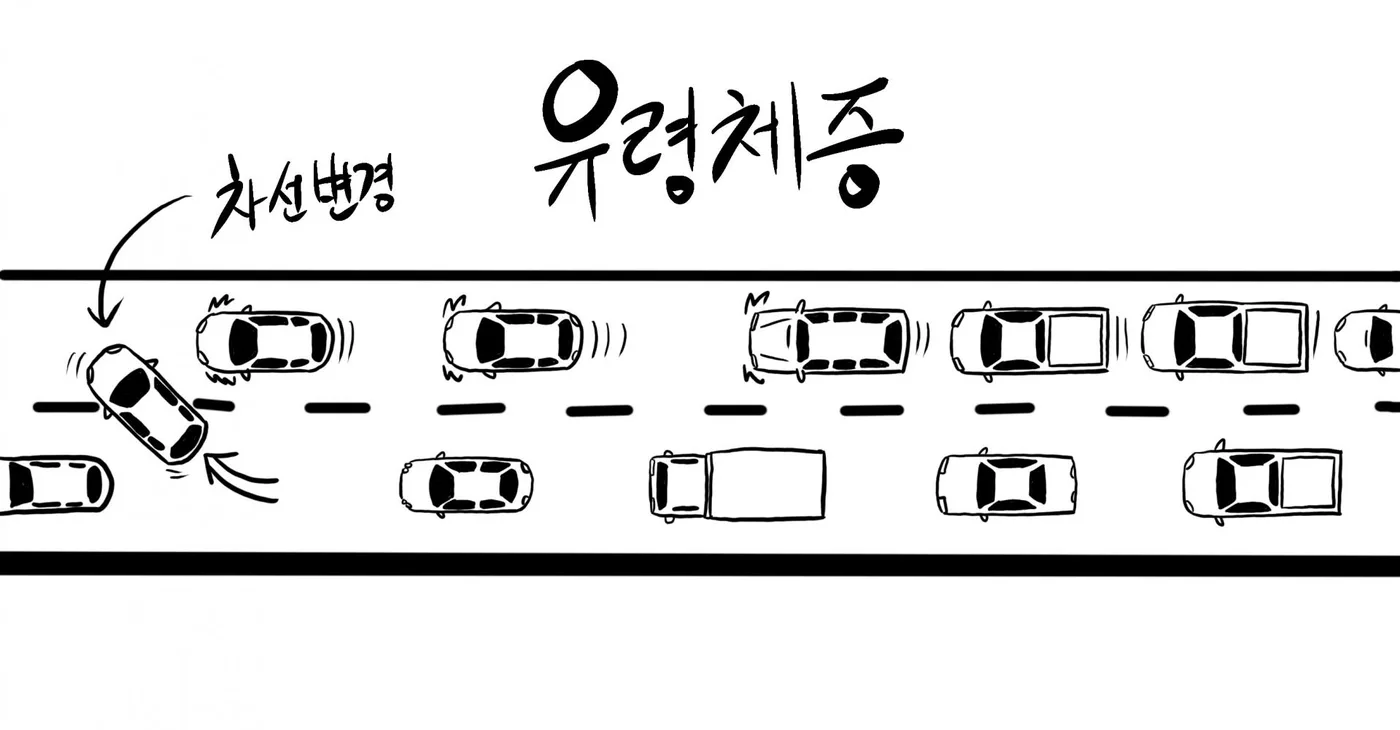
I still vividly remember the production manager grumbling as he smoked during a break. “Damn it, if we just produced according to the production plan, there’d be no problem, but every single day it’s test products and urgent products and everyone making a fuss. It’s driving me crazy. Mr. Kim, you know how highways sometimes get jammed? Do you know why? It’s because so many cars cut in. In production too, we keep having these problems because of the guys who cut in without being in the plan.” It was a perfect analogy. It was exactly like the “phantom traffic jam” on a highway, where cars get stuck with no accident, traffic light or bottleneck. When one car in a smoothly moving flow suddenly brakes, slows down or changes lanes, the cars behind it brake too, and eventually the cars further back come to a stop. Looking down on these conflicts between departments from a bird’s-eye view, it is sales, which treats even a small test order as a strategic step toward long-term revenue growth, colliding with production management, which wants to raise output now to improve profit margins.
B2B salespeople must clearly distinguish between production time (工期) and delivery lead time (納期). Production time is how long the supplier takes to make the product in-house. Some companies even have salespeople take part in drafting the production plan. You confirm the production time by weighing each product’s priority, the shop floor’s capacity and the workload, then add the steps and schedule for inspection, packaging, shipping, transport and customs clearance to calculate the final delivery lead time. In domestic sales, a salesperson can load the goods into a car at the factory and hand them to the customer’s contact within hours. In overseas sales, failing to separate production time from delivery lead time can cause serious problems. I still remember the angry voice of an overseas customer’s manager who, when I missed the delivery date, shouted at me to bring the goods over by plane myself.
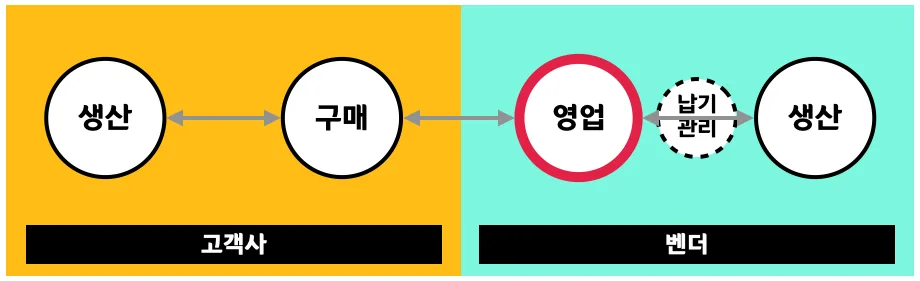
Working in B2B sales, where companies trade with companies, you quickly learn that you must be good at communication, coordination and negotiation. A vendor’s salesperson doesn’t deal only with the customer’s purchasing manager but with many members of the customer’s DMU (Decision Making Unit), including purchasing, production, R&D and quality. Inside the vendor, too, they must constantly communicate, coordinate and negotiate with departments such as R&D, production and quality. Which department handles “delivery management” varies with the vendor’s size. At a small company, the production department may handle everything from design, procurement and production to inspection and delivery management. In some cases, production management or delivery management falls to sales management, and where there are several sales departments, factories and production organizations, a dedicated delivery management team may emerge.
From sales’ point of view, wouldn’t it be better to let them focus on selling rather than worry about delivery management? Whichever organization owns it, proper delivery management starts with gathering and assessing information on the supplier’s internal processes and responding to it. It also means sharing standard times and baseline schedules for production processes, so salespeople don’t make unreasonable delivery promises and can commit to realistic dates.
To be continued