B2B (business-to-business) customers differ from B2C (business-to-consumer) customers in many ways. B2C customers are individuals who buy products and services to satisfy personal wants and needs. B2B customers are organizations and companies that buy materials, parts, equipment, tools, software and services to benefit their business. These purchases involve many stakeholders and decision-makers and go through a long, complex process. Most products and services are customized, proposed through marketing and sales backed by professional consulting, tested, and, once validated, put into mass production. What are the typical characteristics of B2B customers in an actual sales process? Let’s walk through a hypothetical sales scenario.
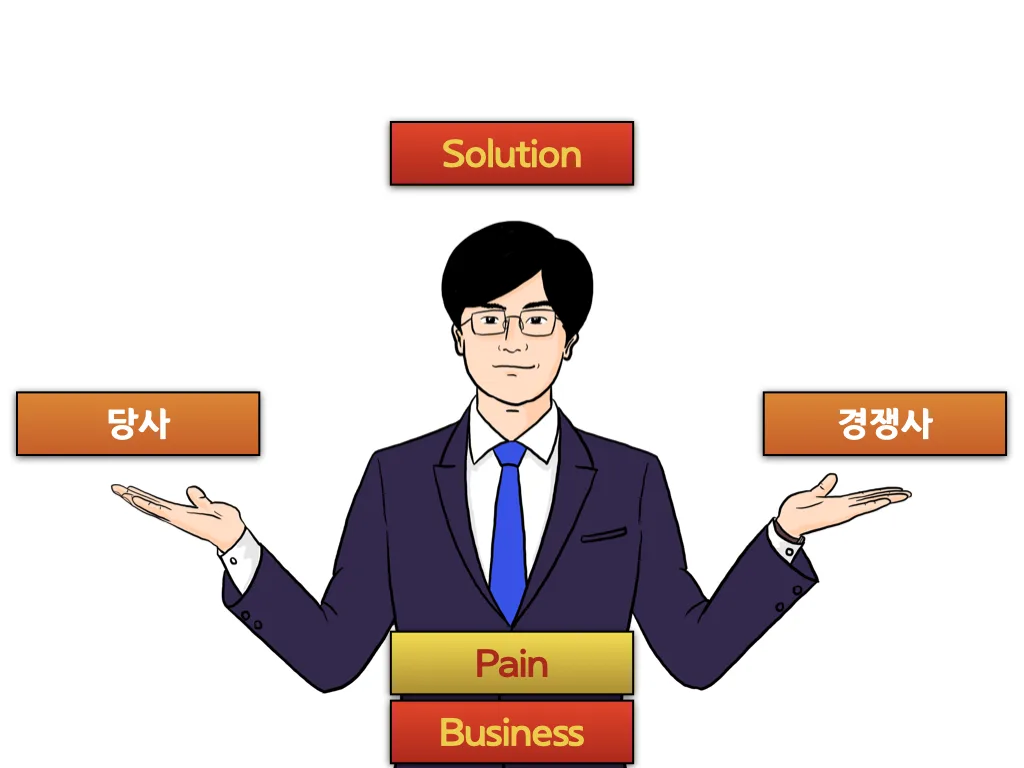
Suppose you approach Company A to supply parts. Unless it is a brand-new startup, it will almost certainly already be using existing parts. The client will compare its current product (to us, a competitor’s product) with ours: quality and performance, technical differentiation, price, lead time, technical support and after-sales service, references and more. So what should our sales rep do first? Start by thoroughly understanding the client’s business. Suppose Company A is a Tier 1 vendor supplying an automotive OO part to the Hyundai Motor Group. Does the client contact need a very detailed explanation of our company profile, history and product? They may well be thinking, “I’m swamped, and this person is going on and on about things that have nothing to do with me…” Start with detailed research on their business. Hyundai and Kia, which Company A supplies, have pushed up to third place in global sales behind Japan’s Toyota and Germany’s Volkswagen. How are Company A’s parts sales doing? Hyundai and Kia’s overseas plants are producing more than their domestic plants, yet Company A’s parts exports are falling sharply. There are two reasons. First, even when a supplier develops innovative technology that cuts production costs and improves quality, the client’s annual cost reduction (CR) at a fixed rate is calculated from the lowered cost base, so there is little incentive to invest in R&D and quality falls behind imported parts. Second, supply prices that include shipping and tariffs are less price-competitive than those of products sourced from nearby regions.
In this situation, you have to empathize with Company A’s pain, the dilemma it is caught in. Under constant price-cut pressure, the client’s volume for its overseas plants is shrinking sharply, and even if A tried to supply other automakers, it would be hard to replace even part of those makers’ existing OO part suppliers. At a time like this, what matters is not our company introduction, part specs or manufacturing process, which they care little about, but whether our product, once applied to Company A’s OO automotive part, delivers a clear, tangible benefit. What benefit can we offer? In this case it isn’t fast lead times, technical support or stable inventory. If we can offer a better-quality product at a lower price, along with factors that also have a positive ESG impact for A and the Hyundai Motor Group, wouldn’t that get their attention? If you empathize with the customer’s pain and offer a solution that adds real benefit, Company A has every reason to try adopting our product. They will send a formal RFP (Request For Proposal) or RFQ (Request For Quotation) and ask for written answers, and they will ask us to supply a certain quantity free of charge for testing. If we pass the pilot test, they will increase the volume, test again, and move into the validation stage on the mass-production line. Now let’s use our imagination on the type of case seen most often at real industrial sites.
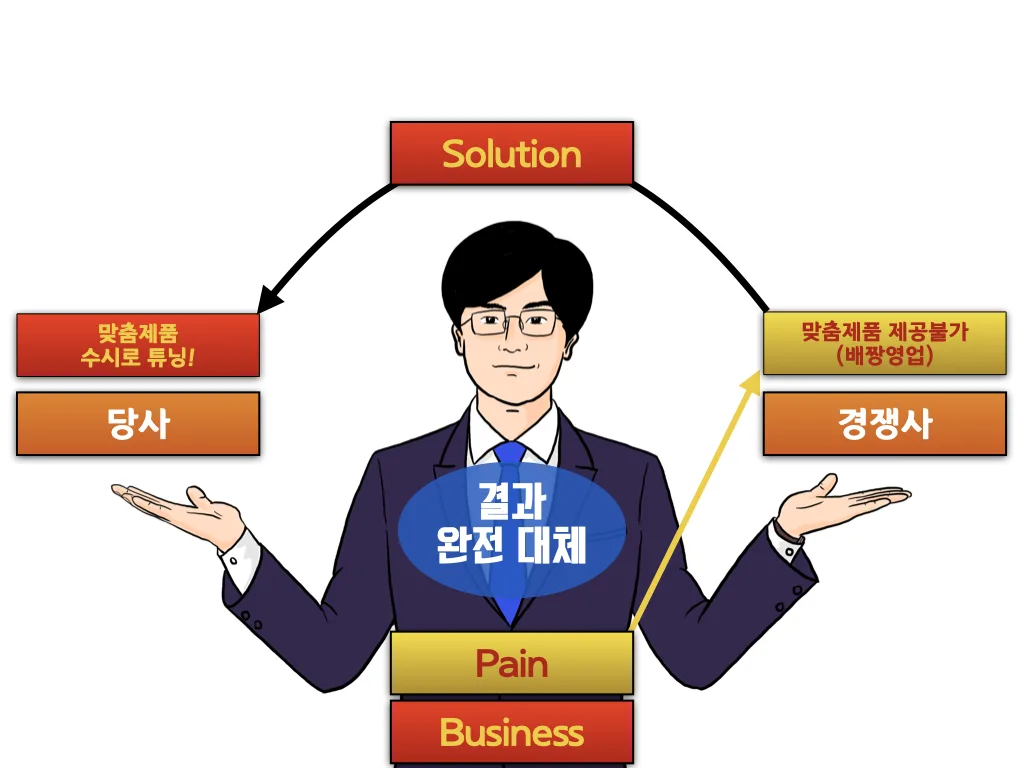
Our company is a chemical manufacturer that wants to supply materials to semiconductor maker B. Before formally proposing our product, we first gathered detailed information through various channels on which supplier’s products B was currently using to make its semiconductors. The existing method was to coat a wafer with a liquid chemical material, dry it, etch it away with a different chemical slurry, and build up the layers again. We discovered that a Japanese company had developed a dramatically thinner film that simplified the process. For the client, the difficult, lengthy existing process had become simple and short, an innovation that gave it a decisive edge in cost and lead time. The old liquid-coating method simply couldn’t compete. Had we started on our proposal without confirming this, we would have wasted time and effort. We also put our full research budget and staff into developing a film, but matching the Japanese product’s performance in a short time is hard. We seem to have reached about 80%. If you were Company B’s sales rep in this situation, how would you approach it? Even a seemingly perfect product has weak points. If good products sold themselves, there would be no need for sales reps. You have to find Company B’s pain points. What might they be? I have seen the common pain points of clients that use imported materials, parts and equipment firsthand at many industrial sites, and heard about them in training sessions, workshops, consulting and mentoring with many clients.
The first pain point is the high supply price. Foreign suppliers of materials, parts and equipment in the US, Germany, Japan and elsewhere often hold so much leverage that even giants like Samsung and Hyundai cannot push them around. For example, ASML of the Netherlands builds only about 50 semiconductor lithography machines a year, at over KRW 300 billion (≈ US$224,450,100) each, and holds more than 90% of the global market. It has the strongest negotiating position in semiconductor equipment. If Company B asked the Japanese supplier of its film for a price cut, would it work? The supplier would most likely refuse, citing a number of reasons. The second pain point is customization. If Company B asked for adjustments to material properties or film thickness to fit its own production conditions, would the supplier oblige? Most likely the answer would be that the product is optimized for the ideal manufacturing environment of the major chipmakers, so B should adjust its other conditions to fit. After all, every client-specific accommodation costs money. When issues arise, the supplier is far away and hard to reach in person, and the language barrier makes technical support difficult. With high prices and no customization, the customer’s frustration had been building little by little. Once you have found these pain points, offering a solution becomes relatively easy. If Company B is a top-tier customer in semiconductors, you would want to supply it even at no profit to secure a reference, so you could offer a lower price than the incumbent Japanese supplier. But you can’t guarantee the same technology and quality as competitors in the short term. Still, before you reach comparable quality, you can make up the gap with time and effort: customization and tuning. You deliver several types of test film designed exclusively for Company B, fine-tune each one based on its production results, and keep a full history to provide fully customized service. You assign a dedicated sales rep to stay close to the account and respond whenever the client calls, whether it’s a holiday, a festival, night or dawn. I have personally experienced many cases of replacing foreign materials, parts, equipment, tools and services this way, and I have often heard similar stories from industry colleagues and clients.
Let’s go back to basics. You need to observe and study your B2B client’s situation and business closely. Once the target customer is set, observation and learning are the baseline. One big advantage B2B has over B2C is that concrete goals are visible. After studying the client, study the competitors, and find the pain points by seeing things from the customer’s side, not yours. Then the solution you can offer will gradually take shape.
To be continued