2) Finding insights customers haven’t noticed
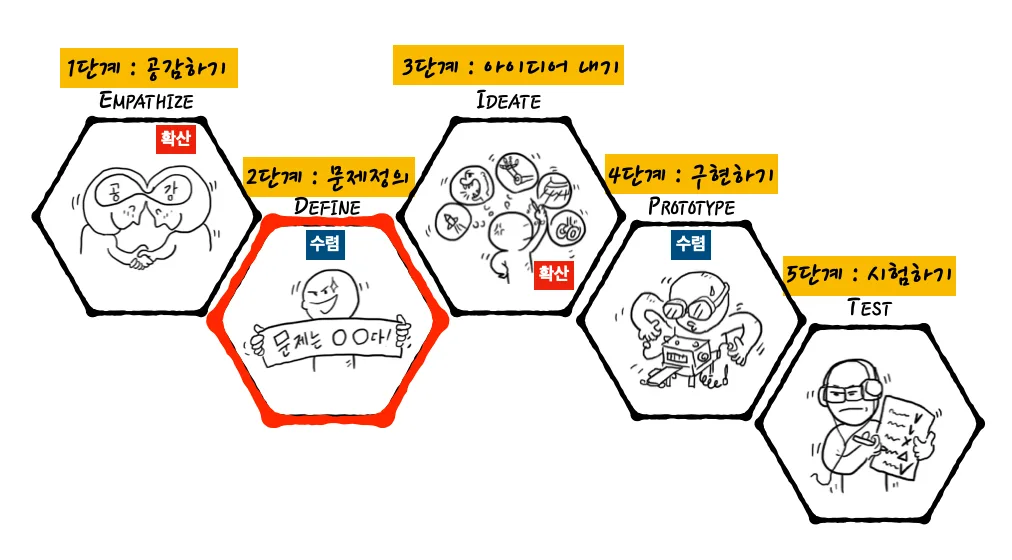
Have you heard of 'Design Thinking'? Design Thinking is a creative tool for solving complex problems. Built on a user-centered perspective, this methodology can be applied across many fields and problems. It starts by defining the problem and understanding users’ needs and motivations, then moves on to developing innovative solutions, building prototypes, and testing them. The five stages are 1) Empathize, 2) Define, 3) Ideate, 4) Prototype, and 5) Test. The 'insight' appears in stage 2, Define. It means something new the persona had not realized: a deep understanding or discovery gained through user observation and research.
In design thinking workshops, learners most often struggle with deriving the insight. It is hard to do unless you observe users closely and deeply understand their needs and pain points. Based on the insight, you must then define the user’s core problem specifically and clearly. Personas, or users, often don’t even know what their real problem is. The same is true in B2B. Let’s look at the example below together.
[ Example ]
Imagine you work for Company A, a specialist paint manufacturer. Your target customer is the 'interior contractor.' Let’s start with their 'core customer problem.' Here you need to put yourself in the contractor’s shoes and empathize deeply. The share of labor costs in interior work varies with project size, location, the type and price of materials, and workers’ skill levels, but I have often heard that it is more than half of total cost. For high-end interiors or custom-design projects the labor share is likely even higher, while projects using standardized solutions and materials may have a lower share. Excluding helpers (commonly called 'shitabari (下張り)'), a skilled worker’s daily wage is about KRW 250,000 (≈ US$185)–350,000, and it keeps rising. The interior contractor’s core problem is labor cost, which accounts for a large part of total cost.

Then you need to draw out the key insight, so that you can offer value the customer will find worthwhile. This step is quite difficult. If you skip it and pitch your own value, you may end up with an off-target proposal the customer can’t relate to at all. A typical example might be 'paint that is 20% cheaper than the current supply price but takes longer and is a hassle to apply.' Whenever I run training or workshops for clients who manufacture paint, I ask them about this, and they say, 'Paint is not a large share of total interior work cost; it’s probably 5–10%.' Hard to know without experience in this industry, isn’t it? So the key insight is 'Paint accounts for only 10% of total interior construction cost.'
Now, as in the 'Ideate' stage of Design Thinking, you can start creating the 'value you offer the customer.' I encourage you to put the book down for a moment and try it with me. Draw on a blank sheet of A4 paper and come up with ideas. When I have run this case in B2B marketing and design thinking workshops, the most common ideas were 'a spray-on format,' 'an easier-to-use applicator tool,' 'a DIY painting kit,' and 'painting robots for rent.' What do you think? Do they get at the core of the problem? As a university student, just before my military service, I worked a few days at a construction site. Interior paint generally took about 3–4 hours to dry completely, and then you had to apply another coat. What problem, if solved, would improve an interior contractor’s revenue? That’s right: the drying time. If the paint dried fast enough to raise the number of jobs per day from 2 to 3, total revenue would rise by 50%.
Now it is time to set the right price. You have delivered a product that lifts total sales by 50%, so there is no need to discount the supply price, right? Another insight to keep in mind here is that 'paint accounts for only 10% of the total cost of an interior renovation.' This means that raising or lowering the price barely affects the overall cost, doesn’t it? So what price would you quote? In our training sessions and workshops, opinions ranged widely: a 100% increase, a 50% increase, a 10% increase, and so on. In my view, a 40–50% increase is reasonable, and customers can fully understand it.
In B2B value propositions, the insights customers haven’t yet noticed can take many forms: hidden needs, coming industry shifts, inefficient work processes, untapped market opportunities, and more. Finding and presenting these insights is one of the best ways to deliver high value and gain a competitive edge. Let’s take them one at a time.
① Unrecognized problems
B2B customers often don’t even realize the problems they face in running their business. They don’t know what is wrong, whether it’s the root cause of low productivity or inefficient data management. Identifying these problems for them and offering a solution can pleasantly surprise your client.
② Lack of preparation for future industry change
Predicting future change and preparing for it is very hard. By proposing solutions that address what is coming, such as digital transformation, ESG strategy, and practical applications of advancing AI technology, you can deliver important value customers have not yet recognized.
③ Inefficient processes
B2B customers may be used to their existing ways of working and stuck in old habits, continuing to use inefficient processes. Proposing ways to optimize or automate these processes to cut costs and raise productivity can delight your client. One caution: people who lose out because of automation can turn into 'blockers.'
④ New market opportunities
Your client may not know that a new market exists for their product or service. Using market analysis to spot these opportunities and helping the client enter the new market is another important way to build a B2B value proposition.
⑤ Improving customer experience
B2B clients sometimes don’t fully recognize the user experience of the services or products they provide. Proposing ways to improve the end user’s experience can raise your client’s customer satisfaction and loyalty.
To be continued