1) What switching costs mean
This case dates back to the mid-2000s, 16 to 17 years ago, when I was in Taiwan selling Korean-made tools to semiconductor foundries such as TSMC and UMC. I will tell the story with the process details, product types, and prices all made up. First, I researched every trade show related to the target market, “the Taiwan semiconductor market,” confirmed which ones fit it, and attended them. There I shortlisted potential customers and partners, especially candidates looking to act as distributors or agents, and commissioned market research. Using data from my own online research and from research agencies, I validated it through meetings and conversations with employees (production, purchasing, quality, and other teams) at direct customers who would buy and use our products. I then re-validated it with data from the distributor candidates, repeating estimate and verification countless times to build up the market research data. I organized key clients, factory locations, the characteristics of each manufacturing line, the number of machines, and the lifespan and price of the parts, materials, and tools currently in use into raw data in Excel.
Next, set your priorities. Assume exclusive supply at 100% Share of Wallet (SOW), estimate usage based on Total Addressable Market (TAM), sort the customers in descending order, and decide which to approach first. You can split this into short-term and long-term goals. In the short term, you go after relatively easy targets directly as the vendor. In the long term, you go after harder targets together with local distributors. If you were targeting TSMC, the world’s No. 1 semiconductor foundry, you would first decide whether to go after Fabs 5, 6, 8, 12, and 15 in Hsinchu or Fabs 14 and 18 in Tainan. You would also check whether you can group fabs by similar technology node and production method and pursue them at the same time. Once you have chosen a fab, you can pinpoint target production lines by production equipment, materials, and end-user characteristics. If your company has already met similar conditions at Samsung Electronics or SK hynix in Korea, you can lead with those references and approach with confidence.
Rather than having a Korean sales rep contact a TSMC purchasing manager directly to set up a meeting, it would be more effective to arrange meetings through a Taiwanese distributor. At first you would meet only the purchasing manager, but over time you would hold several meetings with the purchasing team leader, production managers, the production team leader, and executives. After seeing that the production team leader showed strong interest, I kept in touch with that Taiwanese team leader, who was about 10 years older than me at the time, to try to secure a test opportunity. While meeting people in the production, purchasing, and quality teams, I had to find out, through a mix of formal and informal methods, which competitor they were using, which product, at what price range, and with what quality and lifespan. I learned that the tool they were using at the time was a Taiwanese product supplied at about US$300 per unit, and that its lifespan and quality were below those of our product. If our product’s cost is assumed to be about $150, what quote should you submit, taking into account the margin for the distributor?
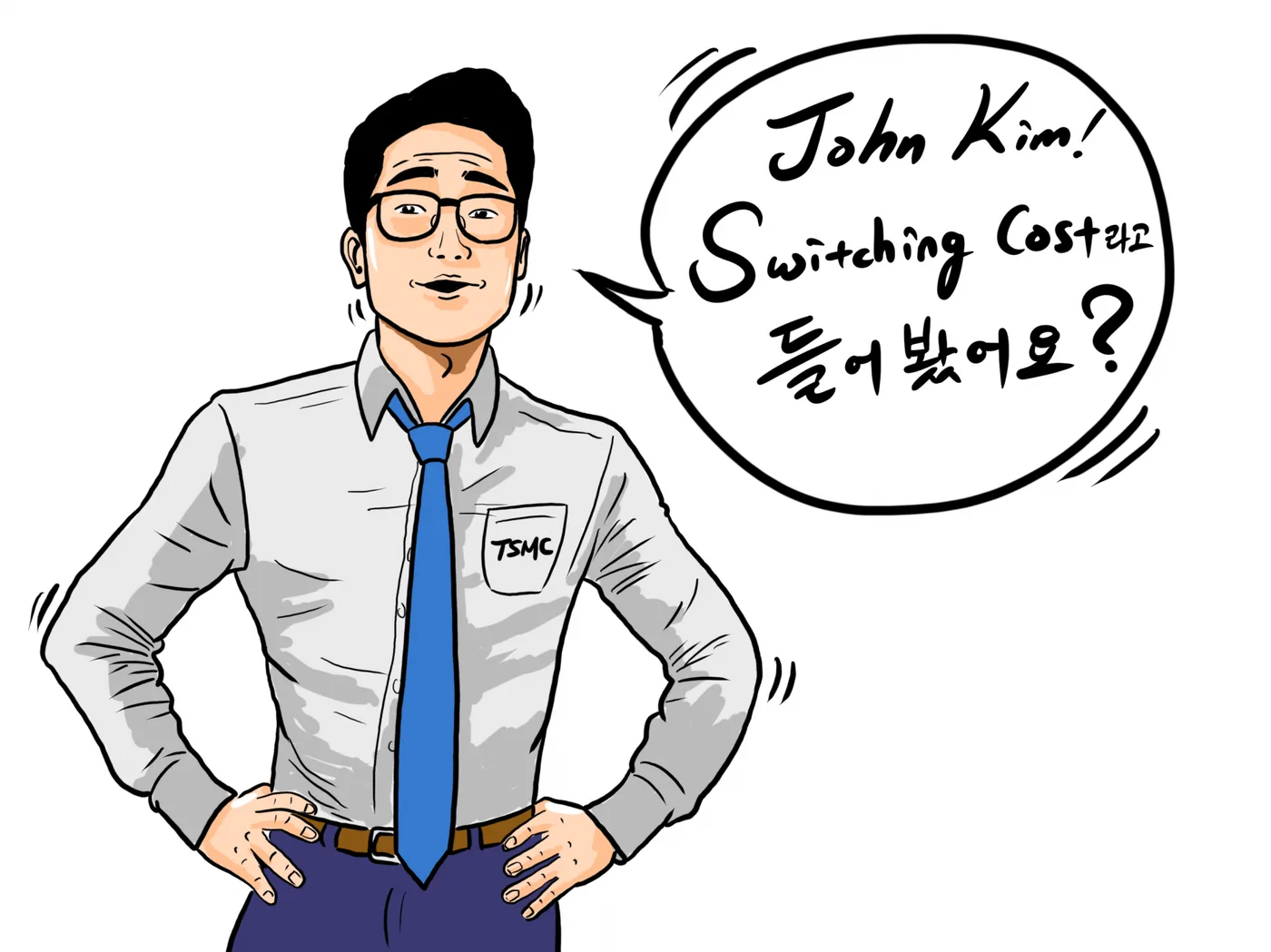
It was a truly difficult problem. Opinions within my own company were divided. Some argued that because we had to win a large volume at an aggressive price, we should quote around $200. Others thought a quote of $270 to $280, not far from the competitor’s supply price, would be enough. So I spent a lot of time over meals and tea with the client’s production team leader and purchasing manager, and asked them frankly, "What price would it take for us to at least get a chance to test our product?" The Taiwanese production team leader, who was 10 years older than me, asked back, "John Kim (the author’s English name)! Have you ever heard of switching cost? If not, look into it, and let’s meet again next week." So I began researching and studying switching cost.
Switching cost covers every type of cost and barrier a customer faces when moving from the product, service, supplier, or system they currently use to an alternative. It can take many forms, including economic, time, psychological, and social factors, and these costs can make customers hesitate to leave their current situation and choose a new option. Switching costs play a very important role in how companies retain customer loyalty and win over competitors’ customers.
After studying switching cost for a few days, I went back to the client’s production team leader. "Team leader, I have already told you, through the references of our current Korean customers, that our product is superior in quality and productivity to the one you use now. Considering switching cost, how much cheaper than your current price would we need to be to get a test opportunity and move the project forward?" He replied, "Switching cost includes direct costs (such as migrating to a new system and purchasing equipment) and indirect costs (such as training, the learning curve, and lost productivity). If you are about 30% cheaper, it should be easy to get internal approval." For me at the time, this was a meaningful moment, because that answer confirmed the client contact’s target price. The Taiwanese tool the client was using cost US$300, so 30% cheaper than that meant a target price of about $210.
Inside the vendor, opinions varied: quote exactly the price the customer wanted; quote lower to give them a pleasant surprise; or quote a bit higher and negotiate down to around US$210, the price the client’s manager wanted. Which would you choose? In my experience, quoting even slightly below the customer’s target price surprised the manager and led to better results. B2B suppliers can manage switching costs to raise customer loyalty and secure a competitive edge. High switching costs keep customers with their existing product or service, which strengthens your position in the market. Conversely, you can lower a competitor’s customers’ switching costs to win them over. For example, you can subsidize their migration costs or offer training to help them move to the new system. Switching costs are tied directly to customer experience, and they play an important role in keeping customers satisfied and loyal over the long term. Companies should therefore weigh their customers’ switching costs carefully and manage them strategically.
When a corporate training provider builds a strategy around switching costs for B2B and B2G clients, the goal is for clients to choose its service and stay for the long term. Training managers at companies and institutions regularly rotate or change roles. If the provider has kept satisfaction high for years without major problems, it is hard for a new manager to take on the risk of replacing it with a new program. That, too, is a switching cost. You need a strategy that makes clients feel that changing services or moving to another provider is a disadvantage, while also raising their satisfaction and loyalty. If you develop and deliver customized training programs tailored to a client’s specific needs and goals, the client gets a service that fits those needs perfectly. A customized program is also hard to move to another training provider. To get the same level of customization elsewhere, the client would have to explain its requirements again, wait for the new provider to adapt, and pay extra. If you also provide an integrated Learning Management System (LMS) for managing employee training, it makes life much easier for the client’s training managers, who can track progress, evaluate results, and collect feedback in one place. Once the client gets used to the LMS you provided and builds it into its training processes, changing the system or moving to another provider’s LMS will take considerable time, money, and effort.
Beyond training programs, if you provide ongoing support and consulting to solve clients’ training-related problems and optimize their training strategy, clients will value the relationship with their training provider more, which adds a heavy psychological and relational cost to switching. With long-term contract discounts and loyalty programs, offering price discounts or extra benefits to clients who stay for a long time gives them an incentive to remain with their current provider and greatly raises the financial cost of moving to another one. If you update training content and programs regularly and keep pace with the latest industry trends and technology, you can increase the "fear of missing out (FOMO)" clients feel when considering another training provider. In other words, you create the worry that they could miss the latest knowledge and skills their current provider offers, which makes clients hesitate to leave.
To be continued