③ How They Buy
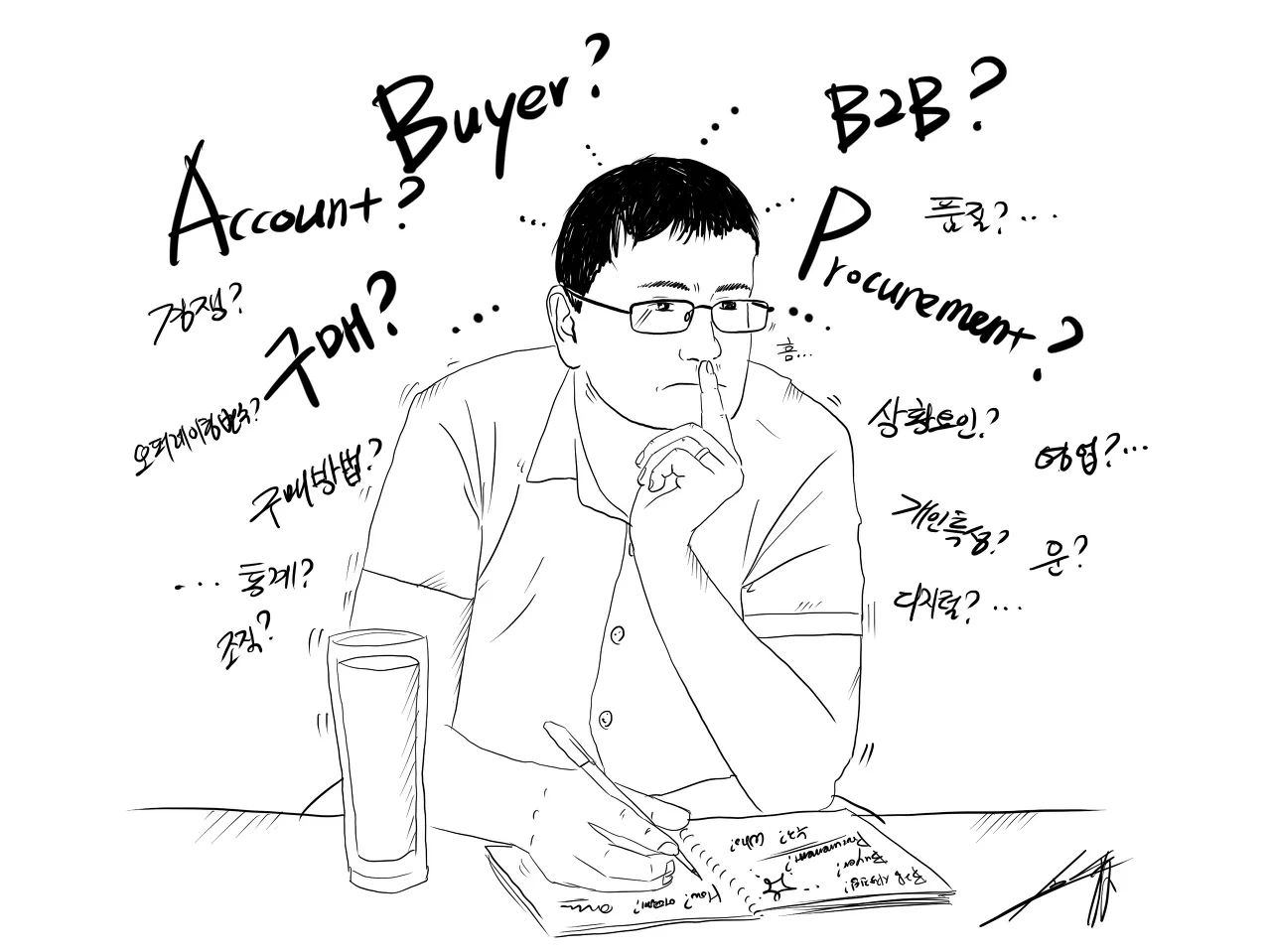
ⓐ Purchasing department: Whether it is called the purchasing team, Buyer, or Procurement, this is your counterpart, the other side of the table. I say 'purchasing department,' but the department that actually makes the buying decision depends on the product or service. For a headhunter or search firm that finds key talent, the buyer is the HR team. For a corporate training company that provides all kinds of training services, the buyer is the training team. For a company that supplies employee snacks and pantry management, it is the general affairs team. For a market research service, it is the marketing team. For a restaurant or bar that hosts 'client entertainment,' it is the sales team. For a materials management automation program, it is the materials team. So limiting your thinking to a department literally named 'purchasing' narrows how you can respond. Start with your own product or service, then picture the department that mainly buys it or plays the decisive role in the purchase. Is it a large corporation with a huge purchasing organization? A small company with no separate purchasing department? Where exactly is the buying done? Understand the size and structure first, then dig into the details of how it functions.
Hand-drawn illustration
ⓑ Power structure: Understanding a client's power structure is essential to running effective sales tactics. During my posting in Taiwan, the economy ran on a large number of small and mid-sized companies rather than a few big conglomerates, so besides large companies like TSMC, I built relationships and did business with employees of countless small firms. In B2B deals, the normal power structure, or approval line, runs staff, senior staff, assistant manager, manager, deputy general manager, general manager, executive, CEO, or more commonly just staff, manager, general manager, executive. But as is true of many Korean small companies, if a client's sales team leader with no real role in the purchase decision is overly involved, he is probably the owner's son. If the head of finance is overly involved, she is probably the owner's daughter. If a female vice president is overly involved, she is probably the owner's wife. Countless relatives are lurking all over small-company org charts even as we speak. If they ever found out about each other, they would probably say, "You too?!"

Yanadoo? [Source: Yanadoo official YouTube]
When you map the power structure in a client's purchasing process, check whether any 'influencers' (people who sway the decision) exist and how much sway they have. Who is the real final 'decision maker'? The president you took to be the final authority may be a figurehead who married into the family, and the vice president, his wife, may be the one who actually decides. And the young chief of staff who sticks close to her side, supplying information and opinions day to day, may be someone who looks minor but strongly shapes the decision. If that chief of staff's wife in turn influences her husband's decisions, she could be the last hidden influencer. You need to find the hidden 'stakeholders' who shape purchasing decisions. They could be the client's sales team, quality team, or logistics team.
ⓒ Relationship with your company: Suppliers and clients with a long relationship maintain high trust and close contact, so breaking through that wall is extremely hard. Even front-line staff prefer to keep doing what they have always done; adapting to the changed terms a new supplier brings is hard work and a hassle. When the relationship with your company is good, many costs shrink: inspection, verification, audits, entertainment, quality control, and more. That leads to fair supply pricing, which benefits both supplier and client. That is why, when segmenting a market, you need to separate existing clients who have a good relationship with your company from new clients.
ⓓ General purchasing policy: Does the client prize proprietary technology and prefer to make most parts in-house, like the Japanese robot maker 'Fanuc'? Or does it outsource all production to cut costs, like 'Apple'? Even with multiple sites, does headquarters buy centrally to negotiate better terms through bulk purchasing? Or does each site buy on its own to respond to customized, urgent needs? Does it buy small quantities whenever a need arises? Does it mainly buy ahead based on forecasts, to get in front of exchange-rate swings, raw material prices, and future demand? Does it buy certain items in bulk to secure safety stock? Because buying many items in small quantities is costly and labor-intensive, does it consolidate purchases through a few distributors? Does it buy through a leasing program? How are suppliers selected? How many pilot tests are run, and over what period? Who, in which department, handles the purchase contract, and how? You need to check this 'purchasing policy' client by client.

ⓔ Purchasing criteria (scope): The purchasing organization and its scope can differ for each product and service a supplier offers. So you must confirm what the responsible department actually buys. Is it purchases or rentals of fixed assets such as office supplies, IT equipment, and data-related supplies? General goods? Contract manufacturing? Facility construction? Payments for general services, repairs, and maintenance? Real estate leases and rentals? Uniforms and food and beverages? Printing and training? Consulting and technical services? In the early 2000s, when I had little sales experience, I learned that a manager at a client company was an upperclassman from my high school. I trusted his confident assurances and had my company prepare for production and supply, only to be eliminated from the supplier selection. The reason was that he, a manager on the purchasing team, had no authority to buy my company's products.
④ Situational factors
ⓐ Rush orders: A 'routine order' is what a client places steadily with little change. A 'new order' goes to a new supplier, or asks an existing supplier to take on a new item, to spark competition among suppliers. A 'rush order' is different: the client places it because of an urgent situation, such as an issue on the production floor. The best-known example of a rush order is the Jeep. In the 1940s, after deciding to enter World War II, the U.S. Army urgently needed a general-purpose military vehicle for battlefields around the world. It sent a request for quotation (RFQ) to more than 140 automakers in Europe and the U.S., and the specs were demanding: four-wheel drive, a weight of no more than 590 kg, a wheelbase of no more than 190 cm, a top speed of 80 km/h, room for three passengers, and a folding windshield. And on top of that, a prototype within 49 days and 70 vehicles delivered within 75 days. It was truly an emergency.

Jeep [Source: classicjeep.com.br]
The design from American Bantam, a small automaker that began as the U.S. arm of Britain's Austin, was chosen at the time. But its output of only a few thousand vehicles a year was a problem, so actual production went to Willys and Ford, which could build in volume. Because of an outrageous poison-pill clause giving the U.S. government the rights to the prototype design, American Bantam was shut out of the business even though it had supplied the basic ideas behind the Jeep. B2B clients also place rush orders from time to time. Sometimes a purchasing manager's mistake empties safety stock and supply is needed urgently. Sometimes a serious quality problem at a competitor disrupts the client's production line. From my own experience, a client's rush order is an opportunity for the supplier. If it comes from a purchasing manager's mistake, that person ends up greatly in the salesperson's debt. If it comes from a competitor's quality problem, it is a golden chance to take away their market share. So clients who place rush orders should be spotted quickly, classified separately, and handled accordingly.
ⓑ Product application: When talking about shifts in product applications, the mobile phone is the obvious example. The moment of change I experienced firsthand was 2007, when Apple's iPhone appeared. Korean makers Samsung and LG took opposite paths. Samsung followed a fast-follower strategy, launching the Windows Mobile-based Omnia (which users derided as a flop). LG Electronics, by contrast, paid McKinsey a whopping KRW 100 billion (≈ US$74,816,700) for consulting and tested every step cautiously. The consultants concluded that 'smartphones are a storm in a teacup, so rather than invest in this new technology, invest in marketing your existing products.' That decision started LG's mobile phone business on the road to collapse. Consider the suppliers that sold parts to LG's phone business. Makers of phone molds, phone cases, PCBs, camera modules, keypads, and other parts for LG Electronics would have gone bankrupt if they had not developed parts in advance for smartphones, the new application for other clients such as Samsung Electronics. Asahi Glass, a Japanese glass manufacturer, was producing glass for CRT picture tubes in Malaysia in 2005, when I was in the field, and supplying it to low-cost local TV makers in Southeast Asia. With the rapid growth of the LCD and PDP markets, it made a sharp change of strategy. It set up Asahi Glass Korea, produced PDP glass substrates, and supplied them to Korean display makers. But because of high power consumption, heat, burn-in, and short lifespan, the PDP application was in turn pushed aside by LCD and OLED. In the end, it shut down its Korean plant in 2015. In an era like today, when rapid technological progress changes markets, products, and applications, you must watch both upstream and downstream of the industry value chain. A mistake like LG Electronics' phone decision can drop an entire business into the abyss in an instant. You need to quickly sort clients into those that respond well to changes in product application and those that do not and have no future.

LG Cyon Chocolate Phone [Source: Cetizen]
ⓒ Order volume: When B2B sales reps (account managers) make a sales presentation to win a new client, it usually runs in this order: company overview, products, revenue, headcount, quality control, intellectual property, key accounts (references), then capacity expansion status, TRM (Technology Road Map), and so on. Cost savings matter to a client’s purchasing department, but a stable supply matters just as much, so a supplier’s capacity status is what they watch most closely.
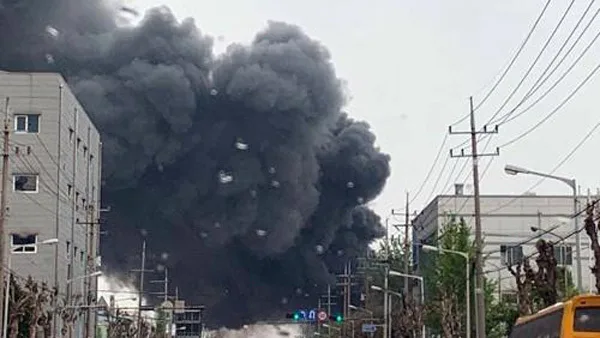
Photo of the May 2020 fire at the Banwol Industrial Complex in Ansan [Source: MBC News]
Every so often the news reports a major fire at an industrial complex, such as Sihwa in Siheung or Banwol in Ansan (both in Gyeonggi Province), Namdong in Incheon, or Gumi in North Gyeongsang Province. When I see such news, the first thing I wonder is how that supplier will notify its clients. Will it be honest and open about the fire? Or make some other excuse? Did it have fire insurance? Was it an old factory full of facilities and equipment due for renewal? Or a state-of-the-art plant recently renewed on a big budget? Now let's think from the standpoint of a competitor of the supplier that had the fire. If it has plenty of spare capacity, this is a huge opportunity. If it increases its supply volume now and takes share, it will be hard for the other supplier to catch up again. That assumes the competitor has ample capacity. But ample capacity means it has not been selling everything it makes, and if the supplier that burned down uses a hefty fire insurance payout as a blessing in disguise to thoroughly renew its plant and equipment, it will soon become a serious threat.
Harim, which has been strengthening its control of the food value chain from grain and livestock to processed foods, suffered a factory fire in May 2003. Damage exceeded KRW 100 (≈ US$1) billion, but because the company had bought cheap insurance, the payout covered only about one-tenth of the loss. Harim had been expanding aggressively and had no funds to rebuild, but outside financing turned the crisis into an opportunity: it transformed an outdated plant into a facility with state-of-the-art equipment. Always keep track of every client’s business situation. If a customer’s orders suddenly surge because of an emergency such as a competitor’s fire, flag that customer and move them up your production schedule for faster production and on-time delivery. It can become a great opportunity.
To be continued