“You’ll send materials that aren’t in the textbook, even after the training ends?” “Then of course I’ll give you my business card to get them.” “I get a fun email every month, so I opened this one to see what the material would be.” “I’m reaching out after reading your blog post. Could we set up a phone call?”
At the center of all these conversations is ‘content.’ It is a very human act and a thoroughly strategic one. This very article is no exception.
1. Content is the least burdensome offer
When someone tells us ‘Buy now’ or ‘Contact me right away,’ it feels awkward and pushy. But when we hear the following, we gladly welcome it.
"Would you like a monthly newsletter? We’ve put together practical stories you can use at work."
"After the training, I have bonus material that isn't in the textbook. I'd be happy to share it if you need it."
"I put together some practical case studies on my blog. I think you'd find them useful."
This is a precursor to a sale. But customers don't perceive it as selling, because it's information and content. It can even give the other person a reason to reach out first.
2. Content is the entrance to the marketing funnel
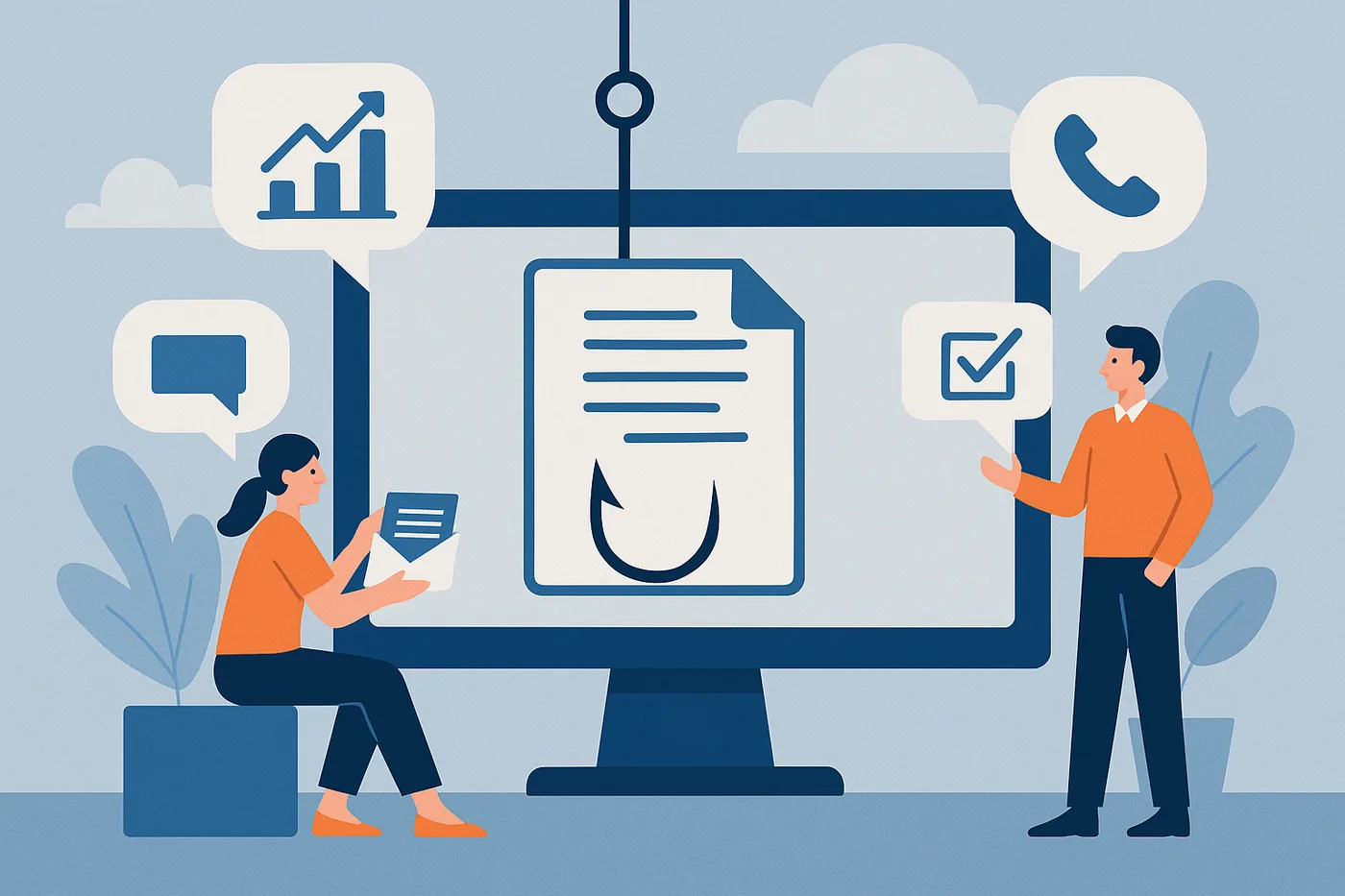
Good content widens the Top of Funnel (TOFU, the entrance) of the marketing funnel (a funnel, or maybe a fish trap?) on its own. A single newsletter, Brunch article, or blog post can:
Turn anonymous visitors into 'anonymous readers,'
readers into 'leads (prospects),'
It turns leads into 'call recipients' or 'training attendees.'
For example, if you publish a 'Practical B2B Marketing Blueprint' on Brunch, marketing practitioners find it through search, click the CTA at the bottom of the post, and request a consultation by chat or phone. This isn't simple inbound. It's a 'landing-style funnel (a fish trap)' built directly by content.
3. Content is the best bait for outbound cold email
Everyone says cold email is hard these days… but a cold email that carries well-made content gets better open rates and better reply rates.
“A report on our sales process for [industry] clients”
“3 content marketing methods companies in △△ are using right now”
“A collection of customer-acquisition case studies from the □□ industry in the spotlight right now"
A cold email with this kind of subject line and content gets opened, gets clicked, and gets a reply. If you then ask, ‘Would it be all right if I walked you through the details by phone at a time that suits you?’, you are less likely to be turned down than if you had started with a cold call.
4. Customers remember the person who gives them good 'content.'
Customers want ‘trustworthy, reassuring information.’ B2B customers even more so, right? Even if they don't buy right now,
‘the person who sends good content’
‘the person who regularly shares useful insights’
‘the person who follows up with extra materials after training’
People like that will come to mind when a buying opportunity arises (once the buyer is motivated).
5. Practical tips – 3 ways to use content as ‘relationship bait’
Collect business cards by offering bonus content after the training “We’ll send you real-world cases and a workbook that aren’t in today’s course materials. If you give us your business card, we’ll share them with you.”
Make your regular newsletter fun and useful “Only useful information inside. Try one issue, then decide.” That one line makes opting in feel natural.
Insert landing CTAs into your blog/Brunch posts “Most-viewed resource among readers of this post: Get the ○○ report → (phone CTA or Channel Talk link)”
Wrap-up: Content isn't a giveaway, it's bait
Content is never free. It has a price, paid in ‘attention’ and in the starting point of a ‘relationship.’ It is the softest, most strategic approach. Even now, content is quietly prompting someone to click a CTA. That action will lead to a phone call, a meeting, a trial, a contract.
To be continued