I'm a man from Daegu, born in 1974, and 52 this year by Korean age. A fan of Lee Seung-hwan and Shin Hae-chul, I played keyboard in a military band's small combo in the mid-90s, banging out ppongjjak (trot) for officers' drinking parties every night. For a jazz lover who adored Herbie Hancock, Bill Evans, and Duke Ellington, it was real torture.
But as the years passed, I suddenly noticed what 'trot' had become: a steady fixture of TV. The very music my parents, uncles, and aunts, now in their 60s and 70s, listened to in their youth has become the mainstream of legacy media. As TV became their exclusive domain, content aimed at the customers with the biggest purchasing power, 'trot' (which I absolutely loathe), flooded the screen.
A generational history of resistance, told through music
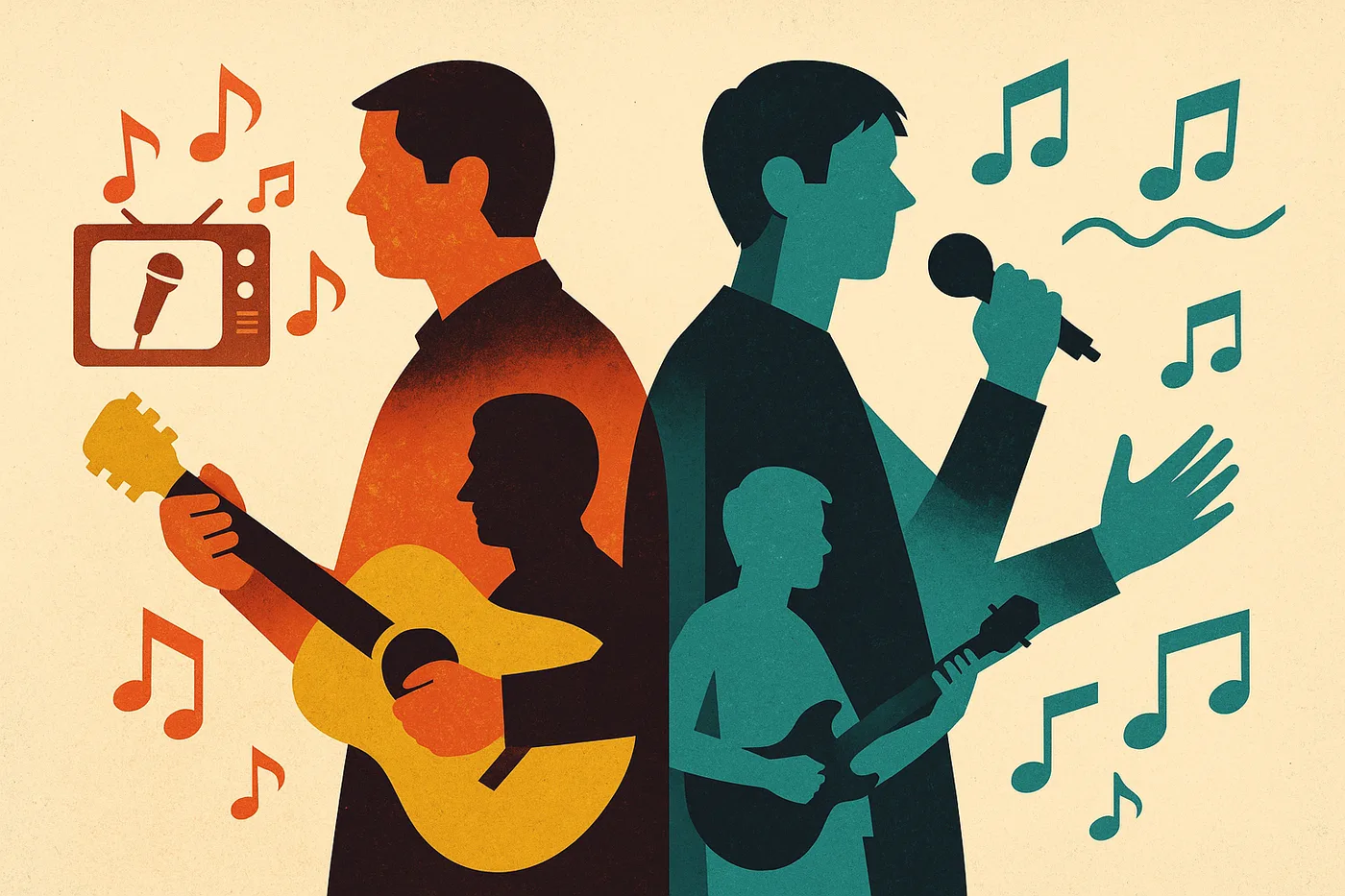
Looking back, I think the history of popular music is really a history of generational rebellion. In the 1960s, the folk generation with their acoustic guitars probably rejected the trot music of their parents, who had lived through Japanese colonial rule and the Korean War. In the U.S., I see the hippie movement in a similar light. Its core was opposition to war, free love, harmony with nature, and self-expression through art and music. The music of Kim Min-ki and Han Dae-soo, who represent that era, was a language of resistance and reflection, completely different from the lamenting melodies of the older generation.
The rock generation of the 1970s and 80s was more direct. The sound of Sanulrim and Deulgukhwa found even folk lyricism stifling and pursued something more distinctive and intense. Then in the 1990s, Gen X voiced clear resistance to the older generation through Seo Taiji and Boys. Having shaken up the music scene with “I Know”, they took on the entrance-exam race and authoritarian schooling head-on in “Classroom Idea”, which I see as the youth of that era (born in the late 70s and early 80s) declaring in music that they would no longer comply.
The Oedipus complex in music
Here an interesting insight emerges. Every generation expresses an "Oedipus complex" culturally, denying and resisting the one before it. Take me, born in 1974: I reject authoritarian culture (schools where corporal punishment was routine, a senior-junior culture that treated age hierarchy as absolute) along with trot, the symbol of that generation.
This is not simply a matter of musical taste. I see it as a rejection of one generation's culture as a whole, expressed through music, the most sensory arena of all. In the 1990s, Gen X turned away from acoustic folk as "cliché" and moved toward rock, punk, and dance music. In the early 2000s, young people bored with a market full of ballads went wild for hip-hop and R&B. I think these are the same pattern.
Even fashion and hairstyles become tools of rebellion alongside music. The rock generation's long hair, the hip-hop generation's loose-fit clothes, the indie generation's vintage looks: all were silent defiance against the older generation's sense of "neatness." I did the same myself. From the mid-1990s to the early 2000s, I dyed my hair blond and grew it long, wore earrings, and walked around in ripped jeans :)
Younger generations’ rejection of ‘ajae’ (middle-aged guy) taste
From this angle, the way today's young generation (born in the 1990s and 2000s) turns against Young Forties, Gen X, and the 586 generation can be understood in the same context. Where Gen X went wild for Muhangguedo's "To You" and Lee Seung-hwan's "As Much Love as Is Scattered Across the World," today's twenty- and thirty-somethings would dismiss all of it as "old-guy sentiment" and reject it. What's interesting is that gender differences show up in this process. Women in their 20s and 30s sympathize with Gen X's progressive leanings, and they actively voiced support during the impeachment crisis. This connects to opposition to authoritarianism and male-centered power structures. By contrast, men of the same age oppose the older generations (Gen X, Young Forties, the 586s) yet tend to admire authority and strength more than progressive values.
Looking at young people's music tastes in 2025 as a Gen X "old guy," I see a lot of hybrid sounds where genre boundaries have collapsed, and many short songs built around intense hooks. K-pop is consumed actively not only in Korea but in global markets, and young Koreans seem to be moving toward more distinctive music and newer styles. More variety makes shopping for music more fun. Overall, their musical choices seem to put the emphasis on diversity, individuality, and emotional immersion rather than rebellion.
Same music, different interpretations — a mirror of generations
Even more interesting is that this rebellion follows a predictable pattern. The trot generation was unfamiliar with rock. The rock generation saw folk as outdated. The hip-hop generation called ballads dull and despised trot. And today's young generation prefers global idols like NewJeans and LE SSERAFIM, hip-hop and R&B artists, and indie musicians over uniform idol groups like H.O.T·Fin.K.L·S.E.S, valuing individuality and diversity. Isn't it only natural that every generation denies the one before it in order to establish its own identity?
Recently, these generational differences have become a bit more complicated. Even the success of K-pop, represented by BTS, BLACKPINK, and KPop Demon Hunters, is read differently across generations. The older generation takes it as 'a source of Korean pride' (with a slightly old-fashioned feel?), while younger people approach it as a 'global standard.' The very way of seeing the same phenomenon differs by generation. Korea's Gen X in the 80s and 90s saw Japan as a leader in technology and culture, but in the 2020s, young Japanese actually see Korea as a more dynamic and advanced cultural center.
The endless cycle of culture
In the end, culture has evolved this way: one generation's rebellion becomes the establishment for the next, and then the target of the generation after, in an endless cycle. What's interesting is that this cultural resistance goes beyond simple generational turnover and creates diversity across society as a whole. Just as those who hated trot rebuilt their own musical world through new genres, each generation's rebellion becomes the engine that opens up new cultural territory.
In fact, I think the richness of Korean popular music is the result of exactly this generational rebellion and diversity. Today's music ecosystem, where trot, folk, rock, ballads, hip-hop, and K-pop coexist, seems to be a cultural product created as each generation pushed back against the one before.
To be continued