High-End Equipment·Commodity Materials·SaaS: Completely Different Rules of the Game
B2B marketing is more than selling products to businesses. It is an overall strategy for how to design and sustain customer relationships. Depending on the client's size and traits and the product's price and nature, the 'rules of the game' in marketing change completely. After all, not every B2B product, from equipment worth hundreds of billions of won to bolts worth a few hundred won, can be sold the same way. Let's take a look.
Customer strategy for the ultra-expensive equipment market

A single EUV (extreme ultraviolet) lithography machine that Dutch company ASML supplied to Samsung Electronics and SK hynix costs about US$200 million (KRW 260 billion (≈ US$194,523,400)). Selling just one equals the annual revenue of the mid-sized company where I worked for about five years, and the operating margin reaches as high as 32% (as of 2024). High-voltage transformers from Korean power equipment maker Iljin Electric also sell for anywhere from several billion to tens of billions of won each. In this ultra-high-priced equipment market, 'a single customer (Account)' can decide the fate of the company. I remember a new hire at a major corporation, in a B2B marketing and sales training I recently delivered, saying, "So we just need to land that one big fish, right?" In fact, the world's three largest semiconductor companies (Samsung Electronics, SK hynix, TSMC) account for more than 70% of ASML's revenue. If they change their capital investment plans or switch to a competitor's product, ASML's results take an immediate hit. (Yet as of now, ASML is effectively the only company able to supply EUV lithography machines at mass-production level!) That is why these companies build their marketing strategy entirely around 'Account-Based Marketing'.
But account management here goes far beyond simple customer service. A B2B vendor must map the client's org chart down to the team level, and keep a database of each team's decision-makers, including their tendencies and technical preferences. When a client changes strategy or settles on a new process-technology direction, the vendor's sales team must get that information in real time and reflect it in its own product roadmap. Going further, building 5- and 10-year technology roadmaps together with key clients is only natural. This is not a relationship of simply selling products; it is a partnership that designs the customer's future strategy together. To do so, each Key Account gets a dedicated engineering team, business development team, and service team, who even attend the client's internal meetings to offer technical advice.
Iljin Electric and Hyosung Heavy Industries have likely also invested for many years in continuous technology development and relationship building to win a giant customer like the Korea Electric Power Corporation (KEPCO). Once selected as a supplier, a company is hard to replace: switching costs are astronomical, and safety and compatibility concerns make a change difficult, so revenue stays stable for the long term. This is the heart of 'account maintenance.' Meanwhile, in North America, the rapid growth of the AI industry is driving a surge in power demand. On top of that comes replacement demand for aging power equipment installed in the 1970s and 80s, so demand for transformers and transmission and distribution equipment is exploding. This is a rare ‘golden window’ for the global power infrastructure market, which long moved conservatively, and it is an unprecedented growth opportunity for incumbent suppliers backed by technical strength and delivery track records. It is a once-in-a-generation chance to win not just one big customer but several at once.
Commodity Materials Markets, Where Price Decides the Winner
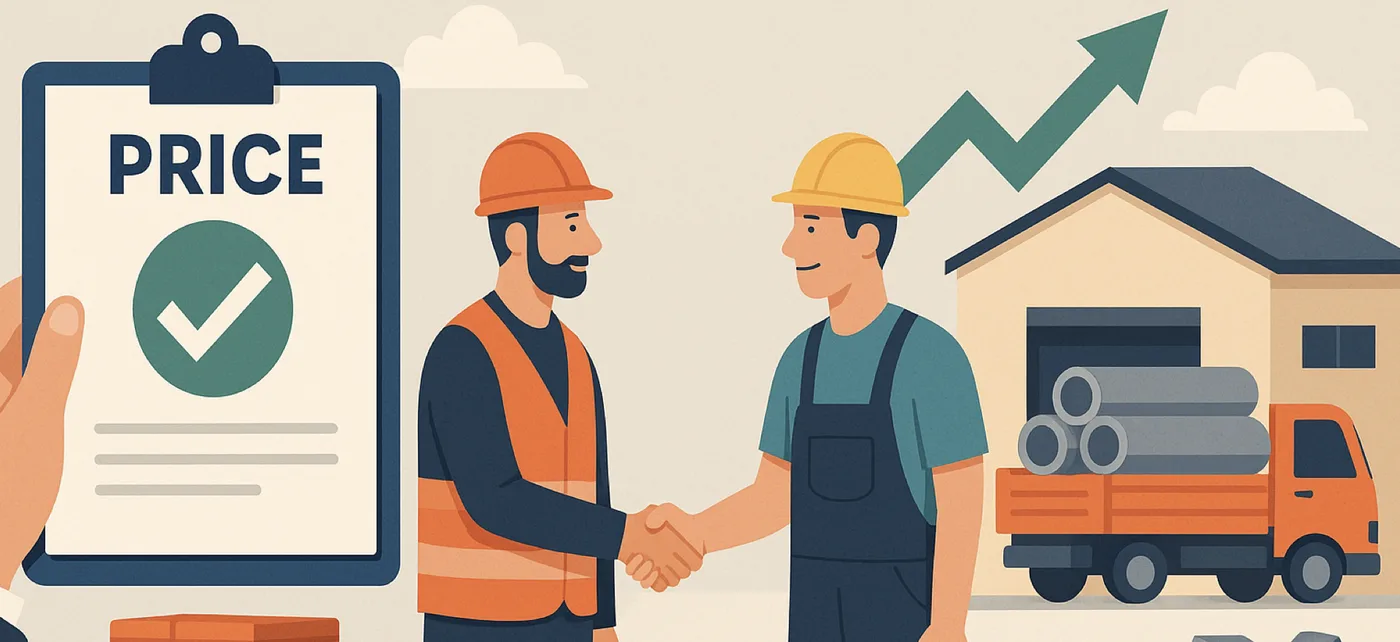
Markets like ready-mix concrete, fasteners such as bolts & nuts, paint, plastic raw materials, packaging, wire and cable, basic chemicals, and industrial gases are a completely different game. Even large contractors like Samsung C&T or Hyundai E&C mainly look at 'price' when choosing a ready-mix supplier, because quality differences are small and switching costs are almost nil. Major Korean ready-mix producers typically have to bid project by project and offer the lowest price to win a contract. But price is not the only source of competitive advantage here. A stable supply chain and efficient distribution and service matter just as much. Ready-mix concrete must be poured within 90 minutes and 20 km of production, so it is a ‘game of time and distance.’ That is why plants need to be near job sites, and depending on traffic, a special mix with a slower set time may be needed. Weather is another variable: in heat you slow the hydration reaction, in cold you speed up setting, and in humidity you adjust the mix. In the end, the winner is whoever best ties together supply chain, logistics, and service. Optimizing dispatch with GPS, checking quality before shipment, and responding instantly when problems arise is what builds trust. In the ready-mix market, competitiveness comes not just from plant size but from the ability to deliver ‘on time, done right.’
The ability to meet delivery dates exactly and supply the needed volume reliably, even in unpredictable markets, builds trust that goes beyond price competitiveness. In fact, US fastener distributor Fastenal grew into a full-line industrial and construction supplies distributor by leading its market early with 'industrial vending machines' installed in factories and job sites, which dispense and automatically manage tools and consumables on the spot, and with 'Onsite solutions,' which station dedicated stores and staff inside customer facilities to run inventory and procurement directly. This simplifies the customer’s purchasing process and reduces Total Cost of Ownership. In such markets, building an efficient distribution network and securing cost competitiveness matter more than traditional salesperson-centered relationship marketing.
SaaS in the Subscription Economy: A New Paradigm

The fast-growing B2B SaaS (Software as a Service) market calls for yet another approach. Enterprise software like 'Salesforce' or 'Fingersales' is neither as daunting as ultra-high-priced equipment nor as simple as commodity materials. 'Fingersales', a CRM SaaS priced at around KRW 20,000 (≈ US$15) per employee per month, is a lighter purchase than heavy equipment. But once adopted, employee and sales data accumulate in the system, so switching costs are never trivial. (That is why IT vendors often offer bigger benefits or discounts at the initial adoption stage, aiming for a ‘Lock-in Effect’ so customers can't easily leave.) Above all, because B2B SaaS is a subscription-based recurring-revenue model, maximizing 'Customer Lifetime Value (LTV)' is the key.
Because of these traits, SaaS companies must focus on customer acquisition, churn reduction, and upselling all at once. They analyze customer usage data to detect early signs of churn and make heavy use of data-driven predictive and personalized marketing, such as tailored content and upsell offers. With marketing automation tools like HubSpot and Marketo, they manage the entire process, from lead generation to conversion and retention, through data. Take Korean SaaS company Imweb: it attracts prospects with content marketing, lifts conversion with free trials, and runs a Customer Success Team to maximize satisfaction and prevent churn. This integrated approach shows the essence of the SaaS business model: retaining customers matters as much as winning new ones.
Differences in Applying Digital Marketing
Applying a one-size-fits-all digital marketing strategy without understanding industry characteristics is a very risky approach. I once worked at a mid-sized company that adopted an expensive foreign IT solution that did not fit the company’s size or way of working. As a result, we ended up with a complex foreign-language UI, a confusing feature set, and a lot of time and money spent on documents and manuals to fit our internal processes to the tool. Adoption that ignores industry traits and organizational context can actually hold back digital transformation. Makers of ultra-expensive equipment, such as EUV machines or high-voltage transformers, have only a handful of potential customers worldwide. Pouring budget into Google search ads or Facebook and Instagram marketing would obviously be wildly inefficient. Focusing on building direct relationships with the decision-makers at key clients would be far more effective. Conversely, for commodity material suppliers such as fasteners or paint, efficient distribution through online platforms and price-comparison services may matter more.
Ultimately, the most important thing in B2B marketing is to understand the characteristics of your own industry accurately and build a strategy that fits. For an ultra-expensive equipment maker, the key is building deep relationships with a small number of core customers. A commodity materials company should focus on price competitiveness and an efficient distribution network, and a SaaS company on data-driven customer journey management. However far digital marketing tools advance, chasing trends while ignoring an industry’s essential nature only wastes time and resources. Real competitive advantage comes only when you build marketing and sales strategies optimized for your own business model.
But different strategies by industry do not mean the industries must be completely cut off from one another. Companies that flexibly absorb the strengths of other industries and apply them a step ahead of competitors can turn that very ability into a powerful weapon. For example, if a commodity materials company collected and analyzed customer data systematically like a SaaS company, it could go beyond simple price competition and gain a new dimension of competitiveness through ‘rapid response’ and ‘tailored proposals.’ Likewise, if an ultra-expensive equipment company used digital content to build technical credibility and customer understanding, it could create strong synergy with the younger generation at its client companies, beyond relationship-driven sales. Ultimately, the essence of B2B marketing is to reflect industry characteristics faithfully while creating differentiated competitiveness through strategic fusion that crosses boundaries.
To be continued