"Can I become a corporate instructor?" Honest advice from a 15-year corporate instructor to aspiring instructors who are wondering

At some point in your career, you’ve probably had this thought.
"I’m worn out by meetings, reports, and getting scolded by my boss… What if I made a living standing in front of people and speaking instead?"
Then the thought comes: "I’m a good presenter and I speak clearly. Why not become an instructor? I hear you can make six figures in no time."
I know that feeling well.
I started down the corporate instructor path around age 40, after working in overseas sales.
But this path is less glamorous than you might expect, and not all romance.
You get freedom, but also a lot of anxiety, and tireless passion alone isn’t enough: you need stamina, follow-through, and self-discipline.
I’ve spent 15 years as a corporate instructor and worked with countless aspiring instructors along the way.
Here is what I’ve learned, at some length and with complete honesty.
If you dream of becoming a corporate instructor, I’m confident it will help.
Case 1: Manager Park, who left a major corporation to become an instructor

Park, a manager, spent 12 years in the HR department of a large corporation in Seoul.
Having worked in HRD for so long, they knew employee training well and had experience booking a wide range of speakers.
After leaving my job, I thought, "Now it’s my turn to teach! I’ll get established in no time," and registered as a sole proprietor right away.
My course content was solid, and I had plenty of field experience.
But the problem was that no requests came in.
Here is what they said:
“I used to be the one hiring instructors, but winning training contracts is really hard.”
That’s right.
The distance between an instructor and a training manager is bigger than you might think.
Knowing something doesn’t mean you can step onto the stage right away.
Where does a corporate instructor work? Start by understanding how the training market is structured.
This is also why corporate instructors from sales and marketing backgrounds adapt faster: they understand the market structure before they start.
Your approach to a lecture changes completely depending on who you are teaching.
To get started, first get clear on where you will fit.
Open-enrollment market (B2C)
Training for individuals, typically self-development, communication, personal branding, and the like.
Instructors have to market themselves or register on platforms to recruit learners directly. This is not an area for beginner instructors.Public institution and school training (B2G)
Training run by schools, government offices, and government-funded organizations.
You may need to bid or register on a local government vendor list, and fees are relatively low. This is usually where new instructors get their start.Corporate training (B2B)
Training delivered inside a company for its employees.
Most of it is requested by a company’s HR or training team.
Instructors either connect with clients directly or win work through training agencies. Low evaluation scores get you dropped immediately.
Of these, the B2B market is where most people called ‘corporate instructors’ work.
Case 2: Mr. Kim, a 30-something instructor who wins work only through his blog

Mr. Kim majored in psychology and is a freelancer specializing in adult-learner training.
He has almost no ties to the large training agencies.
Instead, he steadily built his own brand through a blog, YouTube, and social media.
They had their own web page with a well-organized lecture proposal and portfolio,
and when companies searched for training, the blog often showed up, probably thanks to good SEO.
When an inquiry comes in, a PDF proposal and a link to the web page go out by email together, along with a link to a demo-lecture video posted on YouTube.
What stands out is that most of this instructor’s clients ‘come to them.’
In other words, it’s a successful case of inbound marketing. Well-organized content builds up over time, and competitors can’t easily copy it.
She says:
“At first I was overwhelmed sending emails and making calls myself. But as my content piled up, at some point people started contacting me.”
Training is never a solo act: who is an instructor’s real customer?
When a company decides on training,
an instructor deals with three main groups.
First, the day-to-day contact
This is usually a woman in her 20s or 30s on the HR team (assistant manager or manager level).
Training goes smoothly when you communicate well with her. Calling her out of the blue? She won’t like that.
Respond to messages quickly, and send materials that are neatly organized.
Second, the decision-makers
Department-head-level managers or executives, mostly men in their 40s and 50s.
They look at the course title, curriculum, and instructor background (references)
to judge whether ‘this instructor is right for our organization.’
Third, the participants (employees)
They are the people who actually attend the class (all ages, genders, and backgrounds).
Their satisfaction can lead to follow-up training,
and sometimes requests from other departments later on.
In other words, an instructor has to understand ‘layered clients’ and plan how to serve each of them.
You only get invited back when everyone is satisfied.

An instructor is not just someone who speaks well. Otherwise, announcers and MCs would have taken over this market.
Here is what I often tell people who are about to start out as instructors.
“Being a good speaker is never enough.”
Why?
Because a lecture is built on content and design, not just speech.
The flow, participation methods, worksheets, materials, and emotional pacing
all have to be designed like a single 'work of art.'
On top of that, as a one-person self-employed business,
you have to handle everything yourself: marketing, branding, client service, content creation, accounting, and taxes.
To sum up, here are the skills you need to become an instructor.
Content planning skills
Hands-on experience and expertise
Delivery and expressiveness
Design sense (PPT, video, etc.)
Marketing skills (blogs, social media, writing proposals, etc.)
Industry network and communication skills
Case 3: Jung, a new instructor who landed an opportunity through a demo lecture

Jung had left a job after eight years, completed a corporate instructor program,
and was just about to enter the field.
An "assistant instructor wanted" post went up in an online community for education agencies, and they didn't miss the chance.
They got to assist on-site and give a short trial lecture.
A manager who saw it pulled them aside
and connected them with another course.
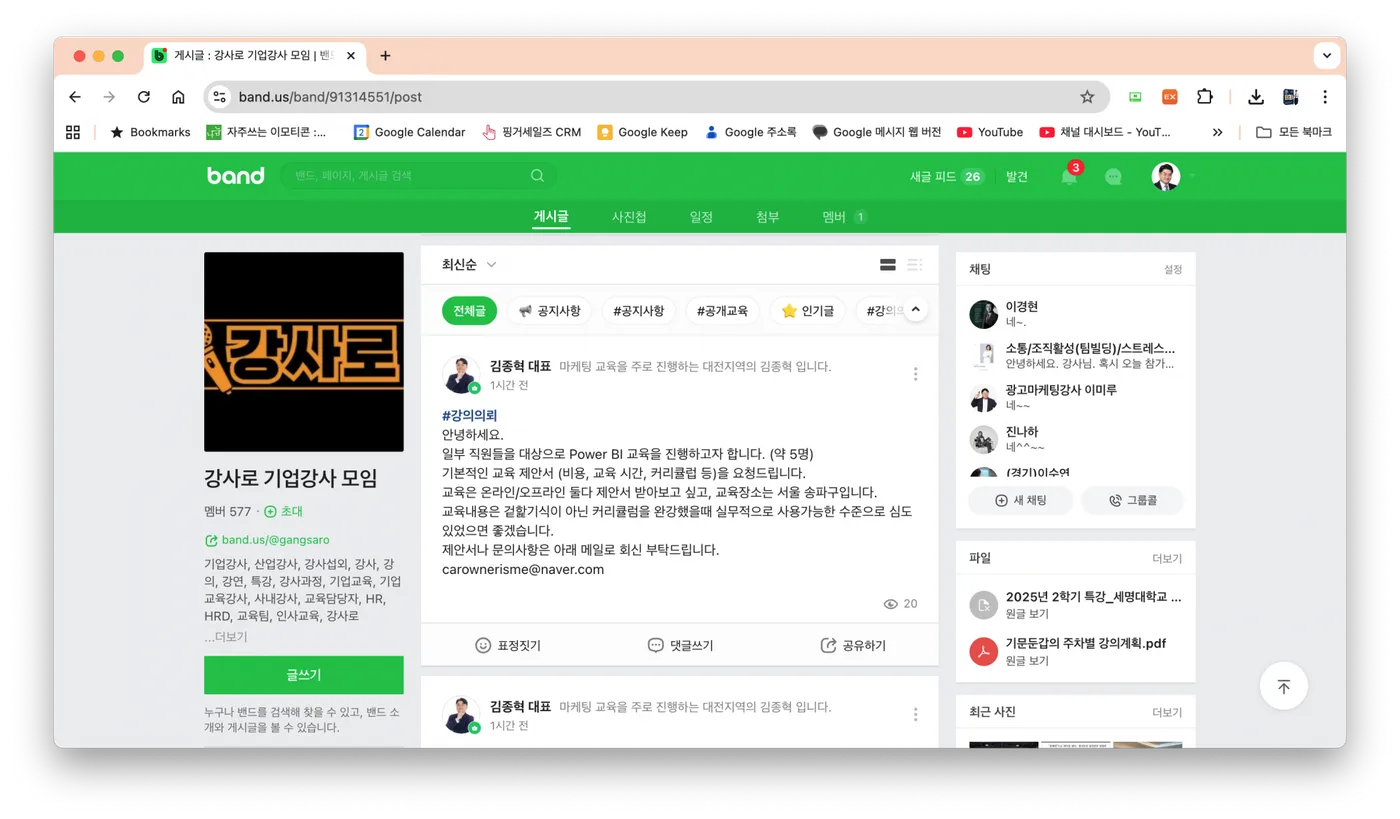
A notice for an “instructor meetup and demo lectures” was posted in an instructor community on Band,
and at that meetup he gave a 15-minute demo lecture on the content he felt most confident about,
and another instructor who saw it connected him with a different engagement.
One lecture, then two, then three… and the lectures kept coming.
Today they deliver more than 100 lectures a year.
At the start, you need hands-on experience, no exceptions.
Instead of waiting for people to notice you,
grab chances such as “assisting,” “facilitating,” and “demo lectures”
and show your face first. Without fail!!!
Are your profile and lecture proposal persuasive?
An instructor has to sell themselves as “content.”
That makes proposals, profiles, and portfolios all the more important.
Here are the points beginners commonly miss.
When your profile photo is too casual or too stiff
When your proposal is packed with text and visually dull
When the course title is too abstract (e.g., ‘The Art of Communication,’ ‘A Happy Organization’)
When it stresses only your résumé and holds little appeal for learners
An instructor has to package ‘themselves’ like a brand,
one that looks good, is easy to understand, and earns trust.
5 realistic steps you can start today
Create your own course content and design it as a story
Keep your blog, social media, and website running consistently. Content is the bait.
Ask a professional for your profile photo. The impression matters
Say yes to every opening first: demo lectures, assistant instructor roles, facilitating
Prepare your training proposal with a balance of text and visuals
One last word for you
Training is not just a one-off activity.
It is a “work of art” that carries a person’s life, philosophy, and experience.
Some burn out because passion runs ahead of them,
while others seize a single opportunity
and build a career of their own.
If you dream of becoming an instructor, I have a question for you:
What is your “story”?
What is the “real message” you want to share in front of people?
If you can prepare that story,
you can become an instructor too.
I run an instructor community on Band (Gangsaro).
If you have questions or need help, feel free to reach out anytime.
As someone who started before you, I'm glad to help.
Join our instructor community on Naver Band ↓↓↓
https://www.band.us/band/91314551
I hope you won’t have to walk this path alone.
John Kim, CEO of Nanum Consulting
010-****-****