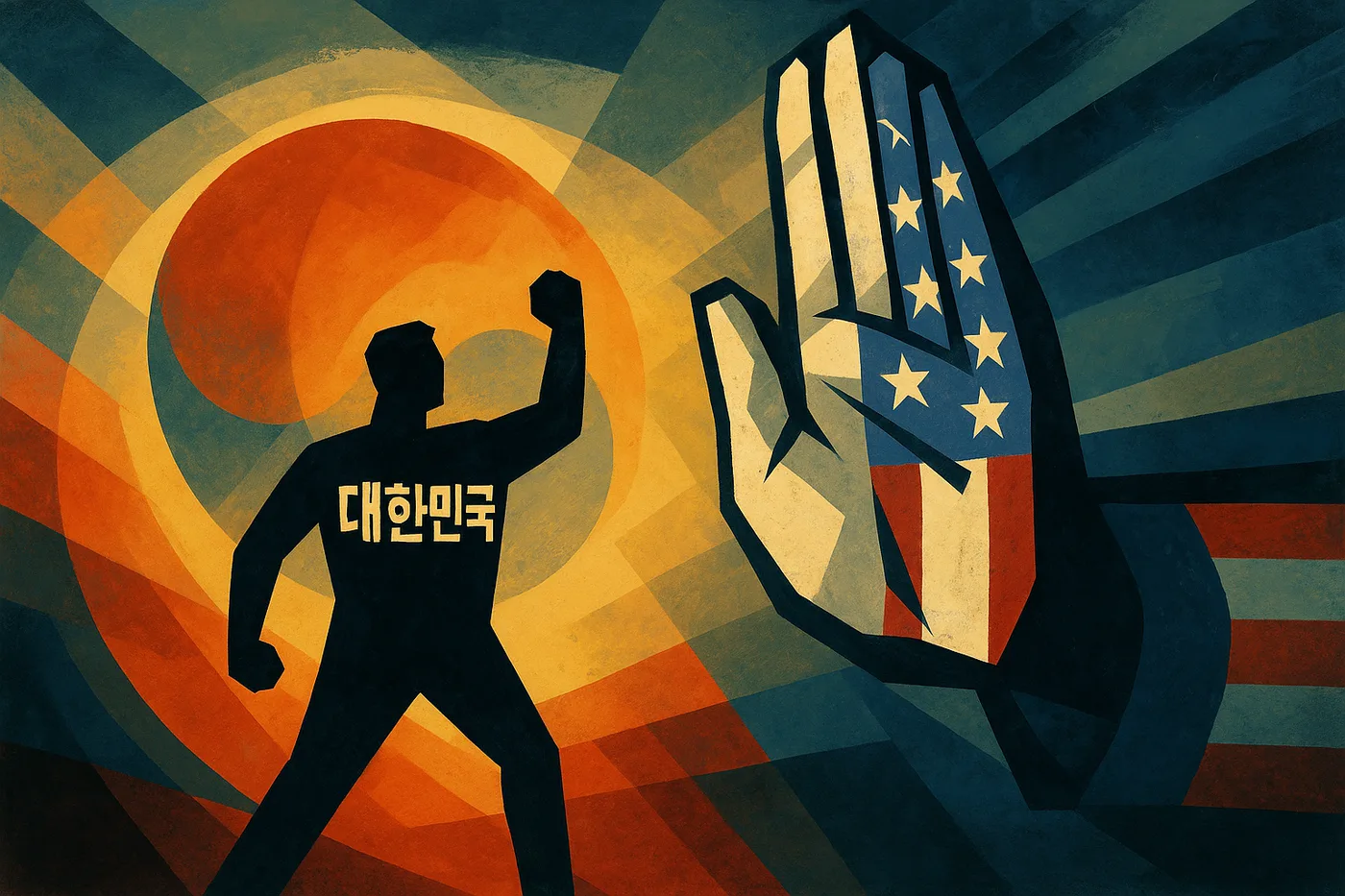
Hello. Do you realize that Korea is facing the greatest economic crisis since its founding? The terms the U.S. put forward in the Korea-U.S. tariff negotiations go beyond an unequal treaty: they amount to a slave contract demanding that Korea surrender its economic sovereignty outright. A recent incident at the Hyundai Motor plant construction site in Georgia, USA, is a telling symbol of this. Even as Korea invests billions of dollars to create jobs in America, our engineers were treated as 'illegal immigrants' and arrested. That is the reality, and that is how America treats Korea.
The shocking U.S. demands
Listen to the terms the U.S. is demanding. Korea would invest USD 350 billion, close to KRW 500 (≈ US$1) trillion, in cash in the U.S., and the U.S. would take 90% of the profits even after the principal is recovered. Let’s work out just how absurd these numbers are. KRW 500 trillion (≈ US$374,083,495,400) is 75% of the Korean government’s annual budget of KRW 660 trillion (≈ US$493,790,214,000). It would mean every citizen, from newborns to the elderly, bearing roughly KRW 10 million (≈ US$7,480) each. Even more shocking, it equals more than 85% of Korea’s USD 415.6 billion in foreign exchange reserves. In a normal investment, risk and returns are both shared. Yet the U.S. demand is for Korea to bear 100% of the risk while the U.S. takes 90% of the profit. This is not investment; it is economic plunder.
The risk of a repeat of the 1997 IMF crisis
Investing KRW 500 trillion (≈ US$374,083,495,400) in cash means putting up 85% of Korea’s foreign exchange reserves all at once. To see how dangerous that is, remember the 1997 IMF financial crisis. A sharp drop in reserves leads to a collapse in the sovereign credit rating, and foreign investors start pulling out en masse. The stock market then crashes, the won plunges, and prices soar. Corporate bankruptcies surge and mass unemployment follows. In the end, the country loses its economic sovereignty and falls under IMF control once again. Remember 1997. Major conglomerates collapsed one after another, millions lost their jobs, and the middle class fell into ruin overnight. Families broke apart, and suicide rates soared.
The lesson of Japan’s Plaza Accord
What happened when Japan gave in to U.S. demands in the 1985 Plaza Accord? A surging yen destroyed its export competitiveness, and the collapse of the real estate bubble began Japan’s Lost 30 Years. A major economic power fell into stagnation. The U.S. demands today are even more vicious than the Plaza Accord. The Plaza Accord was an exchange-rate adjustment; this is a demand for economic subordination. Traditional fleecing meant taking a portion of the profits. What the U.S. is demanding now is to slit the sheep’s throat and carry off the entire carcass.
Why we need to pace investment in the U.S.
As the Hyundai Motor Georgia plant incident shows, the U.S. welcomes our investment while treating our technicians like criminals. Is it really right to keep expanding U.S. investment blindly under these conditions? Look at the reality of American manufacturing. U.S. workers earn three times what Korean workers do, yet their education levels are lower and their productivity lags. Manufacturing is seen as a 3D job (dirty, dangerous, demanding), so labor is hard to find, and those who are hired quit easily. Why should Korean companies go all-in on the U.S. alone? Here is the strategic approach I think Korea should take.
- Pace the investment: Hold off on large-scale commitments
- Market diversification: Broaden alternative investment destinations, such as China, Europe and Southeast Asia
- Strengthen the domestic base: Develop the domestic manufacturing ecosystem first
- Technological self-reliance: Reduce dependence on foreign sources for core technologies
A cold cost-benefit analysis
Let’s run a cold cost-benefit analysis. If Korea accepts a 25% tariff, its exports to the U.S. are expected to fall by roughly US$10 billion to US$15 billion. That is a temporary shock, and it is recoverable. But if Korea invests KRW 500 (≈ US$1) trillion, it immediately loses KRW 500 trillion (≈ US$374,083,495,400) and permanently forfeits 90% of future returns. That is an irreversible surrender of economic sovereignty. The conclusion is clear: a 25% tariff is a hundred times, even a thousand times, better. Once economic sovereignty is given up, it can never be recovered.
The wisdom of the Chinese negotiating style
There is a negotiating approach we can learn from China: manmanDi (慢慢地)! Take it slow and stay relaxed.
- Buy time. Say you will review it and proceed in stages.
- Exploit divisions within the U.S. Take advantage of conflicting interests among individual state governments and businesses.
- Offer alternatives. Use hypotheticals to widen the options: there is this one, and there is that one.
The U.S. is by no means a monolith. There is conflict between government agencies, and different regions have different interests. States compete with one another to attract Korean investment, and within the Republican Party, Trump loyalists and traditional Republicans, free traders and protectionists are at odds.
An effective negotiation strategy
The most important thing in any negotiation is your BATNA: the alternative you have if talks collapse. Korea’s BATNA right now is:
- Accepting the 25% tariff and opening up other markets
- Strengthening economic cooperation with China and Europe
- Expanding the domestic market and achieving technological self-reliance
Phased negotiation strategy:
Step 1: Buy time
- Form an expert committee, citing the need for thorough review
- Use the parliamentary audit schedule, claiming National Assembly approval is required
- Hold opinion polls and public hearings, citing the need for national consensus
Step 2: Negotiate terms
- Propose alternatives to cash
- Demand a 50-50 profit split
- Propose a phased approach
Step 3: Offer alternatives
- Explore other forms of cooperation
- Seek solutions that benefit both countries
Step 4: Responding to pressure
- Make it clear that we have other options too
- State clearly that Korea wants a relationship of mutual respect
Guarding against enemies within
In a national crisis like this, enemies within will inevitably emerge in Korea too. Just as there were traitors who collaborated with the Japanese invaders during the Imjin War, and pro-Japanese collaborators under colonial rule, there are surely forces today who side with the unfair demands of the United States.
They will try to undermine national unity in a variety of ways:
- Appear in the guise of economic experts and argue that the U.S. demands are reasonable
- Use the media to brand opposition as unpatriotic
- Exploit the issue politically to shake the government
- Organize protests and rallies, starting in the Yeongnam region, to stir social unrest
Response options:
- Expose their true colors
- Rebut false claims with facts and logic
- Isolate them with overwhelming public opinion
- Don’t fall for divide-and-conquer tactics
What the public should demand of the government:
- Transparent disclosure: Share the negotiation details with the public, with nothing hidden
- A firm stance: Giving up economic sovereignty is not an option
- Prepare alternatives: Have a range of options ready
- Monitor internal divisive forces: Track the movements of traitorous elements and respond
A message to the United States
This is our message to the United States. South Korea is a liberal democracy. We want friendly relations with the U.S., but we will never accept economic subjugation. We have the freedom to choose. Just as our technicians were treated like criminals at the Hyundai Motor Georgia plant, if the U.S. keeps acting this way, we have no choice but to slow the pace of our investment. If you want a true partnership built on mutual respect, withdraw these unilateral demands.
Conclusion: a turning point in history
This is that moment. We stand at a turning point in history. If we give in, we become an economic colony; if we resist, we can achieve true economic independence. Remember the 1997 IMF crisis. Citizens joined the gold collection campaign, and the whole nation pulled together to overcome the crisis. Today, that same awakening and unity is absolutely essential.
Together, we must protect Korea for our descendants, and protect their future.
To be continued