Characteristics of Korean Business Culture (English)
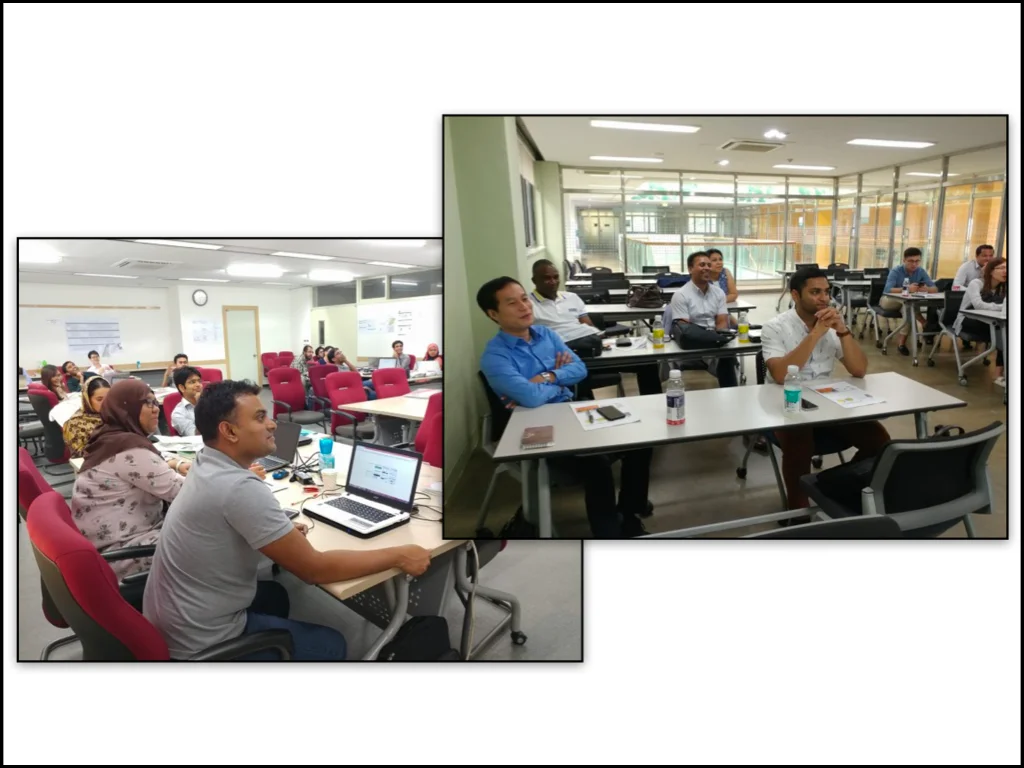
A 4-hour intensive program for foreign professionals working in Korea. It covers hierarchy, decision-making, communication codes, and team collaboration in Korean organizations, built around real workplace situations and delivered fully in English. Participants leave with a personal action plan for their own work context.
Who is this course for?
This course is for foreign employees who have been or are about to be assigned to a Korean entity, members of global companies who collaborate with Korean colleagues and teams, contacts at overseas partner companies who do business with Korean companies and institutions, and representatives of foreign companies preparing to enter the Korean market. The entire course is delivered in English, so no Korean is required.
What will you learn?
- Interpret the hierarchy and decision-making paths of Korean organizations on your own
- Tell what Korean-style indirect speech really means and ask follow-up questions to confirm
- Deliver opinions and feedback in ways that work with Korean colleagues
- Hold a written action plan tailored to your own work situation
Curriculum
- Orientation: identifying participants’ current challenges and agreeing on priorities for the day
- Rank structure and forms of address — why people use job titles instead of names
- How age and hiring cohort affect real influence
- The signals in meeting-room seating and speaking order
- First impressions: business card exchange, greetings, and choosing forms of address
- Comparison: how flat organizations and Korean-style hierarchy work differently
- Why meetings are a place for confirmation, not decision-making
- How pre-alignment (pre-reporting) works and how to take part
- Approval (pumui) and sign-off chains, and the document-first culture — why verbal agreements leave no record
- Pace: how 'ppalli-ppalli' (hurry-hurry) coexists with the demand for thoroughness
- Case study: why has my proposal been stalled for three weeks?
- High-context communication — how to read the unspoken half
- A guide to polite refusals: "We will review it / It may be a little difficult / We will try our best"
- What silence and smiles mean — agreement, reservation, or objection?
- What the tone and response time of emails and chat messages signal
- Three clarifying questions that prevent misunderstandings (with English phrasing provided)
- How to share your opinion while preserving face
- Praise in public, critique in private: the rule and its exceptions
- How to open a 1:1 conversation — and get comfortable with silence
- What company dinners, weddings and funerals, and tea breaks mean, how much to take part, and polite ways to decline
- Generational gap: how employees in their 20s and 30s view hierarchy
- Wrap-up: key takeaways checklist and Q&A
- Personal action plan — 30/60/90-day action list and a first-conversation checklist
Expected results / After the course
- Shorter initial trial-and-error period when adapting to a Korean organization
- Fewer misunderstandings and unnecessary conflicts caused by cultural differences
- Faster trust-building with Korean colleagues
- A personal action plan you can use from your first days on the job
On-site training references
About the instructor

Related courses
We tailor this course to your company
From diagnosis to execution — Nanum Consulting
FAQ

Characteristics of Korean Business Culture (English)
A 4-hour intensive program for foreign employees working in Korea. It covers the hierarchy, decision-making style, communication codes, and team collaboration of Korean organizations through real work situations
- Interpret the hierarchy and decision-making paths of Korean organizations on your own
- Tell what Korean-style indirect speech really means and ask follow-up questions to confirm
- Deliver opinions and feedback in ways that work with Korean colleagues
- Hold a written action plan tailored to your own work situation
- Shorter initial trial-and-error period when adapting to a Korean organization
- Fewer misunderstandings and unnecessary conflicts caused by cultural differences
- Faster trust-building with Korean colleagues
- A personal action plan you can use from your first days on the job
- Orientation: identifying participants’ current challenges and agreeing on priorities for the day
- Rank structure and forms of address — why people use job titles instead of names
- How age and hiring cohort affect real influence
- The signals in meeting-room seating and speaking order
- First impressions: business card exchange, greetings, and choosing forms of address
- Comparison: how flat organizations and Korean-style hierarchy work differently
- Why meetings are a place for confirmation, not decision-making
- How pre-alignment (pre-reporting) works and how to take part
- Approval (pumui) and sign-off chains, and the document-first culture — why verbal agreements leave no record
- Pace: how 'ppalli-ppalli' (hurry-hurry) coexists with the demand for thoroughness
- Case study: why has my proposal been stalled for three weeks?
- High-context communication — how to read the unspoken half
- A guide to polite refusals: "We will review it / It may be a little difficult / We will try our best"
- What silence and smiles mean — agreement, reservation, or objection?
- What the tone and response time of emails and chat messages signal
- Three clarifying questions that prevent misunderstandings (with English phrasing provided)
- How to share your opinion while preserving face
- Praise in public, critique in private: the rule and its exceptions
- How to open a 1:1 conversation — and get comfortable with silence
- What company dinners, weddings and funerals, and tea breaks mean, how much to take part, and polite ways to decline
- Generational gap: how employees in their 20s and 30s view hierarchy
- Wrap-up: key takeaways checklist and Q&A
- Personal action plan — 30/60/90-day action list and a first-conversation checklist