Vibe Coding Extended with APIs
Add live data, payments, text messages and maps to apps built with vibe coding, from public APIs to B2B, partner and internal APIs
"I built the app, but how do I add live weather, exchange rates, payments and text messages?" Once you can build screens with vibe coding, a real service needs one more thing: APIs, the 'data windows' that connect your app to the outside world. This 2-hour advanced course covers exactly that next step. We cover REST and JSON only to the level you need to read them, not write them. Then we start by adding free public APIs, such as OpenWeather, exchange rates and Korea's Public Data Portal, to your own app in 3 lines through vibe coding. Next, we survey how to add business features with paid B2B APIs such as Stripe (payments), Twilio (text messages) and Google Maps (maps); how internal APIs connect contract-based partner APIs with in-house systems; and how to keep API keys, which must never leak, safe. This course does not teach coding from scratch. It focuses on the core patterns and demos for attaching each API through vibe coding, so that in just 2 hours you gain the insight to grow a static app into a live, connected service.
💻 Start learning this topic with an online course →Who is this course for?
Ideal for practitioners, planners and solo developers who have built screens or apps with vibe coding but got stuck on 'how do I add live data, payments, text messages and maps?' It is especially helpful if you want to validate ideas quickly with public APIs and then map out integration with in-house systems.
What will you learn?
- Understand an API as a 'data gateway,' tell apart the four types (public, B2B, partner, internal) by access difficulty, reliability, and data value, and decide for yourself which to use and when
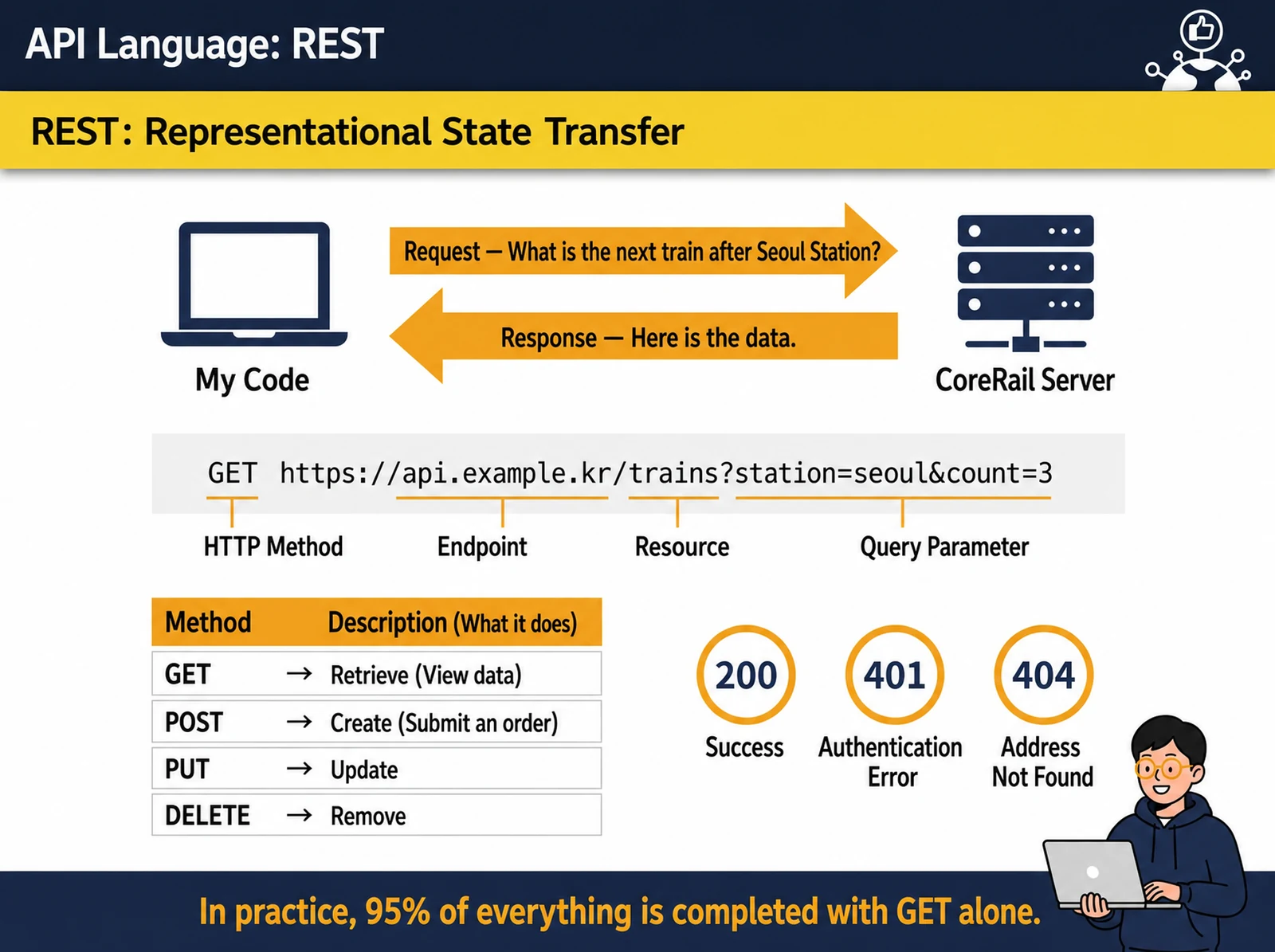
- Read a single REST request (GET address?conditions) and a JSON response, and diagnose problems yourself using status codes (200 success, 401 API key, 404 wrong address)
- Connect free public APIs such as OpenWeather, exchange rates, and the Korean Public Data Portal to your own app through vibe coding and show real-time data on screen
- Understand the pricing structures of B2B APIs such as Stripe (payments), Twilio (SMS and OTP), and Google Maps (maps) — pay-as-you-go, subscription, and credit-based — and add the business features you need
- Manage API keys safely with .env separation, regular rotation, IP whitelisting and rate limits, and draft integration plans for partner APIs and internal company APIs
Curriculum
- API = data window. From public APIs (practice and experiments) to partner APIs (B2B integration) to internal APIs (workflow efficiency), access gets harder, trust gets higher and data gets more valuable
- How to read a single REST request: the 'GET address?conditions' structure and the methods (GET to read, POST to create, PUT to update, DELETE to delete). In practice, 95% of work is done with GET alone
- Three status codes are enough: 200 (success), 401 (API key problem) and 404 (wrong address) tell you right away where you got stuck
- JSON is for 'reading,' not 'writing': { } is one object, [ ] is a list, "key":value is a label and its content, and AI handles the parsing for you
- The vibe coding approach: skip the dense English API documentation. Copy an example and ask the AI to wire it in. It’s faster, and it removes the three usual excuses: no technical background, no time, too much documentation
- 3 free sources to start with — OpenWeather (real-time weather), exchange rate APIs (global rates), and the Public Data Portal (transport, health, and administrative data)
- 3 big advantages of public APIs: 1,000 free calls a month (lower startup costs), same-day idea validation (MVP build time cut by 90%), and plenty of real-world examples
- [Demo] Get live data with just 3 lines, requests.get(url) → response.json(), and attach it to a card-style screen through vibe coding (5 minutes after getting an API key)
- Exchange rate API in practice: live price conversion for e-commerce, automatic calculation of international transfer fees and multinational sales aggregation
- Case study: train-tracker. An app that refreshes delay alerts, seat availability and route recommendations every 3 minutes using the Public Data Portal's live KTX operations API
- Vibe coding prompt pattern — "I’ll paste this API’s JSON response; turn it into a list/dashboard screen"
- Why paid APIs: APIs you pay for, such as payments, messaging and maps, give your business more credibility, and reaching customers is what keeps a business alive
- Stripe payments API: 135 currencies, PCI DSS compliance (no card data stored on your server) and settlement in 2 to 7 days. Ten lines of payment code give you a working revenue pipeline
- Twilio SMS and voice API: 99% global delivery rate (180 countries), OTP identity verification, appointment reminders (to prevent no-shows) and bulk marketing messages, with pay-as-you-go pricing of around KRW 50 (≈ US$1) per text message
- Google Maps API: build delivery, real estate and O2O services with Geocoding (address ↔ coordinates), Distance Matrix (best routes) and Maps Embed (add a map in 3 lines)
- Understand the 3 billing models: pay-as-you-go (Twilio, Maps), subscription (Slack, Zoom) and credit-based (AWS, Azure). Use free tiers and rate limits to avoid surprise bills
- Connect them with vibe coding: add business features with prompts like "Add a payment button with Stripe" or "Send a booking confirmation text with Twilio"
- Partner APIs: invitation-based access granted after contract and review, with clear reliability through SLAs and legal accountability (e.g., 3M dealer API, payment provider APIs). Automate finance, logistics and product spec integration
- Internal APIs — the ultimate goal of digital transformation: company-only, free to customize, 100% data control (ERP-CRM integration, real-time KPI dashboards)
- Internal API design principles: documentation first (specs in Swagger), versioning (keep backward compatibility), clear authentication and authorization. "An API without docs is the start of legacy"
- ⚠️ API key safety: never hard-code keys (keep them in .env), rotate every 3–6 months, use IP allowlists and rate limits. Warning: 'a key uploaded to GitHub is leaked instantly'
- Before/After: data collection from 3 weeks to 3 hours, manual Excel to automated partner API integration, static reports to live dashboards, and "the bottleneck is no longer technology but ideas"
- [Action plan] ① Call one public API yourself this week ② Find APIs you can apply to your own work ③ Draft a plan to integrate with internal systems → Q&A
Expected results / After the course
- Expand an app built with vibe coding from a 'static screen' into a 'live connected service.' A single API connection greatly increases the app's value
- Build data collection and business integrations yourself, without waiting on the dev team (from a 3-week dev team wait to same-day implementation with public APIs)
- A digital transformation roadmap: validate ideas the same day with public APIs, then move through B2B and partner APIs to internal system integration
About the instructor

Related courses
Start with an Online Course
Before you book on-site training, preview the essentials of this topic in an online course.
An introductory hands-on course for building work tools that run on plain conversational instructions.
Use AI in your daily work, from lesson prep to content creation.
An introductory course on how B2B markets are structured and how purchasing decisions are made, taught through real-world cases.
We tailor this course to your company
From diagnosis to execution — Nanum Consulting
FAQ

Vibe Coding Extended with APIs
Add live data, payments, text messages and maps to apps built with vibe coding, from public APIs to B2B, partner and internal APIs
- Understand an API as a 'data gateway,' tell apart the four types (public, B2B, partner, internal) by access difficulty, reliability, and data value, and decide for yourself which to use and when
- Read a single REST request (GET address?conditions) and a JSON response, and diagnose problems yourself using status codes (200 success, 401 API key, 404 wrong address)
- Connect free public APIs such as OpenWeather, exchange rates, and the Korean Public Data Portal to your own app through vibe coding and show real-time data on screen
- Understand the pricing structures of B2B APIs such as Stripe (payments), Twilio (SMS and OTP), and Google Maps (maps) — pay-as-you-go, subscription, and credit-based — and add the business features you need
- Manage API keys safely with .env separation, regular rotation, IP whitelisting and rate limits, and draft integration plans for partner APIs and internal company APIs
- Expand an app built with vibe coding from a 'static screen' into a 'live connected service.' A single API connection greatly increases the app's value
- Build data collection and business integrations yourself, without waiting on the dev team (from a 3-week dev team wait to same-day implementation with public APIs)
- A digital transformation roadmap: validate ideas the same day with public APIs, then move through B2B and partner APIs to internal system integration
- API = data window. From public APIs (practice and experiments) to partner APIs (B2B integration) to internal APIs (workflow efficiency), access gets harder, trust gets higher and data gets more valuable
- How to read a single REST request: the 'GET address?conditions' structure and the methods (GET to read, POST to create, PUT to update, DELETE to delete). In practice, 95% of work is done with GET alone
- Three status codes are enough: 200 (success), 401 (API key problem) and 404 (wrong address) tell you right away where you got stuck
- JSON is for 'reading,' not 'writing': { } is one object, [ ] is a list, "key":value is a label and its content, and AI handles the parsing for you
- The vibe coding approach: skip the dense English API documentation. Copy an example and ask the AI to wire it in. It’s faster, and it removes the three usual excuses: no technical background, no time, too much documentation
- 3 free sources to start with — OpenWeather (real-time weather), exchange rate APIs (global rates), and the Public Data Portal (transport, health, and administrative data)
- 3 big advantages of public APIs: 1,000 free calls a month (lower startup costs), same-day idea validation (MVP build time cut by 90%), and plenty of real-world examples
- [Demo] Get live data with just 3 lines, requests.get(url) → response.json(), and attach it to a card-style screen through vibe coding (5 minutes after getting an API key)
- Exchange rate API in practice: live price conversion for e-commerce, automatic calculation of international transfer fees and multinational sales aggregation
- Case study: train-tracker. An app that refreshes delay alerts, seat availability and route recommendations every 3 minutes using the Public Data Portal's live KTX operations API
- Vibe coding prompt pattern — "I’ll paste this API’s JSON response; turn it into a list/dashboard screen"
- Why paid APIs: APIs you pay for, such as payments, messaging and maps, give your business more credibility, and reaching customers is what keeps a business alive
- Stripe payments API: 135 currencies, PCI DSS compliance (no card data stored on your server) and settlement in 2 to 7 days. Ten lines of payment code give you a working revenue pipeline
- Twilio SMS and voice API: 99% global delivery rate (180 countries), OTP identity verification, appointment reminders (to prevent no-shows) and bulk marketing messages, with pay-as-you-go pricing of around KRW 50 (≈ US$1) per text message
- Google Maps API: build delivery, real estate and O2O services with Geocoding (address ↔ coordinates), Distance Matrix (best routes) and Maps Embed (add a map in 3 lines)
- Understand the 3 billing models: pay-as-you-go (Twilio, Maps), subscription (Slack, Zoom) and credit-based (AWS, Azure). Use free tiers and rate limits to avoid surprise bills
- Connect them with vibe coding: add business features with prompts like "Add a payment button with Stripe" or "Send a booking confirmation text with Twilio"
- Partner APIs: invitation-based access granted after contract and review, with clear reliability through SLAs and legal accountability (e.g., 3M dealer API, payment provider APIs). Automate finance, logistics and product spec integration
- Internal APIs — the ultimate goal of digital transformation: company-only, free to customize, 100% data control (ERP-CRM integration, real-time KPI dashboards)
- Internal API design principles: documentation first (specs in Swagger), versioning (keep backward compatibility), clear authentication and authorization. "An API without docs is the start of legacy"
- ⚠️ API key safety: never hard-code keys (keep them in .env), rotate every 3–6 months, use IP allowlists and rate limits. Warning: 'a key uploaded to GitHub is leaked instantly'
- Before/After: data collection from 3 weeks to 3 hours, manual Excel to automated partner API integration, static reports to live dashboards, and "the bottleneck is no longer technology but ideas"
- [Action plan] ① Call one public API yourself this week ② Find APIs you can apply to your own work ③ Draft a plan to integrate with internal systems → Q&A