Build Your Overseas Market Development Pipeline with AI Agents
Automate 12 steps, from product analysis to buyer sourcing, proposals and contracts
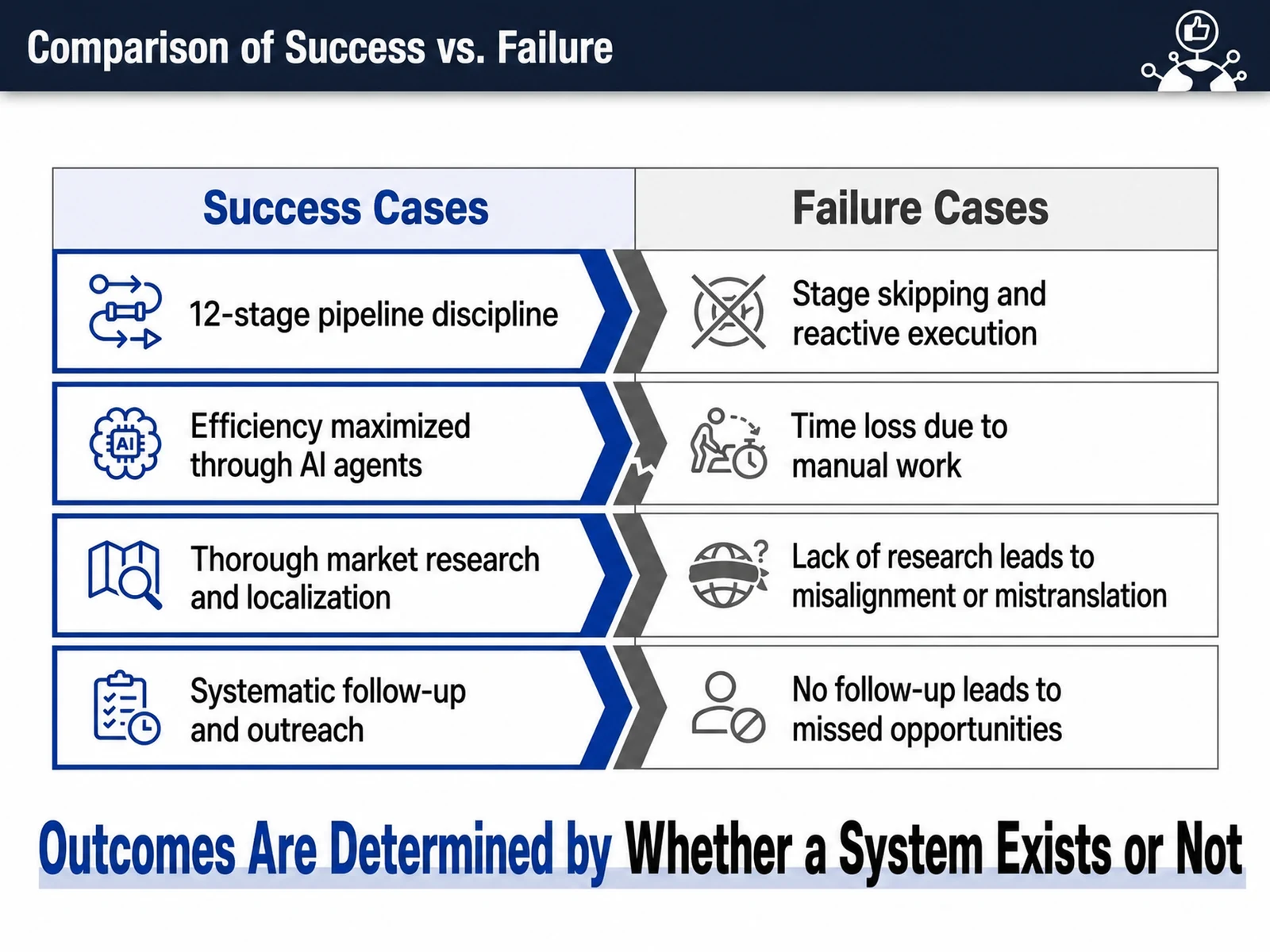
"It's a great product, so why won't it sell overseas?" Small and mid-sized businesses keep failing at overseas expansion, not for lack of talent but for lack of a system. This hands-on workshop walks through a 12-step overseas market development pipeline (product analysis → value proposition → market research → buyer sourcing → outreach → proposal → negotiation → contract → fulfillment → follow-up → expansion → automation), running every step yourself with AI agents (Claude Cowork and Claude Code). Using your own company's real product and target market, you will finish four deliverables on your own laptop: ① a market priority table, ② multilingual value propositions, ③ a buyer list with local-language outreach emails, and ④ a draft proposal. This is not a demo to watch: it is an intensive 4-hour course (2 hours of lecture, 2 hours of hands-on practice) where you build everything yourself, start to finish.
💻 Start learning this topic with an online course →Who is this course for?
Ideal for SME owners and overseas sales managers who have a good product but keep running out of steam abroad, and for trade and marketing staff preparing to export or just starting out. It is not limited to any one industry: it is a general-purpose course where each participant practices with their own product and target market.
What will you learn?
- Understand the difference between chatbots and agentic AI, and identify which of the 12 overseas development steps can be automated with AI
- Automatically collect and compare competitor specs to pinpoint your product’s real strengths, and set target market priorities with data
- Use the VWE (value-to-money conversion) and VP (PPSDN) frameworks to generate multilingual value propositions tuned to each market’s tone
- Screen buyers with the LEAD priority matrix, and automatically draft a first-contact email in the local language and an 8-section proposal
- Build a system that carries through to after the contract is signed: negotiation prep (BATNA), AI review of key contract clauses, and automated follow-up management
Curriculum
- Why overseas expansion so often stalls — the 5 main reasons SMEs fail (no market research, language barriers, trouble finding buyers, no follow-up, one-off efforts)
- Organize these 5 elements into a 12-step pipeline — see the full picture at a glance
- Chatbot vs. agentic AI: how they differ in tool execution, multi-step automation and downloadable outputs
- What AI does well vs. what people must do: the human-in-the-loop principle (AI is the assistant, the CEO decides)
- The 3 highest-ROI areas — repetitive tasks, research, and draft generation
- [Warm-up exercise] Create a Claude project & upload your product materials
- Product strengths: automatically collect competitor specs, compare market prices and analyze review sentiment to find your 'real differentiators'
- Market fit scoring: AI automatically scores demand, regulation (CE/FDA), price competitiveness, distribution channels and cultural barriers
- Target market prioritization — lock in your #1 market with an entry difficulty × market attractiveness matrix
- Building a value proposition — convert performance into 'money' with VWE, then put it into words with the VP (PPSDN) framework
- Market-specific messaging: switch tone for Germany (technology and certification), the US (innovation and storytelling) and Southeast Asia (value for money and localization)
- Deliverables: market priority table + multilingual value proposition statements for each market
- LEAD priority matrix: score market attractiveness × your company’s fit to pick 'enter now' targets
- Buyer sourcing: use LinkedIn search prompts (combining title, industry and region) to extract a list of 10 buyers
- Buyer database: set up a standard format and tag each buyer A, B or C to keep records organized
- First outreach email — auto-generate a draft in the local language, plus subject-line A/B testing (question-style subjects get the highest open rates)
- Follow-up design — contact on Days 0, 3, 7, 14, and 30, offering new value each time
- Draft proposal: automatically write all 8 sections, from Executive Summary to Next Steps, in the local language
- Deliverables: list of 10 buyers + local-language outreach email + draft proposal
- Negotiation prep — BATNA, concession range, and deal-breakers: 'every negotiation has multiple issues'
- AI contract review: check payment terms, Incoterms (FOB/CIF), warranty, liability and dispute resolution against a checklist (final legal decisions are for qualified counsel)
- Follow-up automation: satisfaction surveys, reorder reminders and annual reviews to turn a one-time customer into a lifelong one
- Expansion: document success stories as quantified results and reuse them as references in the same industry
- CRM and automation ideas: Remember → Google Contacts → Zapier/Make → automated greeting emails and Solapi messaging
- Lessons from 3 major failure cases + practical checklist + KPIs + action plan for your team
Expected results / After the course
- Apply the market priority table, multilingual value propositions, buyer list and draft proposal you complete in class straight to your work
- Leave with a 12-step overseas expansion checklist and action plan tailored to your own products and target markets
- Cut the time spent on repetitive market research, buyer sourcing and proposal writing (up to 87% saved in one before-and-after case)
About the instructor

Related courses
Start with an Online Course
Before you book on-site training, preview the essentials of this topic in an online course.
An introductory hands-on course for building work tools that run on plain conversational instructions.
Use AI in your daily work, from lesson prep to content creation.
We tailor this course to your company
From diagnosis to execution — Nanum Consulting
FAQ

Build Your Overseas Market Development Pipeline with AI Agents
Automate 12 steps, from product analysis to buyer sourcing, proposals and contracts
- Understand the difference between chatbots and agentic AI, and identify which of the 12 overseas development steps can be automated with AI
- Automatically collect and compare competitor specs to pinpoint your product’s real strengths, and set target market priorities with data
- Use the VWE (value-to-money conversion) and VP (PPSDN) frameworks to generate multilingual value propositions tuned to each market’s tone
- Screen buyers with the LEAD priority matrix, and automatically draft a first-contact email in the local language and an 8-section proposal
- Build a system that carries through to after the contract is signed: negotiation prep (BATNA), AI review of key contract clauses, and automated follow-up management
- Apply the market priority table, multilingual value propositions, buyer list and draft proposal you complete in class straight to your work
- Leave with a 12-step overseas expansion checklist and action plan tailored to your own products and target markets
- Cut the time spent on repetitive market research, buyer sourcing and proposal writing (up to 87% saved in one before-and-after case)
- Why overseas expansion so often stalls — the 5 main reasons SMEs fail (no market research, language barriers, trouble finding buyers, no follow-up, one-off efforts)
- Organize these 5 elements into a 12-step pipeline — see the full picture at a glance
- Chatbot vs. agentic AI: how they differ in tool execution, multi-step automation and downloadable outputs
- What AI does well vs. what people must do: the human-in-the-loop principle (AI is the assistant, the CEO decides)
- The 3 highest-ROI areas — repetitive tasks, research, and draft generation
- [Warm-up exercise] Create a Claude project & upload your product materials
- Product strengths: automatically collect competitor specs, compare market prices and analyze review sentiment to find your 'real differentiators'
- Market fit scoring: AI automatically scores demand, regulation (CE/FDA), price competitiveness, distribution channels and cultural barriers
- Target market prioritization — lock in your #1 market with an entry difficulty × market attractiveness matrix
- Building a value proposition — convert performance into 'money' with VWE, then put it into words with the VP (PPSDN) framework
- Market-specific messaging: switch tone for Germany (technology and certification), the US (innovation and storytelling) and Southeast Asia (value for money and localization)
- Deliverables: market priority table + multilingual value proposition statements for each market
- LEAD priority matrix: score market attractiveness × your company’s fit to pick 'enter now' targets
- Buyer sourcing: use LinkedIn search prompts (combining title, industry and region) to extract a list of 10 buyers
- Buyer database: set up a standard format and tag each buyer A, B or C to keep records organized
- First outreach email — auto-generate a draft in the local language, plus subject-line A/B testing (question-style subjects get the highest open rates)
- Follow-up design — contact on Days 0, 3, 7, 14, and 30, offering new value each time
- Draft proposal: automatically write all 8 sections, from Executive Summary to Next Steps, in the local language
- Deliverables: list of 10 buyers + local-language outreach email + draft proposal
- Negotiation prep — BATNA, concession range, and deal-breakers: 'every negotiation has multiple issues'
- AI contract review: check payment terms, Incoterms (FOB/CIF), warranty, liability and dispute resolution against a checklist (final legal decisions are for qualified counsel)
- Follow-up automation: satisfaction surveys, reorder reminders and annual reviews to turn a one-time customer into a lifelong one
- Expansion: document success stories as quantified results and reuse them as references in the same industry
- CRM and automation ideas: Remember → Google Contacts → Zapier/Make → automated greeting emails and Solapi messaging
- Lessons from 3 major failure cases + practical checklist + KPIs + action plan for your team